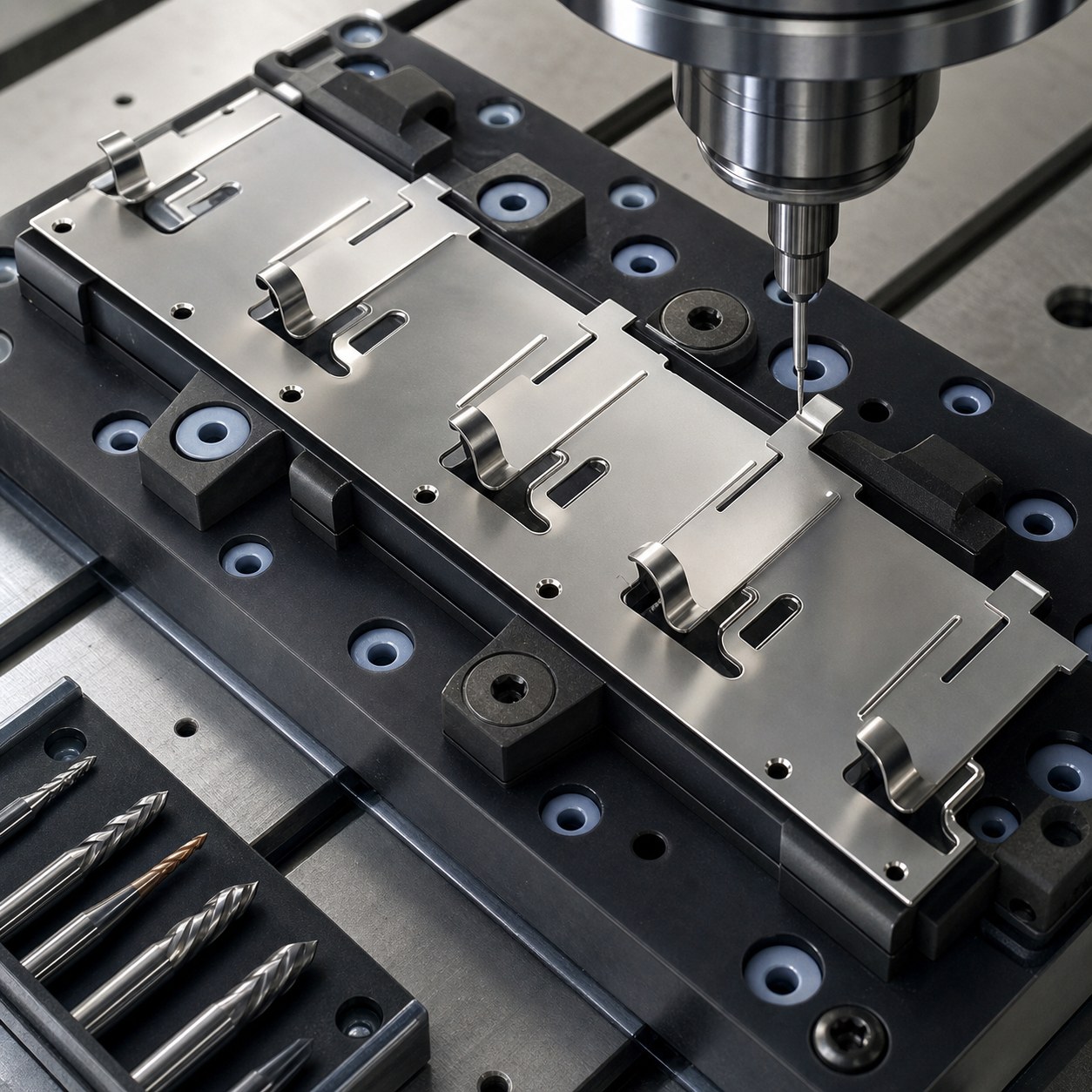
English: 17-7PH Spring Clip Strip CNC Tool Selection for Burr-Free Latch Tabs
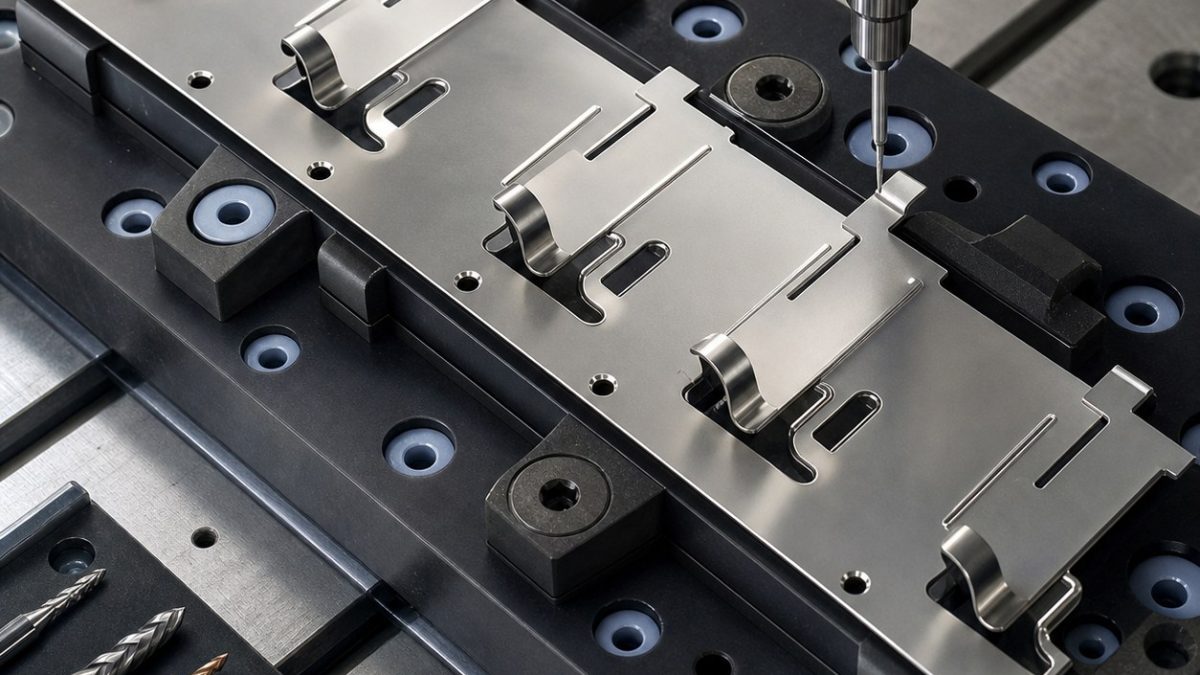
This hypothetical case targets a long-tail problem: how to select CNC tools for a 17-7PH spring clip strip when the drawing includes narrow relief slots, curled latch tabs, tiny countersunk holes and edges that must remain burr-free before forming. The part looks simple, but the process fails if the sheet lifts, the slot cutter rubs, or the tab edge work-hardens before bending.
Drawing interpretation
The functional features are not the outer rectangle; they are the slot ends, latch-tab roots, hole countersinks and burr direction. Unlike a thick 17-4PH bracket case such as cross-hole clevis machining, this strip must be held continuously and inspected after release.
Feature-to-tool selection table
| Drawing feature | Tool selection | Rejected option |
|---|---|---|
| Relief slots | 1.5 mm 3-flute sharp carbide end mill, TiAlN, minimum stickout | A 4-flute tool packs chips and smears the slot wall. |
| Latch-tab root radius | 2 mm corner-radius end mill, spring pass after unclamp sample | A square tool creates a crack starter. |
| Tiny countersunk holes | Carbide drill plus 90-degree micro chamfer mill | A single combined drill-chamfer tool is rejected until burr direction is proven. |
| Final edge break | Small polished carbide deburring mill, climb-only touch path | A brush alone folds burrs into the bend zone. |
Fixture, toolpaths and inspection
The strip is supported on a vacuum-assisted nest with mechanical edge stops and sacrificial underlay. Slotting uses shallow step-down, high air blast and short retracts to prevent heat. Finishing leaves the tab root until nearby slots are opened so the sheet does not flutter. Inspection checks slot width, burr direction, countersink depth and springback after a sample forming pass. The fixture logic connects to thin-sheet vacuum fixturing and the burr logic to thin-wall burr control.
FAQ
Why use a 3-flute micro end mill? It balances edge strength and chip space in stainless sheet.
When are tabs inspected? Before and after forming, because burrs can become cracks.
What limits tool life? Work hardening at slot exits and loss of edge sharpness.
中文: 17-7PH弹簧夹片窄槽与无毛刺卡扣边的数控配刀
这个假设案例针对薄弹簧夹片的配刀问题。图纸包含窄让位槽、卷曲卡扣片、小沉孔和成形前必须无毛刺的边缘。零件看起来像薄片,但真正的难点是支撑、毛刺方向、加工硬化和成形后的回弹。
图纸重点
外形尺寸不是唯一重点,槽端圆角、卡扣根部、沉孔深度和毛刺方向更影响功能。与17-4PH厚支架加工不同,17-7PH薄片需要连续支撑并在释放后复检。
特征到刀具表
| 图纸特征 | 刀具选择 | 不用的方案 |
|---|---|---|
| 窄让位槽 | 1.5 mm三刃锋利硬质合金立铣刀,TiAlN涂层 | 四刃刀排屑空间小,容易糊槽。 |
| 卡扣根部圆角 | 2 mm圆角立铣刀,样件释放后补弹刀 | 尖角刀会形成裂纹源。 |
| 小沉孔 | 硬质合金钻头加90度微倒角刀 | 复合钻倒角刀需先验证毛刺方向。 |
| 最终倒钝 | 抛光刃小倒角铣刀顺铣轻走 | 只刷毛刺会把毛刺压进折弯区。 |
工艺、刀路与检验
夹具采用真空辅助托板、机械边挡和牺牲垫板。窄槽分层小切深加工,配合强气吹降温排屑。卡扣根部留到周边槽开完后再精修,避免薄片振动。检验包括槽宽、沉孔深度、毛刺方向、边缘显微观察和试折后的回弹。相关夹具思路见薄板真空装夹,毛刺处理见薄壁毛刺控制。
常见问题
为什么不用四刃小刀?薄不锈钢槽内容屑空间不足,容易积屑和硬化。
卡扣片什么时候检测?成形前后都要看,因为毛刺可能变成裂纹。
刀具寿命风险是什么?槽出口加工硬化和刃口钝化。
Français: Outils CNC pour clip ressort 17-7PH sans bavure
Cette étude couvre une bande de clips ressorts en 17-7PH avec rainures étroites, languettes à former, petits fraisurages et arêtes sensibles aux bavures. La sélection d’outils doit tenir compte du maintien de tôle et du comportement après formage.
Lecture du plan
Les zones critiques sont les extrémités de rainure, les rayons à la racine des languettes, les fraisures et le sens de bavure. La logique de bridage rejoint le maintien par aspiration des tôles minces.
Table fonction-outil
| Fonction | Outil | Choix écarté |
|---|---|---|
| Rainures de détente | Fraise carbure 1,5 mm, 3 dents, TiAlN | 4 dents trop fermées pour les copeaux. |
| Rayon de languette | Fraise torique 2 mm | Angle vif source de fissure. |
| Petites fraisures | Foret carbure puis micro-fraise à chanfreiner | Outil combiné non validé au début. |
| Arêtes finales | Fraise d’ébavurage carbure polie | Brosse seule trop aléatoire. |
Contrôle
Les parcours limitent l’échauffement par petites passes et soufflage. On mesure largeur de rainure, profondeur de fraisure, direction de bavure et retour élastique après essai. Voir aussi le contrôle des bavures sur parois minces.
FAQ
Pourquoi trois dents? Pour garder de la place au copeau.
Quand contrôler? Avant et après formage.
Risque principal? Écrouissage et micro-bavure dans la zone de pli.
Русский: Инструмент для пружинной клипсы 17-7PH без заусенцев
Условная деталь представляет тонкую ленту из 17-7PH с узкими разгрузочными пазами, защелками под гибку, малыми зенковками и кромками, где заусенец недопустим.
Логика чертежа
Критичны концы пазов, радиус у основания защелки, глубина зенковки и направление заусенца. Деталь надо контролировать после снятия с опоры и после пробной гибки.
Таблица выбора
| Элемент | Инструмент | Почему |
|---|---|---|
| Узкие пазы | 1,5 мм твердосплавная фреза, 3 зуба | Лучший отвод стружки в тонком пазу. |
| Корень защелки | 2 мм радиусная фреза | Острый угол опасен трещиной. |
| Зенковки | Твердосплавное сверло и микро-фасочник | Разделяет отверстие и фаску. |
| Кромки | Полированная фасочная фреза | Щетка может загнуть заусенец. |
Контроль
Приспособление поддерживает лист вакуумом и механическими упорами. Траектории короткие, с малой глубиной и обдувом. Проверяют ширину пазов, заусенец, зенковки и упругий возврат. Дополнительные материалы: AXKXA CNC technology.
FAQ
Почему не 4 зуба? Меньше места для стружки и больше риск наклепа.
Где смотреть заусенец? На выходе паза и у зоны гибки.
Что ограничивает ресурс? Потеря остроты режущей кромки.