English: Deep Pocket Milling Tooling Hub: Reach, Chip Evacuation and Stock Control
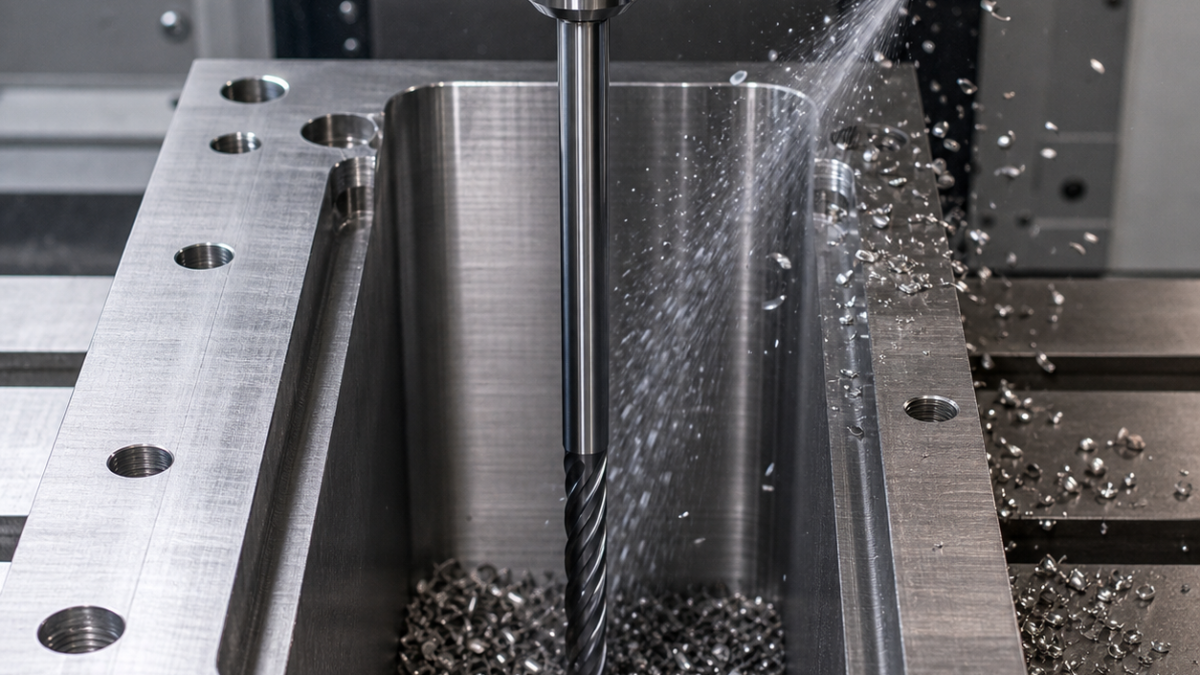
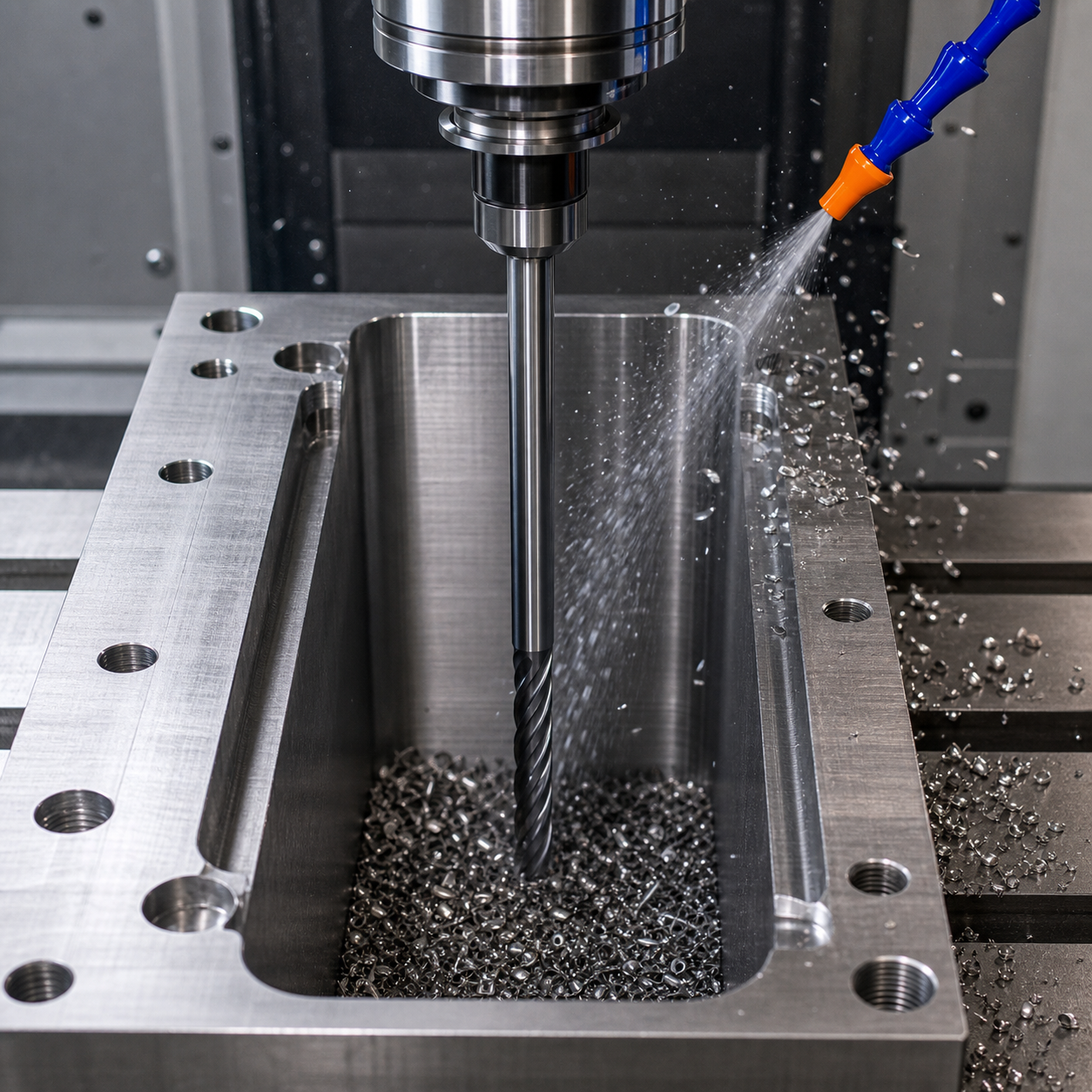
Deep-pocket success comes from dividing the depth into tooling zones. Use the shortest rigid tool for every level, reserve reduced-neck or long-reach tools only for inaccessible bands, and make chip evacuation part of the toolpath. A single extra-long end mill from top to bottom couples chatter, recutting and taper.
Choose by depth, access and residual stock
Split the model at holder-clearance transitions. Open upper levels with a large short rougher; use a reduced-neck tool where the shank can remain strong; deploy a long-reach finisher only after the floor and corners contain uniform stock. Compare depth-to-diameter, minimum corner, holder envelope, flute length and coolant route before selecting diameter.
| Feature / risk | Tool decision | Rejected alternative | Inspection |
|---|---|---|---|
| Upper open pocket | Largest short rougher, 2–5 flutes by material | Long tool from the start | Stock map |
| Holder-limited mid depth | Reduced-neck carbide, strong core, low-runout holder | Unneeded long flute | Neck clearance and taper |
| Deep corners | Small rest tool with constant engagement | Hidden full-width cut | Corner stock |
| Final wall/floor | Separate long-reach finisher, minimal stock | Worn rougher for finish | Taper, Ra, floor step |
Build a decision path, not a tool list
For aluminum use 2–3 polished flutes and strong air/coolant evacuation; for stainless or nickel alloys use a tough 4–6-flute geometry at low radial engagement without trapping heat; for hardened steel favor rigid necks, small stock and air blast. High-feed tools can open broad floors but leave stock; barrel or ball tools suit 3D walls only when contact and effective diameter are modeled.
For an accessible cavity with broad blends, a round-insert rougher is another branch of this decision path. The RPMT10T3 cavity-roughing example follows the changing contact around a round edge and the stock left for smaller tools; it does not treat the round insert as a universal replacement for a ball-nose finisher in a tight 3D corner.
Inspection closes each depth zone
Probe accessible datums before the holder blocks them. Check wall taper at several depths, floor step, corner stock, chatter wavelength and chip scratches. A witness coupon or tool-life gate is useful when the deepest pass cannot be visually inspected. Release the next depth only after evacuation and stock are stable.
Related decision paths: long-reach chatter diagnosis; H13 deep-rib mold case; 7050 fork-pocket case; 6061 thin-wall pocket case; coolant-through evacuation; aluminum chip evacuation; high-feed shallow roughing; holder selection.
Deep-pocket questions
Long flute or reduced neck? A short flute with reduced neck usually retains a stronger core. Coolant through the tool? Useful when it reaches the cutting zone; it must not pack chips at the floor. Why rest-machine? It prevents a small long tool from meeting hidden full-width stock.