This is a realistic hypothetical process-planning example, not a claim about a specific customer drawing or production result.
Related: Compare thin-feature support in the copper thin-fin case and free-state inspection in the A286 curved clamp case.
English: reading the bulk-metallic-glass flexure drawing
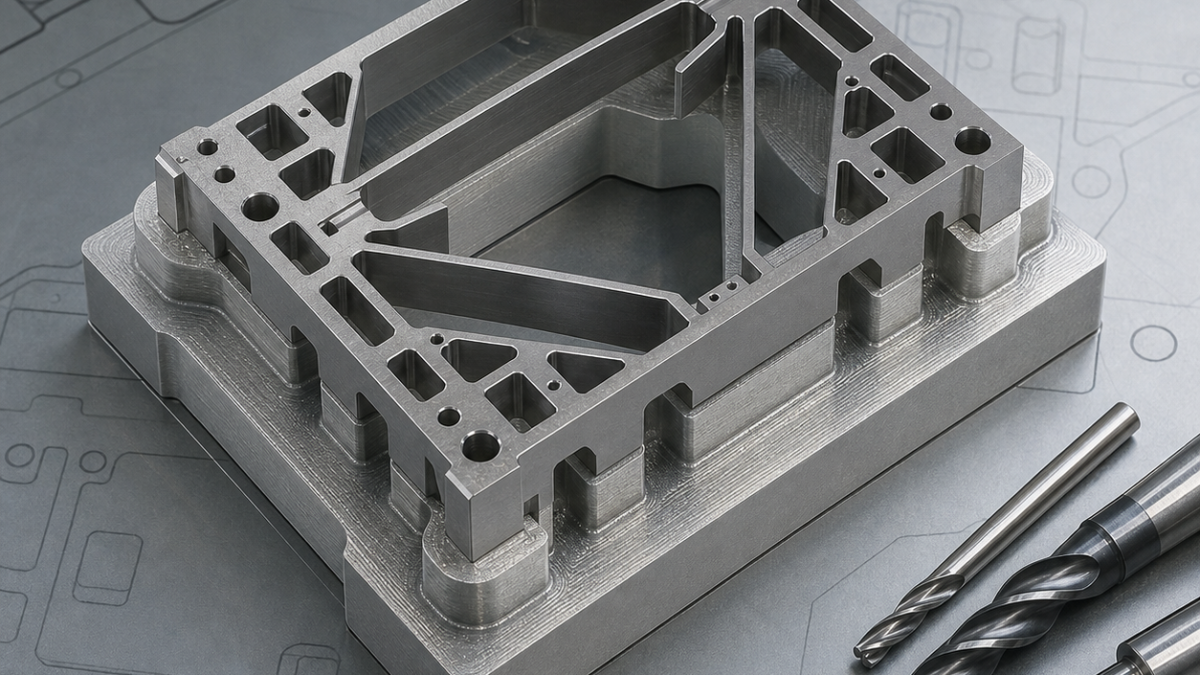
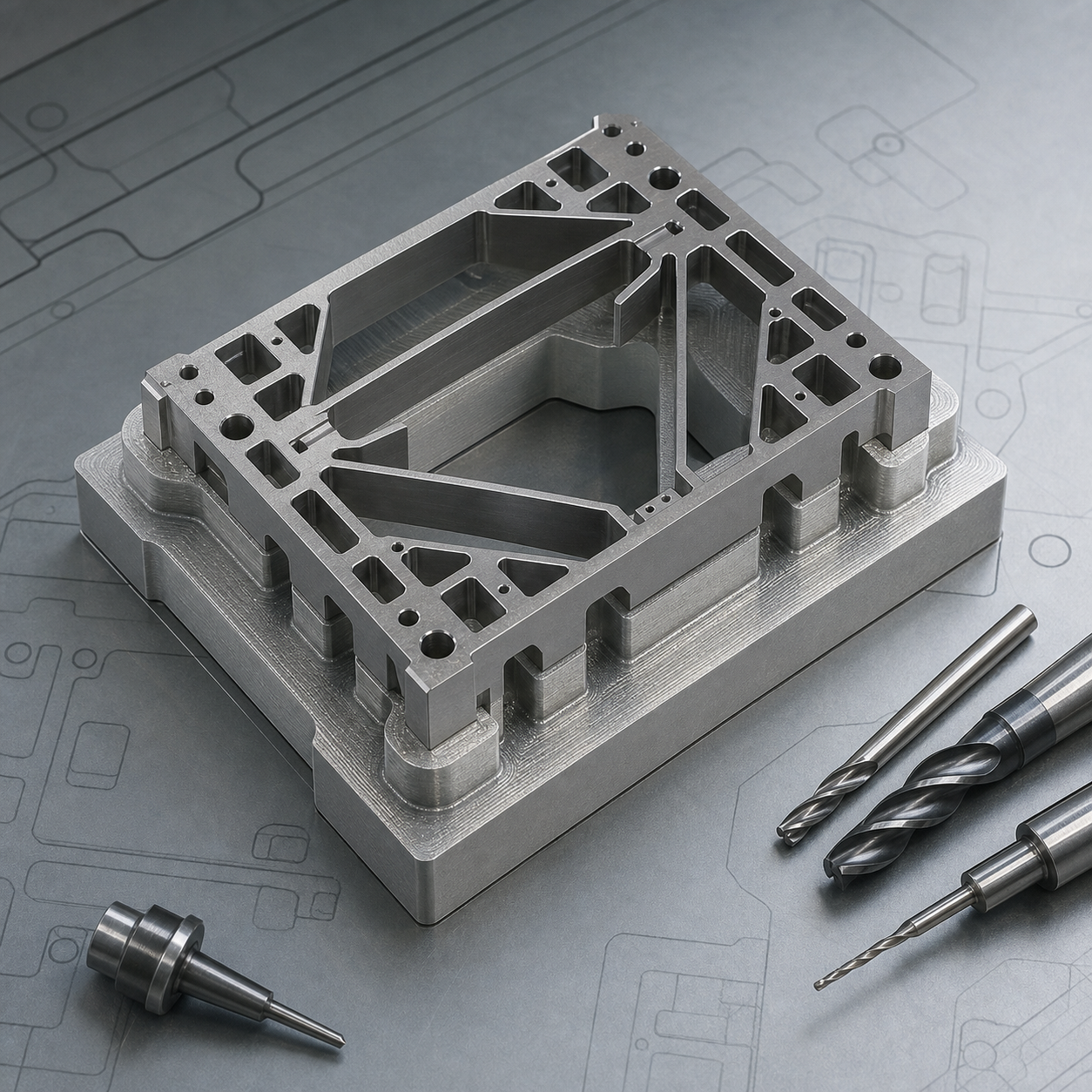
This hypothetical Zr-Cu-Al bulk metallic glass frame contains compliant beams, narrow pockets, pin holes and controlled edge breaks. The material offers high strength but limited tolerance for heat-driven structural change, so the drawing must be converted into a low-heat sequence that preserves the free-state flexure geometry.
Feature, datum and inspection plan
Use the broad outer pads as temporary datums while the center remains supported. Separate functional beam thickness from ordinary pocket dimensions, and identify where profile is inspected in the free state. Pin holes should transfer the coordinate system between roughing, release and final inspection.
Sharp carbide micro-tool package
Use a short sharp carbide end mill for rough pockets with low radial engagement, a reduced-neck finisher for beam walls, carbide micro drills followed by a reamer for the pin holes, and a small chamfer tool for controlled edge breaks. Favor polished flutes and minimal edge hone; rubbing adds heat without useful material removal.
Sacrificial fixture and machining sequence
Bond or mechanically retain the blank on a full-contour sacrificial support compatible with the process specification. Rough pockets in alternating zones, keep bridge tabs around each beam, and allow cooling pauses based on measured temperature rather than fixed time. Finish beam walls before releasing tabs, then remove bridges in a balanced pattern with minimal tool engagement.
Thermal, chipping and tool-life risks
The chief risk is localized heating that changes surface condition or amorphous structure; edge chipping and micro-tool runout are also critical. Use high-speed air or approved coolant, verify spindle runout, avoid dwell, and monitor tool diameter through test cuts. Inspect beam width and frame profile only after release and temperature stabilization.
FAQ
Why not remove all pocket material immediately?
The sacrificial web and bridge tabs prevent flexible beams from vibrating or moving while their surfaces are finished.
Can aggressive coolant always be used?
No. Coolant chemistry and thermal shock must match the alloy and downstream cleanliness specification.
中文:解读 Zr-Cu-Al 块体金属玻璃柔性框架图纸
本假设 Zr-Cu-Al 块体金属玻璃框架包含柔顺梁、窄腔、销孔和受控倒钝。材料强度高,但对局部热引起的结构变化较敏感,因此必须把图纸要求转化为低热输入工艺,并在自由状态下保持柔性结构几何。
特征、基准与检测规划
在中心区域仍受支承时,以外周宽垫作为临时基准。功能梁厚应与普通腔体尺寸分开控制,并明确轮廓度是否在自由状态检测。销孔用于在粗加工、释放和最终检测之间转移坐标系。
锋利硬质合金微刀具组合
短型锋利硬质合金立铣刀以小径向吃刀粗铣腔体,缩颈精加工刀完成柔性梁侧壁;销孔采用硬质合金微钻和铰刀,小倒角刀形成可控倒钝。优先使用抛光排屑槽和小刃口钝圆,避免擦削产生无效热量。
牺牲夹具与加工顺序
依据工艺规范将毛坯粘接或机械固定在全轮廓牺牲支承上。腔体分区交替粗加工,每根柔性梁周围保留工艺桥;冷却间隔应依据实测温度,而不是固定等待。先精加工梁壁,再按平衡顺序低负载去除连接桥。
热、崩边与刀具寿命风险
主要风险是局部升温改变表面状态或非晶结构,同时还要控制崩边和微刀具跳动。使用高速气流或经批准的冷却方式,检查主轴跳动,避免停顿,并通过试切跟踪刀具有效直径。释放并稳定温度后才能评价梁宽和框架轮廓。
常见问题
为什么不能立即挖空全部腔体?
牺牲材料和工艺桥可防止柔性梁在精加工时移动或振动。
是否总能使用强冷却液?
不能,冷却液化学兼容性和热冲击必须符合材料及后续清洁规范。
Français : lire le plan du cadre flexible en verre métallique
Ce cadre hypothétique en alliage Zr-Cu-Al comporte des lames flexibles, des micro-poches, des trous de pion et des arêtes contrôlées. La gamme doit limiter l’échauffement local et préserver la géométrie à l’état libre.
Fonctions, références et contrôle
Les larges plots extérieurs servent de références temporaires tant que le centre reste soutenu. L’épaisseur fonctionnelle des lames est contrôlée séparément, et les trous de pion transfèrent le repère jusqu’au contrôle final.
Micro-outils carbure
Employer une fraise courte très vive pour l’ébauche, une fraise à col dégagé pour les parois, des micro-forets suivis d’un alésoir et une petite fraise à chanfreiner. Les goujures polies et une arête peu honée réduisent le frottement.
Support sacrificiel et séquence
Maintenir l’ébauche sur un support complet, ébaucher des zones alternées et conserver des ponts autour des lames. Finir les parois avant de couper les ponts selon un ordre équilibré et avec faible engagement.
Risques thermiques et d’écaillage
Surveiller la température, le faux-rond et le diamètre effectif des outils. Éviter toute pause en coupe et contrôler le profil uniquement après libération et stabilisation thermique.
FAQ
Pourquoi garder des ponts ?
Ils évitent le déplacement et les vibrations des lames pendant la finition.
Tout arrosage est-il acceptable ?
Non, la chimie et le choc thermique doivent respecter la spécification du matériau.
Русский: чтение чертежа гибкой рамки из металлического стекла
Условная рамка Zr-Cu-Al имеет гибкие перемычки, узкие карманы, отверстия под штифты и контролируемые фаски. Маршрут должен ограничить локальный нагрев и сохранить свободную форму.
Базы и контроль
Наружные площадки служат временными базами при поддержанном центре. Толщину гибких балок контролируют отдельно, а отверстия под штифты переносят систему координат до окончательной проверки.
Микроинструмент
Короткая острая фреза черновит карманы, фреза с шейкой чистит стенки, микросверла и развертка формируют отверстия. Полированные канавки и малая притупленность снижают трение.
Жертвенная опора и порядок
Заготовку удерживают на полной опоре, зоны черновят попеременно и оставляют технологические мостики. Стенки чистят до освобождения, затем мостики удаляют симметрично с малым врезанием.
Тепловые риски и стойкость
Контролируют температуру, биение и фактический диаметр фрез. Нельзя допускать остановки в резании; форму измеряют после освобождения и стабилизации температуры.
FAQ
Зачем оставлять мостики?
Они предотвращают смещение и вибрацию гибких балок.
Подходит ли любая СОЖ?
Нет, химия и тепловой удар должны соответствовать спецификации материала.