This is a realistic hypothetical process-planning example, not a claim about a specific customer drawing or production result.
Related: Review the Inconel seal-ring distortion case and our variable-helix end-mill guide.
English: reading the curved-clamp drawing
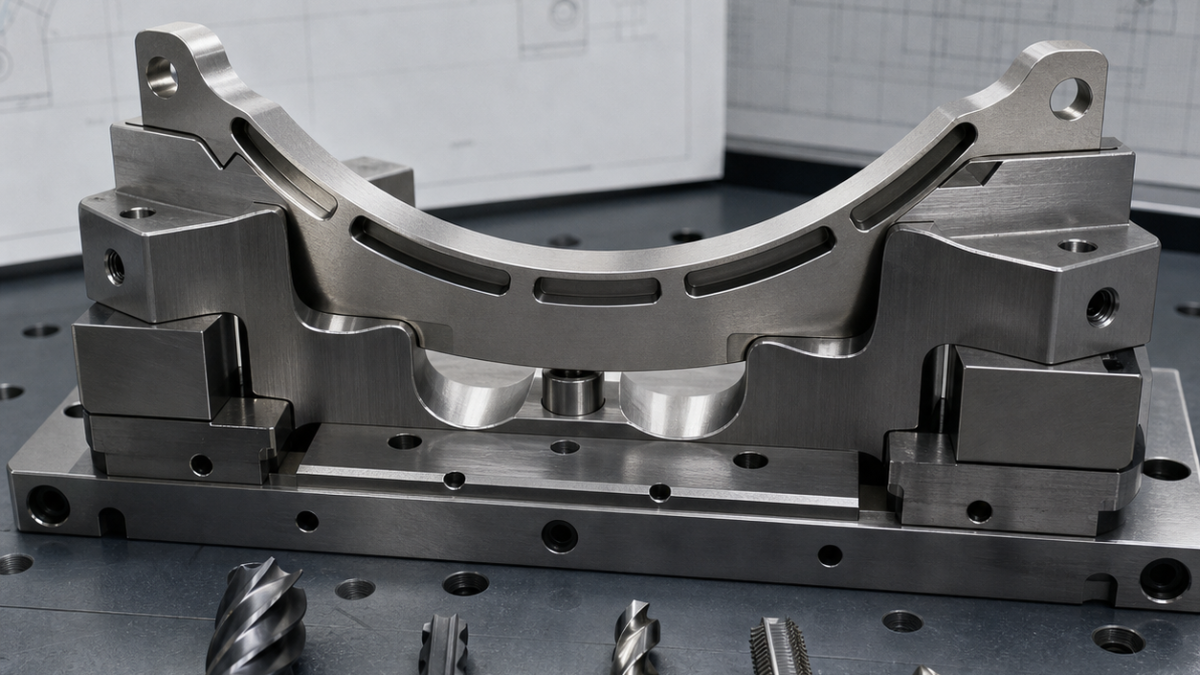
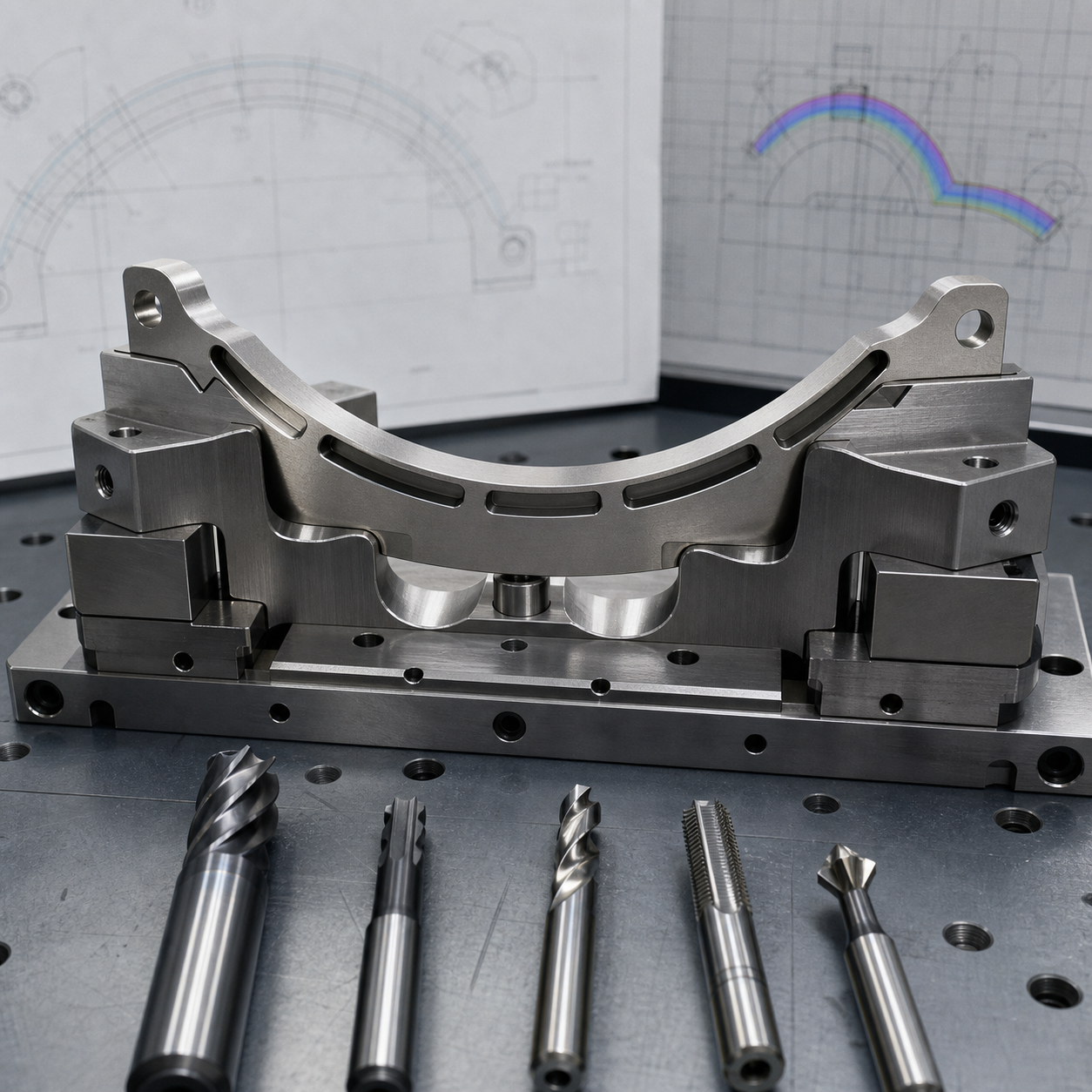
This hypothetical A286 segment has an accurate inner arc, thin connecting wall, narrow relief slots and bolt ears. The drawing should be read as a stiffness problem: arc profile and hole position are meaningful only in the specified free or restrained condition.
Functional interpretation
Identify whether profile tolerance applies free-state or assembled. Use the bolt-ear holes and a central clocking feature to transfer datums, but leave temporary stock across slots so the arc remains supported during roughing.
Tool package
A sharp variable-helix carbide end mill roughs the arc with low radial engagement. A reduced-neck finisher controls wall taper, while a small high-rigidity slot mill opens reliefs in several depths. Carbide drills, a thread mill and a compact chamfer tool complete the ears.
Fixture and sequence
Machine locating pads first, then clamp the blank against a full-contour soft jaw. Rough the inner and outer arcs alternately, leaving equal skin. Finish the profile before opening the final slot depth; add removable bridge tabs when the drawing permits. Release clamps progressively and measure the free-state arc.
Springback, burr and tool-life risks
A286 work-hardens quickly if the cutter rubs. Maintain chip load, avoid dwelling, use constant-engagement paths and high-pressure coolant. Slot exits need supported toolpaths or a sacrificial backup to prevent burr rollover. Track edge wear because a dull cutter increases both heat and springback.
FAQ
Why finish slots late?
Closed material keeps the segment stiff while the accurate arc is generated.
Can clamp force correct the profile?
It can hide error during machining, but the free-state part may spring back outside tolerance.