This is a realistic hypothetical process-planning example, not a claim about a specific customer drawing or production result.
Related: Compare datum and bore control in the 15-5PH pressure sensor flange case and burr strategy in the thin sealing-land case.
English: reading the hermetic connector drawing
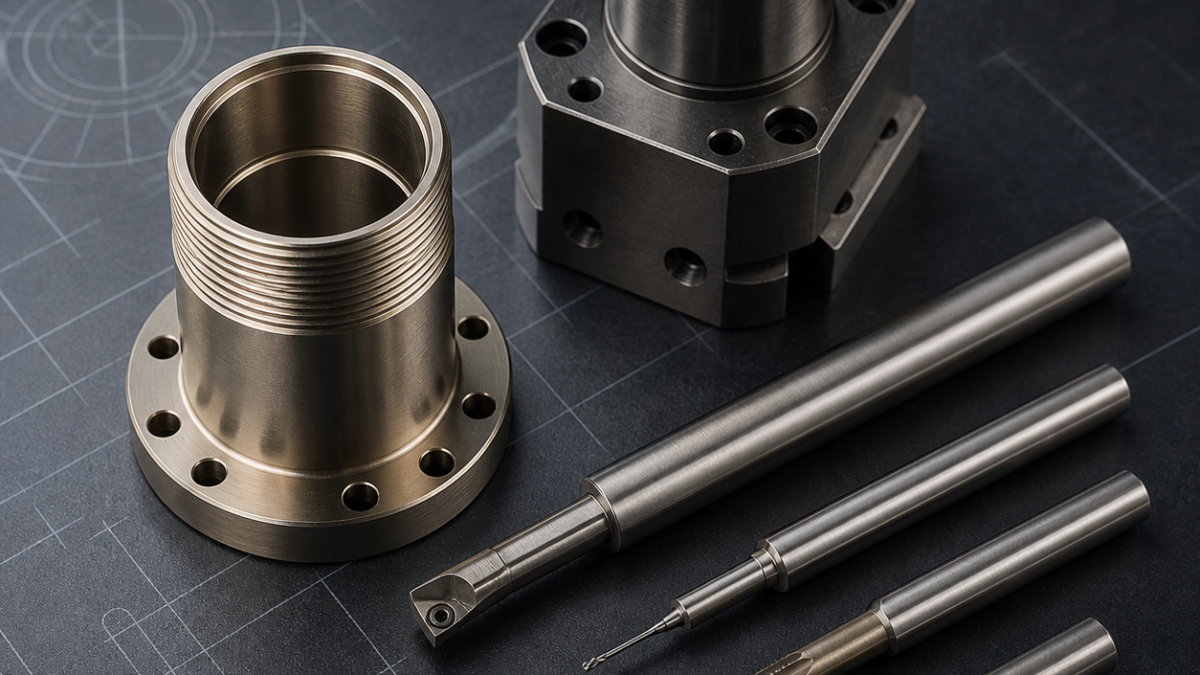
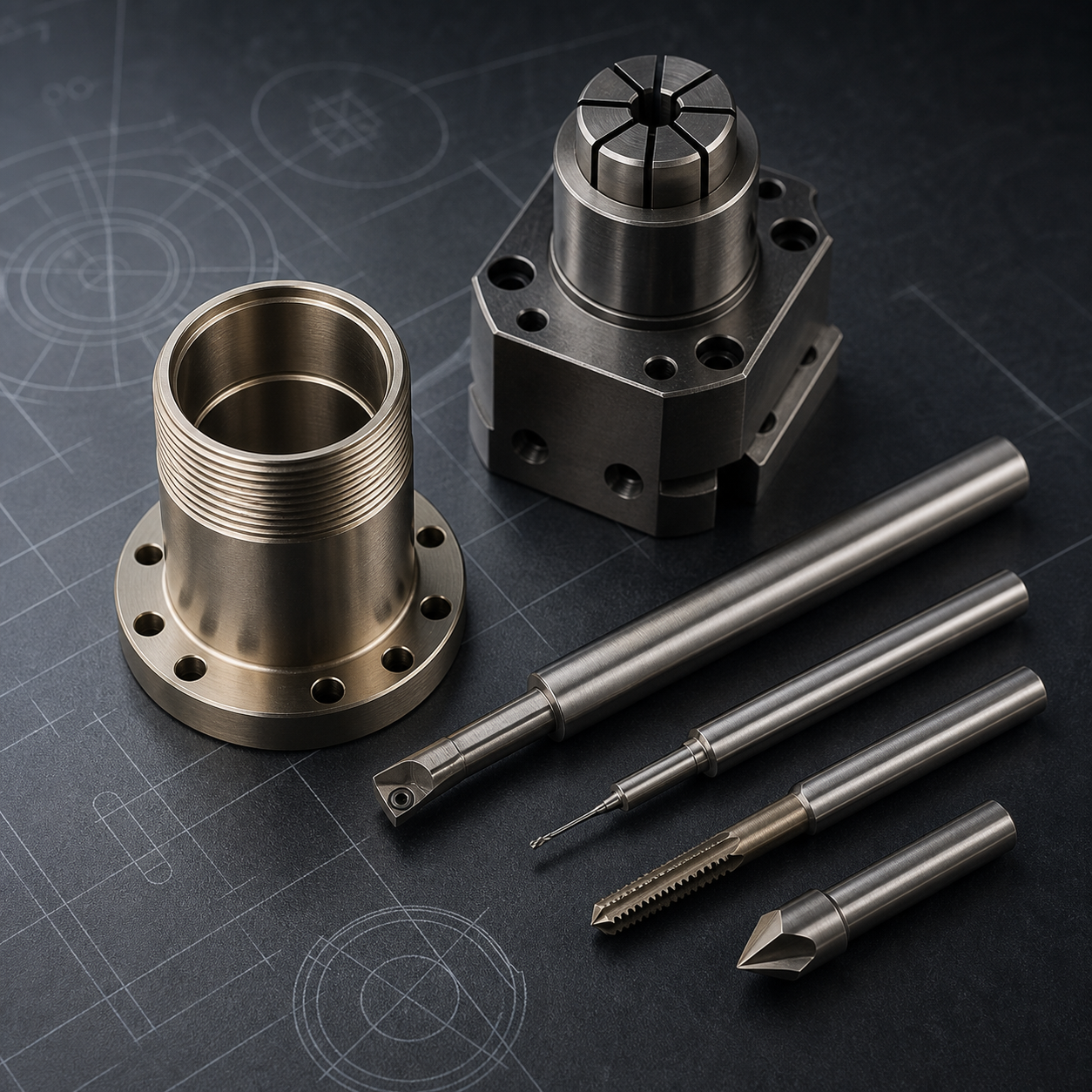
This hypothetical Kovar shell combines a glass-seal bore, thin cylindrical wall, fine external thread, flange face and small mounting holes. The drawing should be read around concentricity and sealing function: a correct thread alone is useless if chucking distorts the bore or the sealing face loses perpendicularity.
Feature and datum interpretation
Use the turned pilot and flange back face as the primary radial and axial datums. Treat the seal bore, external thread pitch diameter and flange face as one coaxial stack. Mark wall thickness as a process-control feature, and confirm whether the small holes are positioned from the bore axis or an external clocking feature.
Carbide tool selection
Rough with a sharp positive-rake carbide turning insert and finish the bore with a small damped boring bar. Use a full-profile thread insert or a rigid thread mill where live tooling permits. Stub carbide drills and a compact chamfer tool complete the flange holes; every tool should have low edge hone to limit work hardening.
Fixture and process sequence
Turn the datum face, pilot and bore in one collet setup while the wall is still supported by extra stock. Finish the thread before removing the internal support allowance, then transfer to a bored soft collet gripping the pilot. Mill the flange pattern, lightly finish the seal face, and deburr with controlled tool motion rather than hand pressure on the thin rim.
Tolerance, surface and tool-life risks
Kovar can smear and work-harden when a tool dwells. Maintain feed through exits, avoid repeated spring passes and keep cutting edges sharp. Verify the seal bore with low-force gauging after unclamping, check face runout from the functional pilot, and inspect thread form without forcing a ring gauge onto a distorted shell.
FAQ
Why keep support stock during threading?
The added section stiffness reduces lobing and pitch-diameter variation under collet pressure.
Should the seal bore be honed automatically?
Only if the drawing allows it; a controlled boring finish may better preserve edge geometry and datum relationships.
中文:解读 Kovar 气密连接器壳体图纸
本假设零件包含玻璃封接孔、薄圆筒壁、细牙外螺纹、法兰密封面和小安装孔。读图时应围绕同轴与密封功能展开:如果夹紧导致孔变形,或密封面对基准轴线不垂直,单独合格的螺纹也没有意义。
特征与基准解释
以内圆定位台阶和法兰背面建立径向、轴向基准,将封接孔、外螺纹中径和法兰面视为同一同轴功能链。壁厚应列为过程控制项目,并确认小孔位置是相对孔轴线还是外部定向特征标注。
硬质合金刀具选择
粗车采用锋利正前角硬质合金刀片,小直径减振镗杆完成孔精加工。细牙螺纹可用全牙型刀片;带动力刀具时也可采用刚性螺纹铣刀。法兰孔使用短型硬质合金钻头和小型倒角刀,刀刃钝圆应尽量小以抑制加工硬化。
装夹与工序顺序
第一工位在筒壁仍有支承余量时一次完成端面、定位台阶和封接孔。先完成螺纹,再去除内部支承余量;第二工位用与台阶贴合的软夹头定位,铣法兰孔系并轻量精加工密封面。薄口部去毛刺应采用受控刀路,避免手工挤压。
公差、表面与寿命风险
Kovar 在停顿和擦削时容易黏刀并加工硬化。刀具必须持续进给通过出口,避免反复空走光刀。卸夹后用低测力量具检查封接孔,以功能台阶复核端面跳动,检测螺纹时不能强行旋入环规掩盖壳体变形。
常见问题
为什么车螺纹时保留支承余量?
更高的截面刚性可以减小夹紧引起的椭圆和螺纹中径波动。
封接孔是否一定需要珩磨?
不一定;必须由图纸允许,受控精镗有时更能保持孔口和基准关系。
Français : lire le plan du boîtier hermétique en Kovar
Ce cas hypothétique réunit un alésage pour scellement verre-métal, une paroi mince, un filetage fin, une face de bride et de petits trous. La priorité est la chaîne coaxiale et l’étanchéité, pas chaque cote isolée.
Fonctions et références
Le pilote tourné et l’arrière de bride définissent les références radiale et axiale. L’alésage, le diamètre sur flancs du filet et la face d’étanchéité forment une seule chaîne fonctionnelle.
Choix des outils carbure
Employer une plaquette positive très vive, une petite barre d’alésage amortie et un outil à fileter au profil complet. Des forets carbure courts et une fraise à chanfreiner compacte terminent la bride avec peu d’écrouissage.
Montage et gamme
Usiner face, pilote et alésage en pince tout en gardant une surépaisseur de soutien. Finir le filet avant d’amincir la paroi, puis reprendre dans une pince douce alésée pour percer la bride et finir légèrement la face de joint.
Risques de qualité et d’usure
Éviter tout frottement ou arrêt, conserver l’avance aux sorties et limiter les passes à vide. Contrôler l’alésage après débridage, le faux-rond depuis le pilote fonctionnel et le filet sans forcer la bague.
FAQ
Pourquoi conserver du soutien pendant le filetage ?
La rigidité supplémentaire limite l’ovalisation sous le serrage.
Faut-il toujours roder l’alésage ?
Seulement si le plan le permet; un alésage de finition peut mieux protéger les références.
Русский: чтение чертежа герметичного корпуса из Kovar
Условный корпус имеет отверстие под стеклянный гермоввод, тонкую стенку, мелкую наружную резьбу, фланец и крепежные отверстия. Главная задача — сохранить общую ось и геометрию уплотнения после снятия зажима.
Функции и базы
Точеный поясок и задняя плоскость фланца задают радиальную и осевую базы. Отверстие, средний диаметр резьбы и торец рассматривают как единую размерную цепь.
Твердосплавный инструмент
Применяют острую положительную пластину, малую демпфированную расточную оправку и полнопрофильный резьбовой инструмент. Короткие сверла и компактная фасочная фреза завершают отверстия фланца.
Установ и маршрут
Торец, поясок и отверстие обрабатывают в одной цанге при сохраненном поддерживающем припуске. Резьбу заканчивают до утонения стенки, затем деталь переносят в расточенную мягкую цангу для отверстий и чистового торца.
Риски точности и стойкости
Kovar наклепывается при трении. Нельзя задерживать подачу и многократно выполнять холостые чистовые проходы. Размер отверстия и биение проверяют после освобождения детали.
FAQ
Зачем оставлять поддерживающий припуск?
Он уменьшает овальность и колебание среднего диаметра резьбы.
Всегда ли нужно хонингование?
Нет, только если оно разрешено чертежом и не нарушает базирование.