This is a realistic hypothetical process-planning example, not a claim about a specific customer drawing or production result.
Related: Read the related CNC tooling case.
English: CNC Thread Milling Large Internal Threads: Pitch Diameter Compensation and Gauge Control
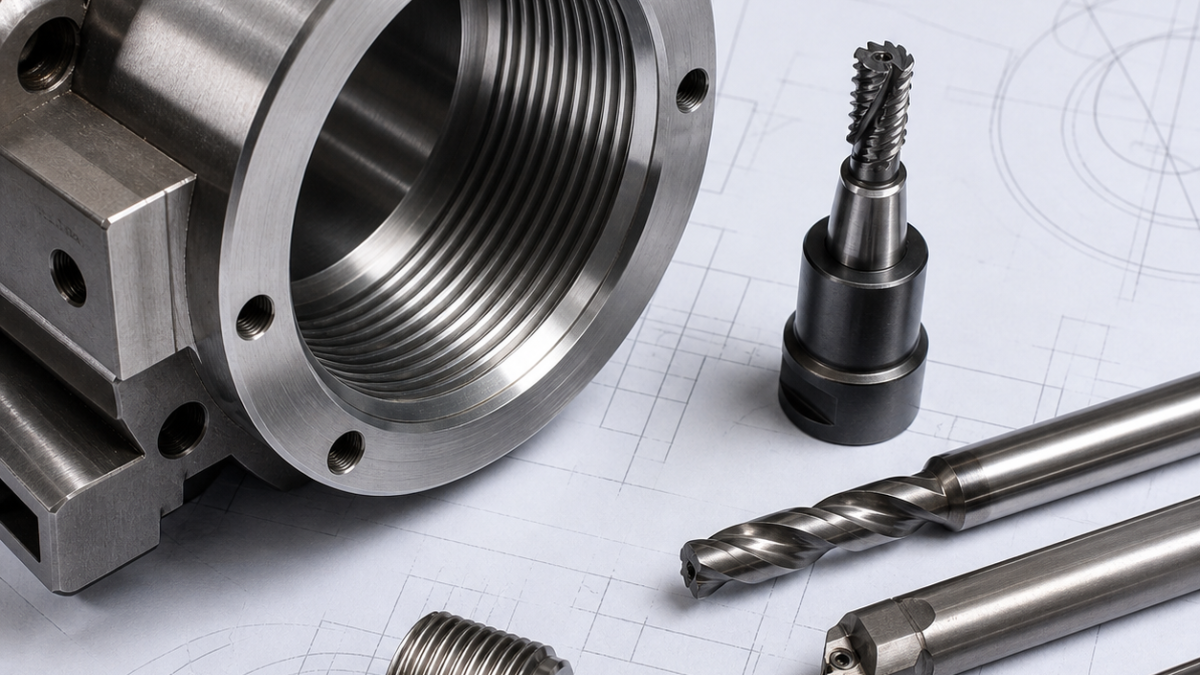
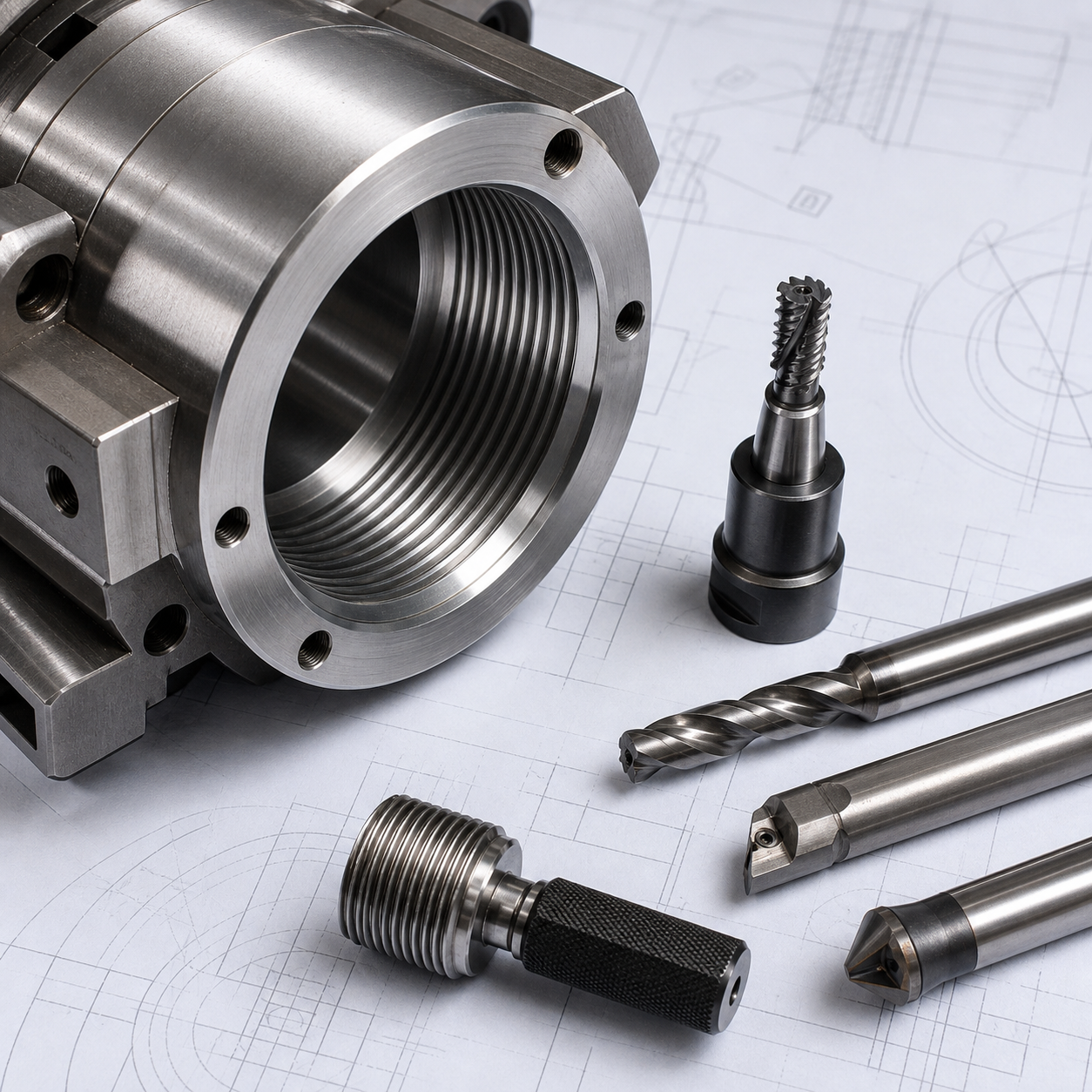
This hypothetical actuator housing uses a large blind internal thread close to a sealing face. Thread milling is selected over tapping because torque, chip evacuation and pitch-diameter adjustment matter more than raw cycle time. The long-tail search intent is how to reach a functional gauge fit without damaging an expensive part.
Feature and datum interpretation
This hypothetical actuator housing uses a large blind internal thread close to a sealing face. Thread milling is selected over tapping because torque, chip evacuation and pitch-diameter adjustment matter more than raw cycle time. The long-tail search intent is how to reach a functional gauge fit without damaging an expensive part.
Tool selection and cutting strategy
Bore the minor diameter with a stable boring bar and machine the entry relief and chamfer first. Choose a carbide thread mill with enough flute length but minimum neck overhang. A multi-row cutter is fast and rigid; a single-row cutter is flexible for different pitches and reduces cutting load.
Fixture and process sequence
Program a helical path with climb cutting, a tangential lead and verified radial clearance. Start with conservative wear compensation, measure the first part, then adjust radius by a controlled fraction of the gauge error. Use a spring pass only if deflection is repeatable, not as a substitute for a worn tool.
Tolerance, surface and tool-life risks
Check pre-bore size, pitch diameter, entry form and bottom clearance. Clean chips before using the GO/NO-GO gauge and never force it. Track compensation history by tool edge; a sudden correction increase indicates wear, runout or material buildup.
FAQ
What should be verified first?
The drawing datum, actual stock and tool runout must be confirmed before compensation.
Can one gauge prove the whole feature?
No. Functional gauging should be combined with dimensional and positional inspection.
中文: 大直径内螺纹 CNC 螺纹铣削:中径补偿与量规控制案例
本假设执行器壳体有一个靠近密封面的盲孔大直径内螺纹。选择螺纹铣削而不是攻丝,是因为扭矩、排屑和中径补偿比单纯节拍更重要。长尾搜索需求是如何在不报废高价值零件的情况下获得功能量规配合。
图纸特征与基准解释
本假设执行器壳体有一个靠近密封面的盲孔大直径内螺纹。选择螺纹铣削而不是攻丝,是因为扭矩、排屑和中径补偿比单纯节拍更重要。长尾搜索需求是如何在不报废高价值零件的情况下获得功能量规配合。
刀具选择与切削策略
先用稳定镗杆加工螺纹小径,并提前完成入口退刀槽和倒角。选择刃长足够但颈部悬伸最短的硬质合金螺纹铣刀。多排刀效率和刚性更高;单排刀适应不同螺距且切削负载更低。
夹具与工序顺序
采用顺铣螺旋刀路、切向引入和经过验证的径向间隙。首次使用保守磨损补偿,测量首件后只按量规误差的一部分调整刀具半径。只有当挠度重复稳定时才使用光刀,不能用光刀掩盖刀具磨损。
公差、表面与刀具寿命风险
检查底孔、小径、中径、入口牙型和孔底间隙。量规检测前必须清屑,不能强行旋入。按刀刃记录补偿历史,突然增大的补偿通常意味着磨损、跳动或积屑。
常见问题
首先应该确认什么?
补偿前必须确认图纸基准、实际余量和刀具跳动。
一个量规能证明全部特征合格吗?
不能,功能量规应与尺寸和位置检测结合。
Français: Fraisage CNC de grands filetages intérieurs : compensation du diamètre sur flancs et contrôle
Ce carter hypothétique comporte un grand filetage intérieur borgne près d’une face d’étanchéité. Le fraisage est choisi pour limiter le couple, évacuer les copeaux et corriger le diamètre sur flancs.
Fonctions et références
Ce carter hypothétique comporte un grand filetage intérieur borgne près d’une face d’étanchéité. Le fraisage est choisi pour limiter le couple, évacuer les copeaux et corriger le diamètre sur flancs.
Outils et stratégie de coupe
Aléser d’abord le diamètre mineur, puis réaliser dégagement et chanfrein. Choisir une fraise carbure avec longueur utile suffisante et porte-à-faux minimal.
Montage et gamme
Programmer une hélice en avalant avec entrée tangentielle. Mesurer la première pièce puis corriger le rayon par une fraction contrôlée de l’erreur de calibre.
Tolérance, surface et durée de vie
Contrôler avant-trou, diamètre sur flancs, entrée et fond. Nettoyer avant le calibre GO/NO-GO et suivre l’historique des corrections.
FAQ
Que vérifier en premier ?
Références, surépaisseur réelle et faux-rond doivent être confirmés avant compensation.
Un seul calibre suffit-il ?
Non, le contrôle fonctionnel doit être complété par des mesures dimensionnelles et de position.
Русский: Фрезерование крупной внутренней резьбы: коррекция и контроль калибром
В корпусе выполнена крупная глухая внутренняя резьба рядом с уплотнением. Резьбофрезерование снижает момент, улучшает отвод стружки и позволяет корректировать средний диаметр.
Функции и базы
В корпусе выполнена крупная глухая внутренняя резьба рядом с уплотнением. Резьбофрезерование снижает момент, улучшает отвод стружки и позволяет корректировать средний диаметр.
Инструмент и стратегия резания
Сначала растачивают малый диаметр, канавку и фаску. Выбирают твердосплавную фрезу с достаточной длиной и минимальным вылетом шейки.
Установ и маршрут
Программируют винтовую траекторию с попутным резанием и касательным входом. После первой детали радиус корректируют только на контролируемую долю ошибки.
Допуски, поверхность и стойкость
Проверяют отверстие, средний диаметр, вход и дно. Перед калибром удаляют стружку и записывают историю коррекций инструмента.
FAQ
Что проверить сначала?
До коррекции проверяют базы, фактический припуск и биение инструмента.
Достаточно ли одного калибра?
Нет, функциональный контроль дополняют измерением размеров и положения.