English: PMMA Optical Flow Cell CNC Tooling Case: Polished Windows and Microchannels
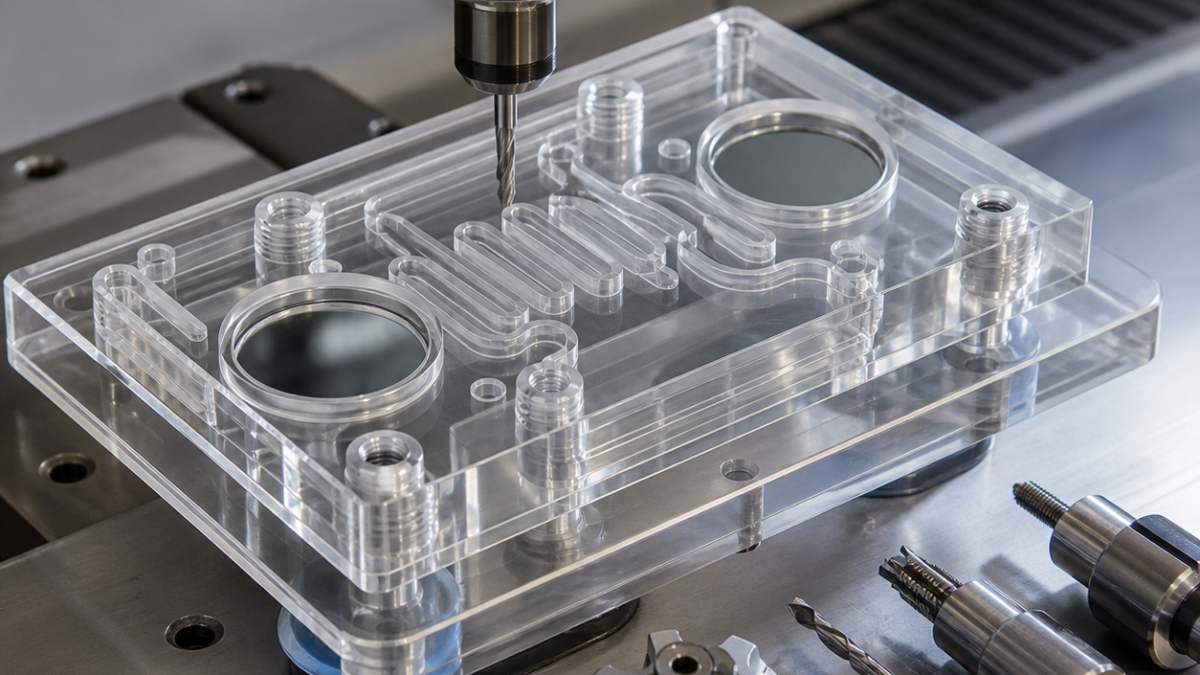
For a transparent PMMA flow cell, optical windows must be finished before the microchannels remove support, while ports and threads must be machined without coolant chemistry that can cause crazing. The tool set therefore combines a balanced PCD fly cutter for the viewing faces, polished single-flute carbide for channels, and a small carbide thread mill that produces threads without tap torque.
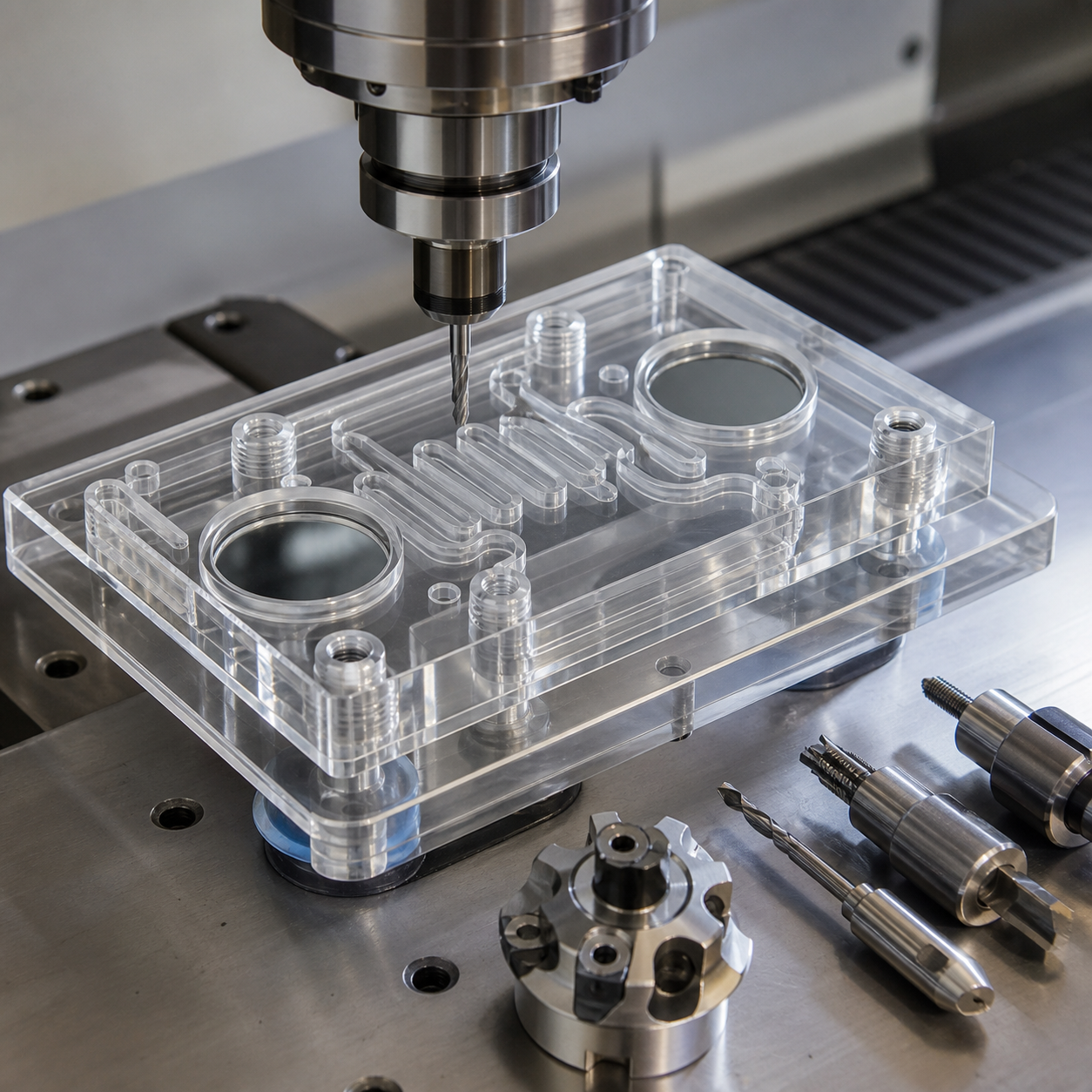
Optical surface first: drawing intent
Viewing face A is the optical datum; dowel holes B-C locate a cover. Two 32 mm windows require flatness 0.015 mm and a diamond-machined finish target of Ra 0.05 µm. The serpentine channel is 1.20 ±0.03 mm wide by 0.80 ±0.02 mm deep, the O-ring groove is 1.50 mm wide, and four M4 ports meet the channel without visible whitening or loose burrs. A 0.20 mm edge break protects assembly while preserving the clear aperture.
Tool selection by surface energy and chip escape
| Feature | Selected cutter and holder | Reason / rejected choice |
|---|---|---|
| Optical windows | Ø40 single-point PCD fly cutter, 0.5 mm nose, balanced ultra-precision arbor | One continuous sweep avoids stitch lines; a small end mill would leave overlapping tracks. |
| Block squaring | Ø10 single-flute polished uncoated carbide O-flute, 30° helix, hydraulic holder | Large polished gullet ejects warm chips; a coated four-flute steel tool can melt and recut them. |
| 1.2 mm microchannel | Ø1.0 two-flute polished carbide, 15° helix, 3 mm cutting length, precision micro chuck | Leaves side compensation and limits upward pull; a 1.2 mm form tool cannot correct width. |
| O-ring groove | Ø1.2 single-flute polished carbide, flat end, 2.5 mm flute | Controls floor and width independently; a ball tool produces a sealing cusp. |
| Port pilots | Ø3.3 stub polished-carbide drill, 90°–100° point, double margin, low-runout collet | Short point reduces breakthrough wedge; a standard 118° drill can lift a white exit cone. |
| M4 threads | Ø2.5 single-row uncoated carbide thread mill, sharp edge, hydraulic micro holder | Low torque and adjustable pitch diameter; a tap can wedge chips and craze the boss. |
| Edge break | Ø6 single-flute polished carbide chamfer mill, 90°, preset height | Produces 0.20 mm before final cleaning; hand scraping clouds the edge. |
Fixture, thermal pause and contamination control
The annealed blank rests on a clean sacrificial acrylic plate over a low vacuum zone, with three hard stops outside the viewing aperture. Window A and its opposite face are fly-cut in separate light passes with a thermal pause between them. B-C are then drilled, and the block is located to mill the channel from its outlet toward the inlet so chips always have an open escape. Radial engagement stays low and every pass ends outside the optical area.
Chilled clean air and vacuum extraction remove chips; only a PMMA-compatible coolant qualified by the facility may touch the part. Alcohol, aggressive solvent and overheated recutting are excluded. A milky edge, curled fused chip or rising spindle load marks excessive heat or a dull edge. Threads are milled after channels but before the final optical cleaning, and a sacrificial plug supports each port breakout.
Inspection and real search questions
Interferometric or qualified optical measurement checks window flatness and transmitted distortion. A vision system measures channel width, corner condition and burr; a depth instrument references A. Thread pitch diameter is verified with a polymer master at limited torque, dowels by CMM, and the assembled cell by pressure or leak testing compatible with the hypothetical drawing. Inspection occurs after thermal stabilization and protective film removal.
What cutter produces a clear PMMA optical window?
A balanced single-point PCD fly cutter can create a continuous optical sweep when the machine, blank and thermal process are qualified.
How can a 1.2 mm acrylic microchannel be held to width?
Use an undersized Ø1.0 polished two-flute carbide tool and finish each wall with compensation instead of relying on a full-width form cutter.
Why thread mill PMMA ports instead of tapping?
Thread milling reduces wedging torque, clears chips and allows pitch-diameter correction without stressing the transparent boss.
Compare polished-tool chip control in POM and thermal control in precision polymer machining.
中文: PMMA光学流通池配刀:透明窗口、微流道与无裂纹螺纹
PMMA流通池应先完成有充分支承的光学窗口,再开微流道;接口和螺纹则必须避开会诱发银纹的冷却液和高扭矩刀具。配刀采用平衡PCD飞刀加工观察面、抛光单刃或双刃硬质合金加工流道,并用小径螺纹铣刀代替丝锥。
图纸的光学优先级
A为观察面,B-C定位盖板。两个32 mm窗口平面度0.015 mm、目标Ra 0.05 µm;蛇形流道宽1.20 ±0.03 mm、深0.80 ±0.02 mm,O形圈槽宽1.50 mm,四个M4接口与流道相交处不得发白或残留游离毛刺。
表面能量与排屑决定的配刀表
| 特征 | 刀具和刀柄 | 理由 |
|---|---|---|
| 光学窗口 | Ø40单点PCD飞刀,R0.5,动平衡超精刀杆 | 一次连续扫面,无小立铣刀重叠纹。 |
| 方料外形 | Ø10单刃抛光无涂层O刃刀,30°,液压刀柄 | 大抛光容屑槽排热屑;四刃钢件刀易熔屑再切。 |
| 1.2 mm微流道 | Ø1.0两刃抛光硬质合金,15°,刃长3 mm,微夹头 | 两侧可补偿且上提力低。 |
| O形圈槽 | Ø1.2单刃抛光平底刀,刃长2.5 mm | 槽底和宽度独立控制,拒绝球刀密封残峰。 |
| 接口底孔 | Ø3.3短型抛光硬质合金钻,90°–100°,双刃带 | 短钻尖降低出口楔裂。 |
| M4螺纹 | Ø2.5单排牙无涂层硬质合金螺纹铣刀,锋利刃,液压微夹头 | 低扭矩且可补偿中径;丝锥会堵屑胀裂透明凸台。 |
| 边缘 | Ø6单刃抛光90°倒角刀,预调高度 | 程序形成0.20 mm,手刮会发雾。 |
夹具与热管理
退火毛坯放在洁净牺牲亚克力板和低真空区上,三处硬挡块避开视窗。A面和对面分别轻切,中间等待热稳定;钻B-C后再定位流道,刀路从出口朝入口展开,让切屑始终有开放方向。每刀在光学区外退出。
用冷却洁净空气和吸尘排屑,只允许车间确认与PMMA兼容的冷却介质。乳白边、熔卷屑或负载上升提示温度过高或刃口钝化。接口由牺牲塞支承出口,螺纹在最终光学清洗前完成。
检验与问题
干涉或合格光学系统测窗口平面度和透射畸变,视觉系统测流道宽度、角部和毛刺,深度仪以A为基准。螺纹用限扭聚合物主件检查,B-C由三坐标测量,热稳定并揭膜后再做压力或泄漏测试。
PMMA透明窗口用什么刀?
合格设备和热流程下,单点平衡PCD飞刀可形成连续光学刀纹。
1.2 mm流道怎样控宽?
用Ø1.0抛光两刃刀分别补偿两侧,而不是满宽成形。
为何不用丝锥?
螺纹铣削扭矩低、排屑好且可补偿中径。
Français: Cellule PMMA : fenêtres optiques et microcanaux
Les fenêtres sont finies avant que les canaux ne retirent leur support. Une fraise PCD crée le plan optique, des carbures polis usinent les canaux et une fraise à fileter évite le couple du taraud.
Tableau fonction–outil
| Fonction | Outil | Choix |
|---|---|---|
| Fenêtre | Outil PCD monopointe Ø40, R0,5, équilibré | Balayage continu sans raccord. |
| Contour | Carbure poli Ø10, une dent O, 30° | Grand dégagement des copeaux chauds. |
| Canal 1,2 | Ø1,0, deux dents polies, 15°, coupe 3 mm | Compensation des deux parois. |
| Joint | Ø1,2, une dent, fond plat | Fond sans crête de fraise boule. |
| Pilote | Foret poli Ø3,3, pointe 90°–100° | Faible coin de sortie. |
| M4 | Fraise à fileter carbure Ø2,5, une rangée | Faible couple, diamètre réglable. |
| Chanfrein | Carbure poli Ø6, une dent, 90° | Arête claire programmée. |
Thermique et contrôle
La pièce recuite repose sur une plaque acrylique sacrificielle sous faible vide. Les faces reçoivent des passes légères séparées par une pause. Air propre refroidi et aspiration évacuent les copeaux; seuls les fluides PMMA qualifiés sont admis. Bord laiteux, copeau fondu ou charge croissante imposent l’arrêt.
Optique, vision et MMT contrôlent fenêtre, canal et pions; un maître polymère limité en couple vérifie M4.
Quel outil optique?
PCD monopointe équilibré.
Comment tenir 1,2 mm?
Ø1,0 poli avec deux finitions compensées.
Pourquoi fraiser le filet?
Pour réduire couple et contrainte.
Voir le POM et la maîtrise thermique du PEEK.
Русский: Оптическая ячейка PMMA: окна и микроканалы
Оптические поверхности заканчивают до снятия опоры каналами. PCD формирует окно, полированный карбид — каналы, резьбофреза — порты без момента метчика.
Таблица инструментов
| Элемент | Инструмент | Причина |
|---|---|---|
| Окно | Одноточечный PCD Ø40, R0,5, балансировка | Непрерывный след. |
| Контур | Полированный O-зуб Ø10, 30° | Вывод горячей стружки. |
| Канал | Ø1,0, два зуба, 15°, длина 3 мм | Компенсация стенок. |
| Уплотнение | Ø1,2, один зуб, плоское дно | Без гребня шара. |
| Пилот | Полированное Ø3,3, 90°–100° | Малый клин выхода. |
| M4 | Однорядная карбидная Ø2,5 | Малый момент. |
| Фаска | Полированная Ø6, 90° | Прозрачная кромка. |
Тепло и контроль
Отожжённая заготовка лежит на жертвенной акриловой пластине под малым вакуумом. Между лёгкими проходами есть тепловая пауза. Охлаждённый чистый воздух и вытяжка удаляют стружку; растворители исключены. Молочный край или расплавленная стружка требуют остановки.
Оптика проверяет окно, зрение — канал, КИМ — штифты, полимерный образец — резьбу.
Чем делать окно?
Балансированным одноточечным PCD.
Как держать 1,2 мм?
Фрезой Ø1,0 с компенсацией сторон.
Зачем резьбофреза?
Она снижает момент и напряжение.
См. POM и тепло в PEEK.