English: Maraging 300 Flexspline Cup CNC Tooling Case: Thin Wall, Spline Preform and Aging Stock
A Maraging 300 flexspline cup needs a tooling plan that anticipates aging rather than merely surviving soft machining. The cup wall is semifinished with a sharp low-force carbide insert while a close-fitting mandrel carries radial load; the external tooth preform is cut with an AlCrN carbide form cutter; and defined stock remains on the pilot and tooth flanks for restoration after aging. The drawing therefore controls when each tool is allowed to create a final surface.
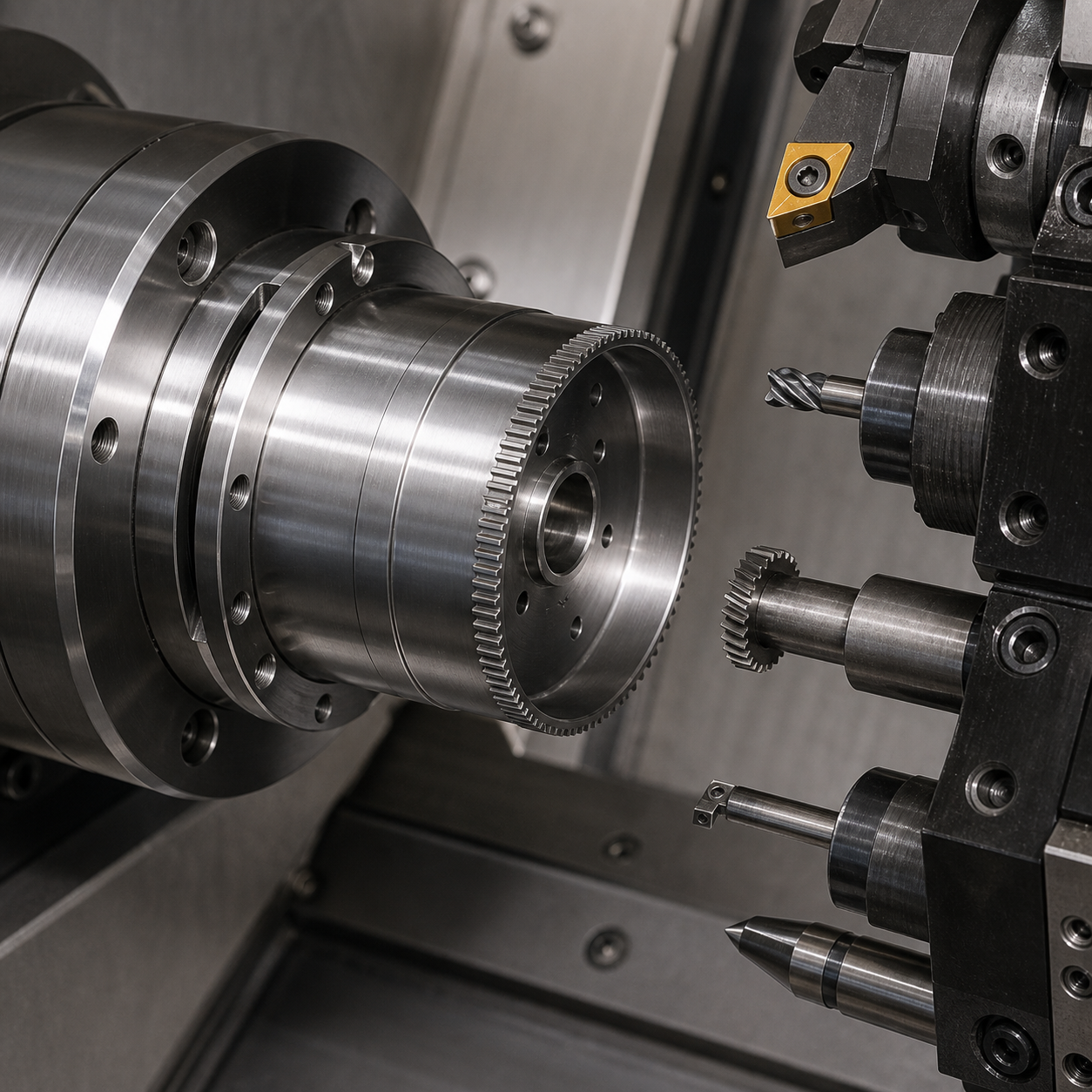
Separate final features from aging-sensitive features
Pilot bore A and diaphragm face B establish the flexspline axis, while one bolt hole defines C. The cup wall is 1.20 ±0.05 mm, the diaphragm blend is R3.0 ±0.10 mm, wall-to-A runout is 0.020 mm, and the external tooth preform is profile-toleranced 0.035 mm before aging. The route targets 52–54 HRC after the specified aging cycle. The drawing leaves 0.12 mm on the pilot diameter and 0.08 mm per tooth flank for final hard finishing; the diaphragm thickness and bolt pattern are finished before aging because later access would load the compliant cup.
Feature-to-tool and process-state selection
| Feature and state | Selected tool, edge and holder | Why / tool not selected |
|---|---|---|
| Solution-treated blank rough turning | CNMG 120408 P30 fine-grain carbide, PVD TiAlN, 0.08 mm hone, rigid cap-clamp holder | Tough enough for intermittent scale. A sharp finishing geometry would notch before the blank becomes continuous. |
| 1.2 mm wall semifinish | Ground VCGT 160404 positive carbide, thin AlTiN PVD, polished rake, R0.4, damped precision holder | Low radial force protects roundness. A negative wiper insert pushes the wall onto and off the mandrel. |
| R3 diaphragm blend | Ø8 five-flute AlTiN bull-nose end mill R1, variable pitch, short flute, shrink holder | Five-axis contouring controls local thickness. A full R3 form tool would load the complete blend. |
| Pilot bore before aging | Positive micrograin-carbide fine-boring insert R0.2 in a short modular head | Leaves concentric 0.12 mm stock. A reamer cannot intentionally distribute hard-finish allowance. |
| External spline preform | Ø50 solid-carbide involute form cutter, 10 teeth, AlCrN coating, edge hone 0.03 mm, precision arbor | Indexes each space with a rigid flank. A small end mill would accumulate profile and indexing error over the full tooth count. |
| Diaphragm bolt holes | Ø4.8 stub through-coolant carbide drill, 140° point, followed by Ø6 three-flute AlTiN chamfer mill | Short drill limits wander through the thin diaphragm; a combined drill-chamfer risks breakout tearing. |
| Post-aging pilot restoration | CBN-tipped fine-boring cartridge R0.2, balanced head, measured wear offset | Holds size in 52–54 HRC material. Coated carbide wear would vary along the interrupted entry. |
| Post-aging tooth flanks | Qualified carbide power-skiving or profile-grinding handoff, selected from distortion map | Only a measured distortion study decides the final method; repeating the soft-state form cut would copy aging error. |
Support strategy and alternating stock removal
The blank is rough-turned as a thick cup and stress-relieved before the wall is released. A ground expanding mandrel contacts the pilot, while a removable backup sleeve supports the wall to within 4 mm of the active cut. Inner and outer diameters are semifinished in alternating 25 mm axial bands so no long unsupported membrane is created. The sleeve is retracted only for the final low-force pass, and wall thickness is verified ultrasonically before tooth machining.
The form cutter machines diametrically opposite tooth spaces in a balanced index sequence. Chip evacuation is directed away from the thin rim, and cutter runout is checked before a profile offset is entered. Rising wall ovality, a repeating tooth-thickness wave or a bright rub band signals mandrel pressure, cutter runout or a dull edge respectively. After aging in a support fixture, free-state roundness and the actual distortion harmonic determine the pilot and tooth-flank finishing offsets.
Inspection and FAQ for flexspline tooling
An air gauge and roundness instrument measure A before and after aging. A CMM checks B-C, diaphragm blend and bolt pattern with the cup supported only at its pilot. A gear measurement system reports tooth thickness, lead and profile around the full circumference; data are Fourier-reviewed to separate indexing error from two-lobe aging distortion. Wall thickness is mapped ultrasonically, then a low-force functional wave-generator check is performed only after dimensional acceptance.
Which insert should turn a 1.2 mm Maraging 300 cup wall?
A ground positive VCGT-style carbide insert with a polished rake, small nose radius and thin PVD coating minimizes radial force; the support mandrel remains equally important.
How much spline stock should remain before aging?
The amount must come from the drawing and qualified distortion study; this hypothetical route leaves 0.08 mm per flank rather than claiming a universal value.
Why not finish the flexspline teeth before aging?
Aging can introduce ovality and harmonic profile change. Measured stock permits the final flanks to be restored from the hardened pilot axis.
Related datum handoffs appear in a carburized spline preform case and the thin-cup support choices in a deep-bore heat-shield cup.
中文: Maraging 300柔轮杯配刀:薄壁、外齿预形与时效余量
Maraging 300谐波减速器柔轮的配刀必须预判时效变形,而不是只追求软态好切。薄杯壁由锋利低力硬质合金刀片在贴合芯轴支承下半精;外齿预形用AlCrN硬质合金成形刀;定位内孔和齿面按图保留硬精余量,时效后再从恢复的轴线完成。图纸因此必须规定每把刀在哪个材料状态下才能形成最终面。
区分时效前成品面和时效敏感面
A为定位内孔,B为膜片端面,一个螺栓孔定义C。杯壁1.20 ±0.05 mm,膜片过渡R3.0 ±0.10 mm,壁面对A跳动0.020 mm,外齿预形在时效前轮廓度0.035 mm。规定时效后目标52–54 HRC;定位孔留0.12 mm、每侧齿面留0.08 mm硬精余量,膜片厚度和孔系在时效前完成,因为后续刀具接近会使柔性杯体受力。
图纸特征—刀具与材料状态表
| 特征和状态 | 刀具、刃口与刀柄 | 选择理由 |
|---|---|---|
| 固溶态毛坯开粗 | CNMG 120408 P30细晶硬质合金,PVD TiAlN,0.08 mm强化刃,刚性压板刀杆 | 承受断续氧化皮;锋利精刀会先产生沟槽磨损。 |
| 1.2 mm杯壁半精 | 精磨VCGT 160404正角刀片,薄AlTiN PVD,抛光前角,R0.4,减振精密刀杆 | 径向力低;负角修光刀会把杯壁反复压向芯轴。 |
| R3膜片过渡 | Ø8五刃变齿AlTiN牛鼻刀R1,短刃,热缩刀柄 | 五轴轮廓可控制局部厚度;全R3成形刀会整段加载。 |
| 时效前定位孔 | R0.2正角微粒硬质合金精镗刀,短模块化镗头 | 均匀保留0.12 mm;铰刀不能主动分配硬精余量。 |
| 外齿预形 | Ø50整体硬质合金渐开线成形刀,10齿,AlCrN,0.03 mm刃口强化,精密刀杆 | 刚性齿面逐槽分度;小立铣刀会累积轮廓和分度误差。 |
| 膜片孔系 | Ø4.8短型内冷硬质合金钻,140°+Ø6三刃AlTiN倒角刀 | 短钻减小薄膜片出口偏摆;复合钻倒角刀易拉裂出口。 |
| 时效后定位孔 | CBN刀尖精镗盒R0.2,平衡镗头,实测磨损补偿 | 稳定加工52–54 HRC;涂层硬质合金在断续入口磨损漂移。 |
| 时效后齿面 | 依据变形图选择合格硬质合金强力刮齿或齿形磨削交接 | 必须用实测畸变决定;重复软态成形刀只会复制时效误差。 |
支承、对称去料与刀寿迹象
毛坯以厚壁杯形开粗并消除应力后再释放薄壁。磨制胀套以内孔定位,可移动背衬套把支承保持在距切削区4 mm以内;内外径按25 mm轴向带交替半精,避免一次形成整段悬空膜壁。背衬只在最终低力走刀前后退,切齿前用超声测厚确认余量分布。
成形刀按直径相对的齿槽平衡分度,排屑方向远离薄齿圈,输入齿形补偿前先测刀具跳动。杯壁椭圆增大、齿厚出现周期波、表面出现亮摩擦带,分别指向芯轴压力、刀具跳动和刃口钝化。时效时使用支承夹具;出炉后以自由状态圆度和实际谐波畸变计算内孔及齿面终精补偿。
检验与常见问题
气动量仪和圆度仪分别在时效前后测A孔;三坐标只以A孔支承测B-C、R3过渡和孔系。齿轮测量中心沿整圈报告齿厚、齿向和齿形,并用傅里叶分析区分分度误差与二阶时效椭圆。超声扫描杯壁厚度,尺寸合格后才做低力波发生器功能试装。
1.2 mm Maraging 300杯壁用什么刀片?
精磨正角VCGT类刀片、抛光前角、小刀尖圆弧和薄PVD涂层可降低径向力,同时必须有贴合芯轴。
时效前齿面留多少余量?
应由图纸和合格的变形研究决定;本假设路线每侧0.08 mm,不作为通用参数。
为什么不能时效前把齿做到成品?
时效会引入椭圆和谐波轮廓变化,保留实测余量才能从硬化后的定位轴线恢复齿面。
延伸阅读:渗碳花键预形与基准恢复以及薄杯支承配刀。
Français: Flexspline Maraging 300 : paroi mince, denture et vieillissement
La gamme doit anticiper le vieillissement. Une plaquette positive semi-finit la coupe sur mandrin proche, une fraise de forme carbure AlCrN prépare la denture, puis des réserves mesurées restent sur l’alésage et les flancs pour la finition dure.
État du plan
A est l’alésage pilote, B le diaphragme, C un trou. La paroi vaut 1,20 ±0,05 mm, le raccord R3,0 ±0,10 mm et le battement 0,020 mm. L’alésage garde 0,12 mm et chaque flanc 0,08 mm avant le vieillissement vers 52–54 HRC.
Tableau fonction–outil
| Fonction | Outil | Décision |
|---|---|---|
| Ébauche | CNMG 120408 P30, TiAlN PVD, honage 0,08 mm | Tenace dans la peau intermittente. |
| Paroi 1,2 mm | VCGT 160404 positive, AlTiN mince, face polie, R0,4 | Faible force; une racleuse négative déforme la coupe. |
| R3 | Torique Ø8, 5 dents AlTiN, R1, frettée | Charge locale au lieu d’un outil de forme complet. |
| Pilote doux | Alésage fin carbure positif R0,2 | Laisse uniformément 0,12 mm. |
| Préforme denture | Fraise carbure Ø50, 10 dents, AlCrN, arête 0,03 mm | Indexation rigide; la petite fraise cumule les erreurs. |
| Trous | Foret carbure Ø4,8 à 140° puis chanfrein Ø6 | Sortie maîtrisée dans le diaphragme. |
| Pilote dur | Cartouche CBN R0,2 équilibrée | Dimension stable à 52–54 HRC. |
| Flancs durs | Power skiving carbure qualifié ou rectification selon carte | La distorsion mesurée choisit la méthode. |
Support et contrôle
Un mandrin expansible et une manchette mobile soutiennent la coupe à moins de 4 mm. Intérieur et extérieur sont alternés par bandes de 25 mm. Les espaces de dents sont indexés par paires opposées. Après vieillissement, la rondeur libre et l’harmonique de déformation déterminent les corrections.
Jauge pneumatique, rondimètre, MMT, mesure d’engrenage et ultrasons contrôlent respectivement A, ovalité, B-C, denture et épaisseur.
Quelle plaquette pour la paroi?
VCGT positive polie R0,4 sur un support proche.
Quelle réserve?
Celle du plan et de l’étude; ici 0,08 mm par flanc.
Pourquoi finir après vieillissement?
Pour corriger ovalité et profil harmonique.
Voir la préforme de cannelure et le soutien d’une coupe mince.
Русский: Flexspline Maraging 300: тонкая чашка и припуск
Маршрут учитывает старение: позитивная пластина обрабатывает стенку на близкой оправке, твердосплавная профильная фреза AlCrN создаёт зубчатую заготовку, а на пилоте и боках остаётся припуск для твёрдой отделки.
Чертёжное состояние
A — пилот, B — диафрагма, C — отверстие. Стенка 1,20 ±0,05 мм, переход R3,0 ±0,10 мм, биение 0,020 мм. На отверстии остаётся 0,12 мм, на каждом боку зуба 0,08 мм до старения к 52–54 HRC.
Таблица элемент–инструмент
| Элемент | Инструмент | Почему |
|---|---|---|
| Черновая | CNMG 120408 P30, PVD TiAlN, кромка 0,08 мм | Прочная на прерывистой корке. |
| Стенка | VCGT 160404 позитивная, тонкий AlTiN, R0,4 | Малая радиальная сила. |
| R3 | Тороидальная Ø8, 5 зубьев AlTiN, R1 | Локальная нагрузка. |
| Мягкий пилот | Позитивная карбидная расточка R0,2 | Равномерно оставляет 0,12 мм. |
| Зубья | Карбидная профильная Ø50, 10 зубьев, AlCrN | Жёсткая индексация. |
| Отверстия | Карбид Ø4,8, 140°, затем фаска Ø6 | Чистый выход диафрагмы. |
| Твёрдый пилот | CBN R0,2 в балансированной головке | Стабильно при 52–54 HRC. |
| Твёрдые бока | Карбидное power skiving или шлифование по карте | Метод выбирает фактическая деформация. |
Опора и контроль
Разжимная оправка и подвижная втулка держат стенку в 4 мм от резания. Диаметры обрабатываются чередующимися полосами по 25 мм, зубья — противоположными парами. После старения свободная круглость определяет коррекции.
Пневмокалибр, кругломер, КИМ, зубоизмерительная машина и ультразвук проверяют пилот, овальность, базы, зубья и толщину.
Какая пластина для стенки?
Позитивная полированная VCGT R0,4.
Какой припуск?
По чертежу и исследованию; здесь 0,08 мм на бок.
Почему после старения?
Чтобы исправить овальность и гармонику профиля.