English: D2 Stripper Plate CNC Tooling Case: Narrow Slug Slots and Grinding Allowance
This hypothetical D2 stripper plate separates what carbide should machine before heat treatment from what wire EDM and grinding should finish afterward. The search intent is practical: choose tools for 5 mm slug slots, dowel bores and counterbores without wasting long carbide cutters or losing the datum chain through hardening.
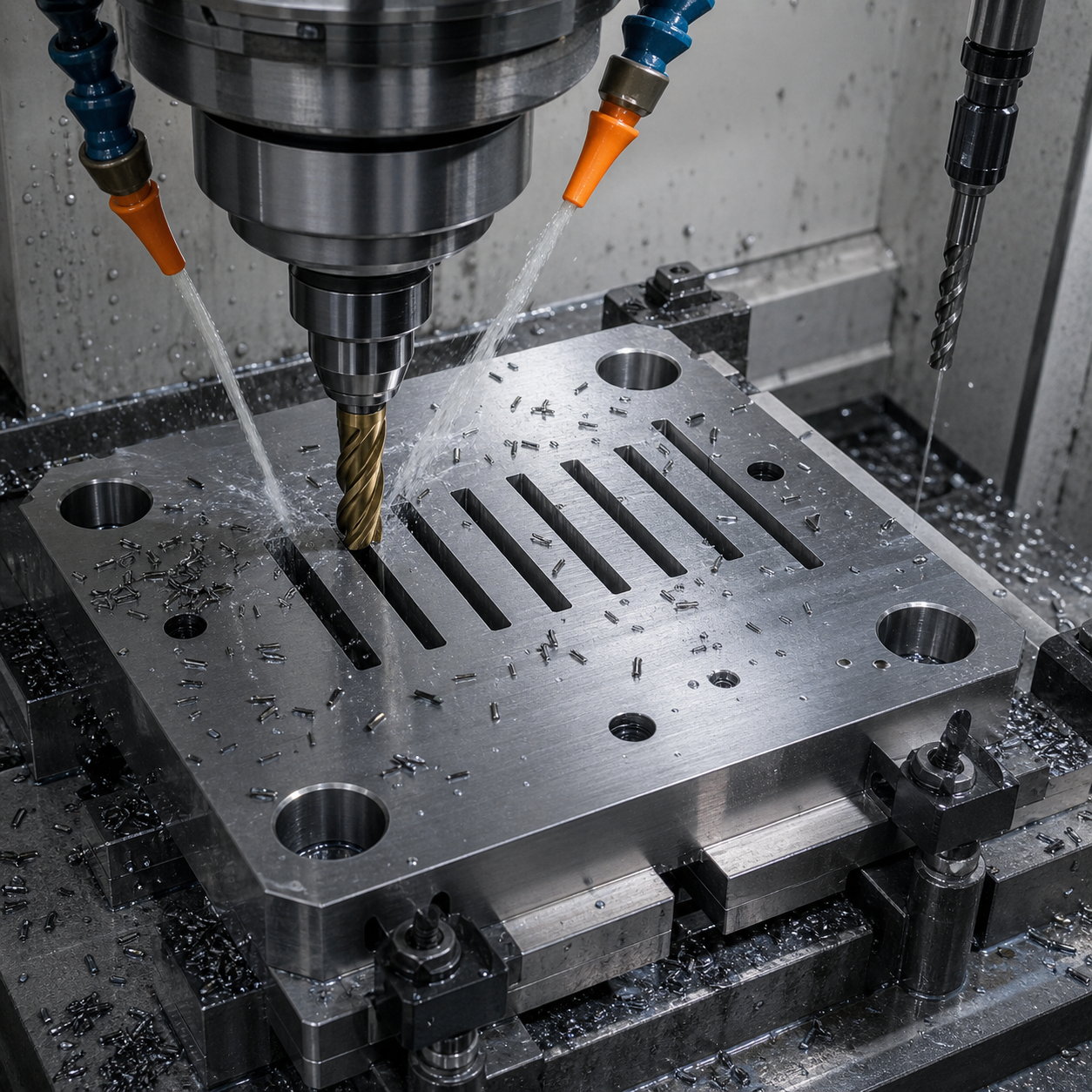
Drawing state and allowance plan
The 32 mm plate uses ground face A, long edge B and dowel C. Eight slots are 5.00 +0.02/0 mm with 0.015 mm position, faces require 0.01 mm parallelism after 58–60 HRC heat treatment, and dowels are Ø12 H7. The drawing marks 0.20 mm per slot wall for wire EDM, 0.30 mm per face for grinding and leaves starter holes outside finished corners.
Feature-to-tool plan
| Feature | Tool selection | Why / rejection |
|---|---|---|
| Pre-hard pocket clearing | Ø12, 5-flute AlTiN carbide, variable pitch, strong 0.1 mm edge hone, hydraulic holder | Stable in D2; a sharp aluminum tool chips on carbides. |
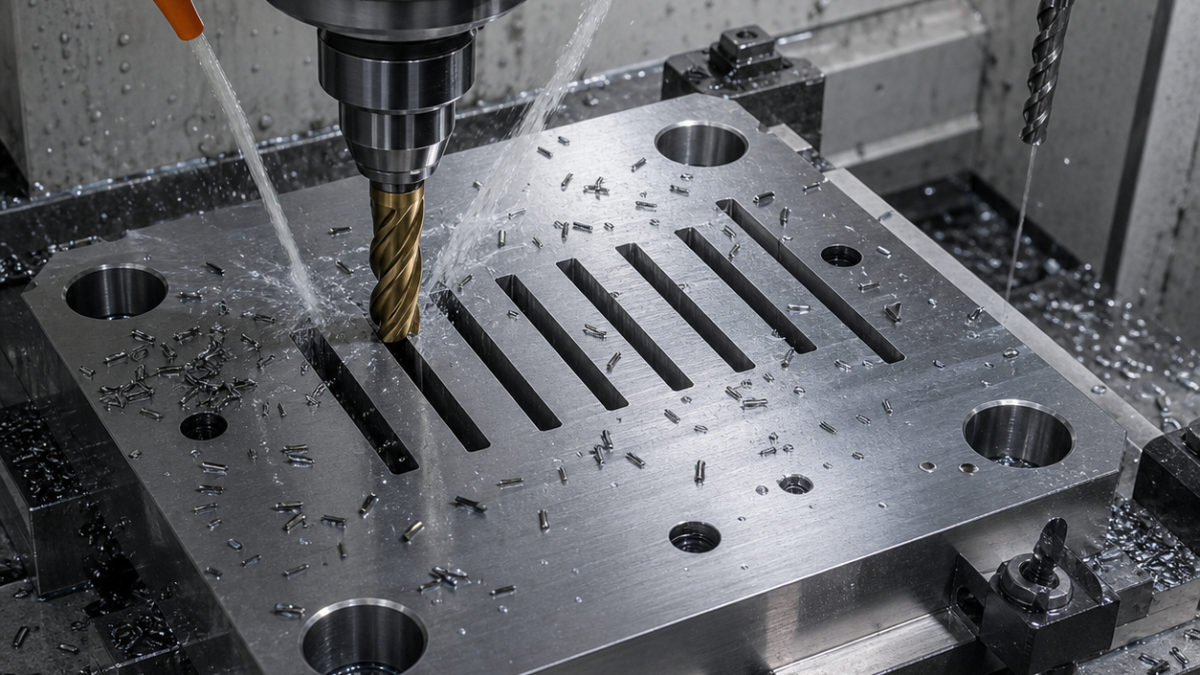
| 5 mm slot preform | Ø4, 4-flute TiAlN carbide, necked 28 mm reach, shrink holder | Leaves EDM stock; a Ø5 full slot cutter has no chip space or correction allowance. |
| EDM starter hole | Ø2.5 through-coolant carbide drill, 140° point | Controlled straightness; HSS wanders in high-chromium D2. |
| Dowel pre-bore | Ø11.5 carbide drill then Ø11.8 carbide boring tool | Leaves stock for post-hard jig grinding; reaming before heat treat cannot hold final relation. |
| Counterbore | Indexable carbide helical interpolation tool | Adjustable diameter; fixed counterbore is vulnerable to wear shift. |
Process and tool-life decisions
A and B are established on a stress-relieved blank. High-efficiency roughing stays below 12% radial engagement and uses through-spindle coolant. Slots are opened by trochoidal paths from starter holes, leaving uniform EDM allowance and full corner bridges. After roughing, the plate rests before a second skim verifies movement. Heat treatment uses protected surfaces; faces are ground to A, then wire EDM locates from ground A-B-C and alternates slots across the plate to distribute residual stress.
Carbide failure is monitored by corner chipping, load spikes and a rising burr at the slot entrance. The Ø4 tool is not run to size; its job is only a stable preform. Burrs before heat treatment are chamfered with a 6 mm, 4-flute TiAlN carbide chamfer mill at 0.15 mm. After EDM, a fine stone removes only recast feather under magnification—no uncontrolled edge rounding.
Inspection and FAQ
A CMM checks preforms and starter-hole clearance before heat treatment. After grinding and EDM, it rebuilds A-B-C, measures slot position and width, dowel relation and counterbore depth. Flatness is measured free-state, while surface finish and recast-layer acceptance follow the drawing.
Why not mill the 5 mm D2 slots to final size?
Heat-treatment movement and 32 mm depth make wire EDM the more controllable finishing process; carbide creates a uniform, economical preform.
Which coating suits pre-hardened D2?
A tough AlTiN/TiAlN system with reinforced edge and stable coolant delivery; ultra-sharp uncoated geometry is too fragile here.
When are dowel holes finished?
After hardening and face grinding, so their axis is tied to the final datum surfaces.
Compare EDM allowance planning and H7 hole tool selection.
中文: D2卸料板配刀:窄落料槽、线切割余量与磨削基准
本假设案例明确区分热处理前硬质合金刀具的任务,以及热处理后线切割和磨削的任务。核心搜索意图是:32 mm厚D2卸料板的5 mm槽、定位孔和沉孔怎样配刀而不浪费长刃刀,也不丢失淬火后的基准关系。
特征—刀具表
| 特征 | 刀具 | 理由 |
|---|---|---|
| 预硬开粗 | Ø12五刃变螺距AlTiN硬质合金,0.1 mm强化刃口,液压刀柄 | 抗D2碳化物冲击;铝用锋利刀易崩。 |
| 5 mm槽预形 | Ø4四刃TiAlN缩颈刀,28 mm悬伸,热缩刀柄 | 保留线切割余量;Ø5满槽无容屑与修正空间。 |
| 穿丝孔 | Ø2.5内冷硬质合金钻,140°钻尖 | 直线度优于高速钢钻。 |
| 定位孔预孔 | Ø11.5钻+Ø11.8小镗刀 | 留给淬硬后坐标磨;热前铰孔无法保证最终关系。 |
| 沉孔 | 可转位硬质合金螺旋插补刀 | 直径可补偿,优于固定沉孔刀。 |
工艺与检验
A面、B边和C孔建立后,以小于12%径向吃刀量开粗。Ø4刀从穿丝孔摆线预开槽,每侧留0.20 mm线切割余量;两面各留0.30 mm磨削余量。粗加工后静置复测,再热处理至58–60 HRC。先磨A面,再由A-B-C定位线切割,并跨板交替切槽以均衡应力。
刀尖崩损、负载尖峰和入口毛刺增大是换刀信号。热前用Ø6四刃TiAlN倒角刀做0.15 mm倒角;线切割后只在放大镜下去除重铸层薄毛边。最终三坐标测槽宽位置、定位孔关系和沉孔深,平台测自由状态平面度。
常见问题
为何不直接铣到5 mm成品槽?
32 mm深度和淬火变形使线切割更可控,硬质合金只负责均匀预形。
D2选什么涂层?
强化刃口的AlTiN/TiAlN并稳定冷却,拒绝过于锋利脆弱的铝用几何。
定位孔何时完成?
淬火并磨好基准面后完成。
Français: Plaque dévêtisseuse D2 : outils, fentes étroites et réserve EDM
Le carbure prépare la géométrie avant trempe; l’électroérosion et la rectification ferment les tolérances après 58–60 HRC.
Table fonction-outil
| Fonction | Outil | Choix |
|---|---|---|
| Ébauche | Ø12, 5 dents variables AlTiN, arête 0,1 mm, hydraulique | Résiste aux carbures du D2. |
| Préforme 5 mm | Ø4, 4 dents TiAlN, col 28 mm, fretté | Conserve 0,20 mm EDM; Ø5 en pleine rainure colmate. |
| Trou de départ | Foret carbure arrosé Ø2,5, pointe 140° | Moins de dérive que HSS. |
| Pion | Perçage Ø11,5 et alésage Ø11,8 | Réserve pour rectification coordonnée. |
| Lamage | Outil carbure interpolé | Diamètre compensable. |
Gamme et contrôle
A-B-C précèdent l’ébauche à engagement radial inférieur à 12%. Les fentes sont trochoïdales, puis la pièce repose avant trempe. A est rectifiée, les fentes EDM sont alternées et les trous sont terminés depuis les références finales. Ébréchure, charge et bavure déclenchent le changement d’outil. La MMT contrôle positions, largeurs et profondeurs.
FAQ
Pourquoi ne pas finir au fraisage?
La profondeur et la trempe favorisent l’EDM final.
Quel revêtement?
AlTiN/TiAlN avec arête renforcée.
Quand finir les pions?
Après trempe et rectification des faces.
Voir les réserves EDM et les trous H7.
Русский: Плита D2: инструмент для узких пазов и припуск EDM
Карбид создаёт заготовку до закалки, а EDM и шлифование обеспечивают конечные базы после 58–60 HRC.
Элемент и инструмент
| Элемент | Инструмент | Выбор |
|---|---|---|
| Черновая | Ø12, 5 переменных зубьев AlTiN, кромка 0,1 мм | Стойкость к карбидам D2. |
| Паз 5 мм | Ø4, 4 зуба TiAlN, шейка 28 мм | Оставляет 0,20 мм EDM; Ø5 забивается. |
| Стартовое | Ø2,5 с внутренней подачей, 140° | Меньше увода HSS. |
| Штифт | Ø11,5 и расточка Ø11,8 | Запас для координатного шлифования. |
| Цековка | Интерполируемый карбид | Компенсация размера. |
Маршрут
После A-B-C черновая обработка идёт при зацеплении ниже 12%. Пазы трохоидальны, затем деталь выдерживают и закаливают. A шлифуют, EDM-пазы чередуют, отверстия заканчивают от финальных баз. Скол, нагрузка и заусенец определяют смену.
Вопросы
Почему не фрезеровать в размер?
Глубина и закалка делают EDM стабильнее.
Какое покрытие?
AlTiN/TiAlN с усиленной кромкой.
Когда закончить штифты?
После закалки и шлифования.
См. припуск EDM и H7.