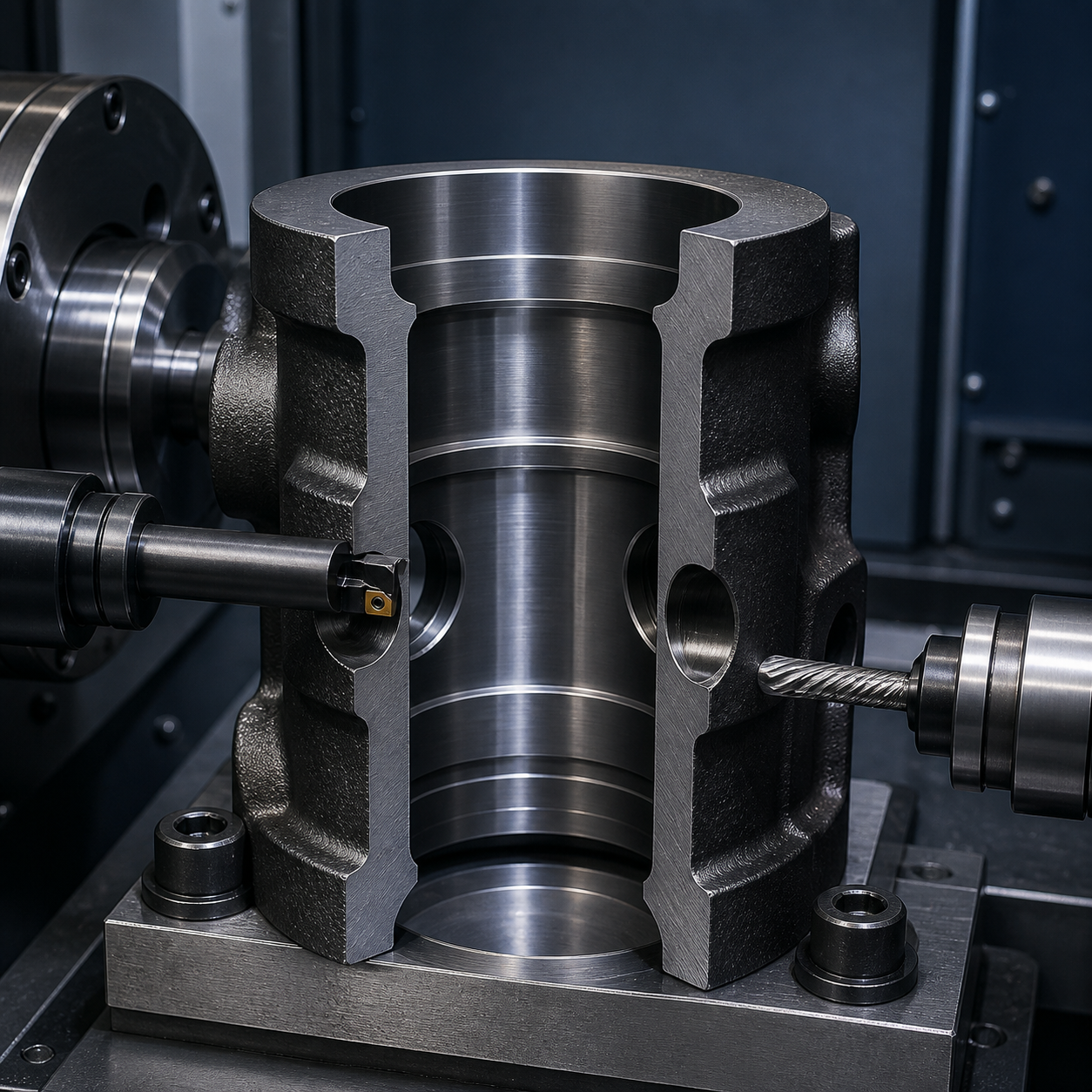
This is a realistic hypothetical process-planning case, not a customer project or confidential drawing.
English: H13 Mold Core Insert CNC Case: Deep Ribs, EDM Allowance and Polishing Datum Control
Search intent and drawing interpretation
The search intent is how to machine an H13 mold core insert with deep narrow ribs while coordinating CNC, EDM and polishing. Interpret draft angles, shutoff faces, corner radii, heat-treatment condition, parting-line datums and surface-class symbols before assigning any area to milling or EDM.
- Protect shutoff and parting-line datums
- Mark inaccessible root radii for EDM
- Separate final steel dimensions from polishing stock
Carbide tool selection
Use rigid variable-helix carbide end mills for bulk roughing, reduced-neck high-feed or bull-nose tools for deep rib corridors, and small ball-nose carbide cutters only where reach and deflection are verified. Choose coating and edge preparation for the actual H13 hardness state.
Process planning and fixture choice
Establish the base and two side datums in a rigid vise or pallet fixture. Rough symmetrically, leave heat-treatment and finishing stock, re-establish datums after hardening if required, then semi-finish before electrodes are finalized. Reserve protected reference pads for polishing and CMM alignment.
- Maximize holder clearance before increasing tool length
- Use modular pallets for repeatable CNC-to-EDM transfer
- Do not polish away the measurement datums
Roughing, finishing and toolpaths
Apply rest machining from large to small tools, constant-engagement toolpaths and short step-downs in deep ribs. Blend ball-nose paths with consistent cusp height and avoid sharp reversals at slender walls. Leave explicit, uniform EDM and polishing allowances rather than an informal hand-finishing margin.
Material risks, chip or burr control and tool life
H13 hardness variation changes heat and edge strength requirements; long tools chatter, pack chips and may leave tapered walls. Recut chips damage small cutters. Track runout, cutting time, deflection marks and corner wear; replace micro tools before root-radius growth exceeds allowance.
Tolerances, surface finish and inspection
Probe base and side datums after every transfer, CMM-check rib position and draft, use optical or replica methods for deep roots, verify shutoff flatness and confirm remaining stock maps before EDM and polishing. Surface finish should be judged after the assigned process stage, not prematurely.
H13 mold insert machining FAQ
When should deep ribs be EDM instead of milled?
Use EDM when tool access, required root radius, wall deflection or tool-life risk makes milling unreliable.
How much polishing stock should be left?
It must be drawing- and process-specific, uniform, measurable and agreed with the polishing method; there is no safe universal value.
Can hardened H13 be milled with carbide?
Yes, with a grade and geometry matched to hardness, rigid setup, controlled engagement and strict wear limits.
中文: H13模具型芯CNC加工:深筋、放电余量与抛光基准
搜索意图与图纸解读
本案例回答H13模具型芯带深窄筋时,怎样协调CNC、EDM和抛光。读图先识别拔模角、碰穿面、分型面基准、根部圆角、热处理状态和表面等级,再决定哪些区域铣削、放电或抛光。
- 保护碰穿面与分型面基准
- 标出刀具不可达的根部供EDM
- 区分成品钢料尺寸和抛光余量
硬质合金刀具选择
大面粗加工用刚性变螺旋硬质合金刀,深筋通道用避空颈高进给刀或圆鼻刀;只有校核有效伸出与挠度后才使用小球刀。涂层和刃口处理必须对应H13实际硬度状态。
工艺规划与夹具选择
在刚性虎钳或托盘上建立底面与两个侧基准,对称粗加工并保留热处理和精加工余量。需要淬硬时重新找正基准,半精后再最终确定电极。保留受保护的抛光与三坐标参考台。
- 先优化刀柄避让,再增加刀具长度
- 用重复定位托盘衔接CNC与EDM
- 抛光不得破坏检测基准
粗精加工与刀路
从大刀到小刀进行残料加工,深筋采用恒定负载和短层切。球刀按一致残留高度衔接,细长壁处避免急转向。EDM与抛光余量必须明确且均匀,不能依赖口头手工余量。
材料风险、切屑毛刺与寿命
H13硬度波动会改变热量和刃口强度需求;长刀易振动、塞屑并形成锥度。二次切屑会损伤小刀。寿命要监控跳动、实际切削时间、挠刀纹和圆角磨损。
公差、表面与检测
每次转序后探测底面和侧基准,用三坐标检查筋位和拔模角,深根部用光学或复制法评估,验证碰穿面平面度,并在EDM及抛光前确认余量图。
H13型芯加工常见问题
深筋什么时候改用EDM?
当刀具可达性、根部圆角、壁挠度或寿命风险使铣削不稳定时使用EDM。
抛光留多少余量?
应按图纸和抛光方法明确、均匀且可测量,没有通用安全数值。
淬硬H13能用硬质合金铣吗?
可以,但牌号几何要匹配硬度,装夹刚性、负载和磨损限值必须受控。
Français: Insert de moule H13 : nervures profondes, reprise EDM et polissage
Intention de recherche et lecture du plan
Il s’agit d’usiner un noyau H13 à nervures profondes en coordonnant fraisage, EDM et polissage. Lire d’abord dépouilles, portées de fermeture, références du plan de joint, rayons, état thermique et classes de surface.
- Protéger références et portées de fermeture
- Affecter à l’EDM les racines inaccessibles
- Distinguer cote acier finale et stock de polissage
Choix des outils carbure
Employer des fraises carbure à hélice variable pour l’ébauche, des outils à col dégagé ou à grand avance dans les couloirs et de petites fraises boule seulement après contrôle de portée et flexion. Adapter revêtement et préparation à la dureté H13.
Gamme et bridage
Créer base et deux côtés de référence sur montage rigide, ébaucher symétriquement et conserver les surépaisseurs thermique et finale. Reprendre les références après trempe, semi-finir avant de figer les électrodes et préserver des plots de contrôle.
- Optimiser le porte-outil avant d’allonger la fraise
- Utiliser une palette répétable entre CNC et EDM
- Ne pas polir les références de mesure
Ébauche, finition et trajectoires
Combiner reprise de matière, engagement constant et faibles profondeurs dans les nervures. Garder une hauteur de crête constante à la fraise boule. Spécifier clairement les surépaisseurs EDM et polissage.
Risques matière, copeaux et durée de vie
Dureté variable, grand porte-à-faux, bourrage et recoupe provoquent vibration, conicité et usure de rayon. Suivre faux-rond, temps de coupe, traces de flexion et usure des micro-outils.
Tolérances, surface et contrôle
Reprendre les références à chaque transfert, contrôler nervures et dépouilles par MMT, racines par méthode optique ou réplique, planéité des fermetures et carte de stock avant EDM et polissage.
FAQ insert H13
Quand préférer l’EDM aux nervures ?
Quand accès, rayon de racine, flexion ou durée d’outil rendent le fraisage instable.
Quelle surépaisseur de polissage ?
Une valeur propre au plan et au procédé, uniforme et mesurable; pas de valeur universelle.
Peut-on fraiser le H13 trempé ?
Oui avec carbure adapté, montage rigide, engagement contrôlé et limite d’usure stricte.
Русский: Обработка вставки H13: глубокие ребра и припуск EDM
Поисковая задача и чтение чертежа
Задача — обработать вставку H13 с глубокими узкими ребрами, согласовав CNC, EDM и полирование. Сначала прочитайте уклоны, запорные поверхности, базы разъема, радиусы, состояние термообработки и класс поверхности.
- Защитить базы и запорные поверхности
- Недоступные корни назначить на EDM
- Разделить размер стали и припуск полирования
Выбор твердосплавного инструмента
Для черновой обработки нужны жесткие твердосплавные фрезы с переменной спиралью, для глубоких коридоров — инструменты с шейкой или высокой подачей. Малые сферические фрезы применяйте только после проверки вылета и прогиба; покрытие выбирайте по твердости H13.
Маршрут и закрепление
Создайте нижнюю и две боковые базы в жестком приспособлении, снимайте материал симметрично и оставляйте припуск под термообработку. После закалки восстановите базы, выполните получистовую обработку, затем уточните электроды и сохраните площадки контроля.
- Сначала улучшить доступ патрона, затем увеличивать вылет
- Использовать повторяемую паллету CNC-EDM
- Не удалять базы при полировании
Черновая, чистовая обработка и траектории
Применяйте доработку остатка от большого инструмента к малому, постоянное зацепление и короткие слои. Сферические проходы задавайте по постоянной высоте гребешка. Припуски EDM и полирования должны быть явными и равномерными.
Риски материала, стружка и стойкость
Изменение твердости, длинный вылет, забивание и повторное резание вызывают вибрацию, конусность и износ радиуса. Контролируйте биение, время резания, следы прогиба и износ микроинструмента.
Допуски, поверхность и контроль
После каждого переноса щупайте базы, измеряйте ребра и уклоны на КИМ, глубокие корни оптически или слепком, проверяйте плоскостность запорных поверхностей и карту припуска до EDM и полирования.
FAQ по вставке H13
Когда ребра лучше делать EDM?
Когда доступ, радиус корня, прогиб или стойкость делают фрезерование ненадежным.
Какой припуск оставить на полирование?
Конкретный по чертежу и методу, равномерный и измеримый; универсального значения нет.
Можно ли фрезеровать закаленный H13?
Да, подходящим твердым сплавом при жестком закреплении и строгом контроле износа.