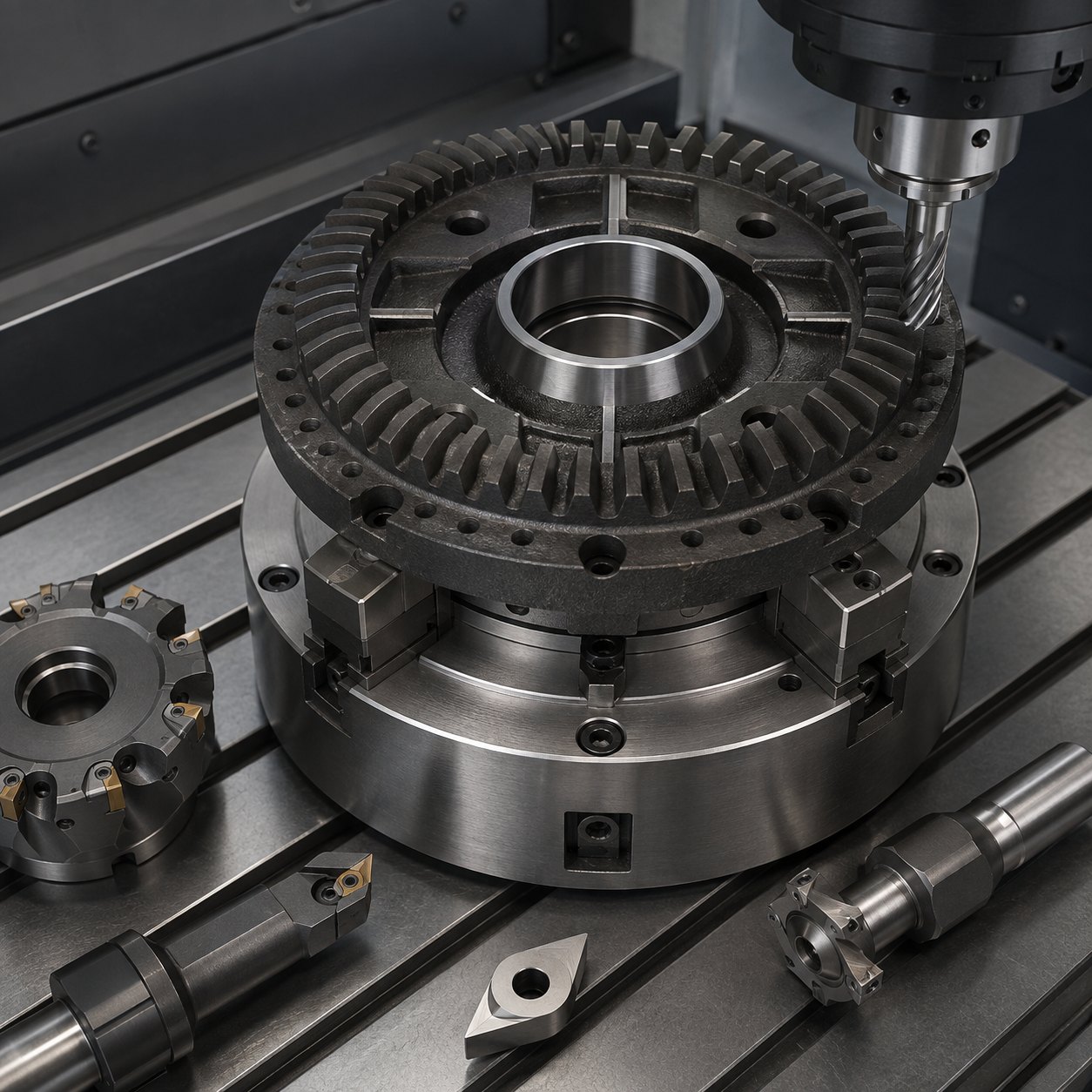
English: ADI Robot Reducer Output Flange CNC Tool Selection for Face Teeth and Tapered Bearing Seat
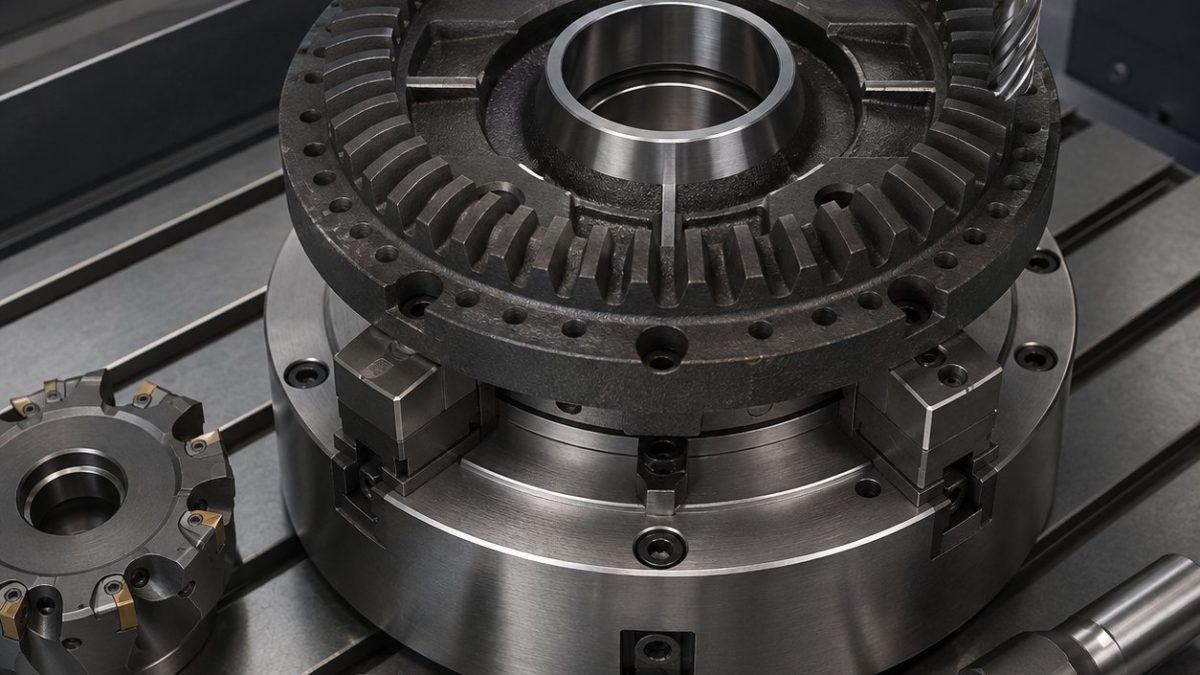
This case focuses on selecting carbide and CBN tools for an austempered ductile iron robot reducer output flange with curvic-style face teeth, a tapered bearing seat, bolt circle and cross oil grooves. The drawing challenge is to connect tooth contact, bearing geometry and oil-groove burr control without losing the flange axis.
Datum and machining logic
The bore is roughed first but not accepted as final until the face teeth and bearing seat are semi-finished. An expanding mandrel controls the axis while the face tooth pattern is indexed. Existing AXKXA bearing-axis thinking can be compared with AISI 4340 sheave bearing bore tooling and cast iron bearing housing tool selection.
Feature-to-tool selection
| Drawing feature | Tooling package | Reason for selection |
|---|---|---|
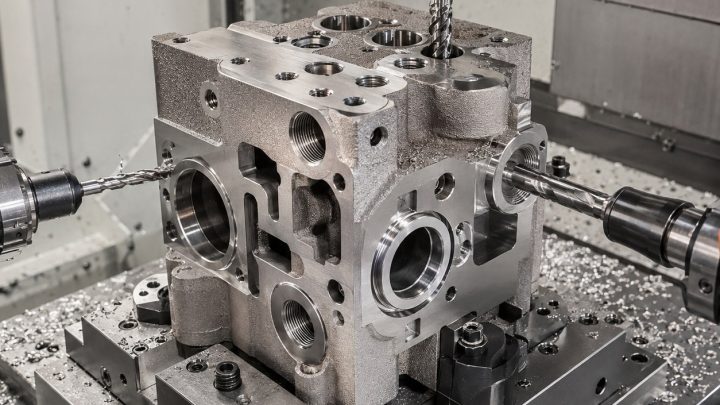
| ADI skin and rough flange | ISO-K/PVD carbide shoulder mill, strong edge prep | Handles graphite nodules and interrupted entry; sharp aluminium geometry is rejected. |
| Tapered bearing seat | Fine boring head with CBN or wear-resistant carbide insert | Maintains taper and roundness; reaming is rejected because taper correction is limited. |
| Curvic-style face teeth | Small ball end mill for root clearing plus form-relief carbide finisher | Separates root access from flank contact; one large form cutter risks chatter. |
| Cross oil grooves | Ø2 mm coated carbide end mill and controlled edge-break tool | Prevents loose burrs entering the bearing. |
| Bolt circle and spotfaces | Carbide drill, circular spotface interpolation, 90° chamfer mill | Keeps spotfaces square to datum A. |
Toolpath, burr and inspection plan
Use adaptive roughing on the flange pockets, indexed 3+2 machining for tooth spaces, spring passes only after the mandrel has stabilized, and dry air blast for cast-iron chips. Inspection checks bearing-seat taper, bore runout to face teeth, oil-groove burr height, tooth contact pattern and bolt-circle true position.
中文: ADI机器人减速器输出法兰端面齿与锥轴承座配刀
ADI 等温淬火球铁输出法兰的难点是端面齿、锥形轴承座、油槽和螺栓孔都围绕同一轴线。配刀不能只追求去除率,还要保证端面齿接触和轴承座圆度。
特征配刀
| 图纸特征 | 刀具组合 | 选择理由 |
|---|---|---|
| 毛坯皮和法兰开粗 | ISO-K/PVD 硬质合金肩铣刀,强刃口 | 适合球铁断续切削;不选铝用锋利刀。 |
| 锥形轴承座 | 精镗头配 CBN 或耐磨硬质合金刀片 | 可修正锥度和圆度;不选铰刀。 |
| 端面齿根和齿面 | 小球刀清根加成形修光硬质合金刀 | 分开控制齿根空间和齿面接触。 |
| 交叉油槽 | Ø2 mm 涂层硬质合金立铣刀加受控倒角刀 | 防止轴承区游离毛刺。 |
| 螺栓孔和沉台 | 硬质合金钻、圆插补沉台、90°倒角刀 | 保证沉台垂直于基准面。 |
检验
检验锥度、轴承座圆度、端面齿相对跳动、油槽毛刺高度、齿面接触印和螺栓孔位置度。
Français: Outils CNC pour bride ADI avec dents frontales
La bride de réducteur robot en fonte ADI combine dents frontales, portée conique de roulement, rainures d’huile et cercle de vis. Le choix d’outil relie contact dentaire et géométrie de roulement.
Table outil-fonction
| Zone | Outil | Pourquoi |
|---|---|---|
| Ébauche ADI | Fraise carbure ISO-K/PVD à arête renforcée | Supporte les entrées interrompues. |
| Portée conique | Tête à aléser fine avec CBN ou carbure résistant | Contrôle conicité et rondeur. |
| Dents frontales | Fraise boule puis outil carbure de finition de flanc | Moins de vibration qu’un seul gros outil. |
| Rainures d’huile | Fraise carbure Ø2 mm et outil d’ébavurage | Bavure contrôlée. |
| Cercle de vis | Foret carbure et interpolation de lamage | Position stable. |
Contrôle
La validation inclut conicité, faux-rond, contact des dents, hauteur de bavure et position du cercle de vis.
Русский: Инструмент для ADI фланца редуктора
Фланец редуктора из ADI имеет торцевые зубья, коническое посадочное место под подшипник, масляные канавки и отверстия. Инструмент выбирается по общей оси детали.
Карта инструмента
| Элемент | Инструмент | Причина |
|---|---|---|
| Черновая обработка | ISO-K/PVD карбидная фреза с прочной кромкой | Подходит для чугуна ADI. |
| Коническое место | Точная расточная головка с CBN или карбидом | Контроль конуса и круглости. |
| Торцевые зубья | Шаровая фреза и чистовой профильный инструмент | Стабильный контакт зубьев. |
| Масляные канавки | Ø2 мм карбидная фреза и фасочный инструмент | Меньше заусенец. |
| Отверстия | Карбидное сверло и круговое фрезерование площадки | Точная позиция. |
FAQ
Why use CBN on the bearing seat?
ADI can be abrasive and locally hard; CBN or a wear-resistant carbide insert keeps taper size stable.
Can the face teeth be cut with one form cutter?
Only if the machine and fixture are very rigid. In this case a ball tool plus finishing cutter lowers chatter risk.
What inspection links the features?
Runout between the bearing seat and face tooth pattern is the key relationship.