This is a realistic hypothetical process-planning example, not a claim about a specific customer drawing or production result.
Related: Compare polymer burr control in the PEEK manifold case and long-part stability principles in the residual-stress guide.
English: reading the UHMWPE metering-screw drawing
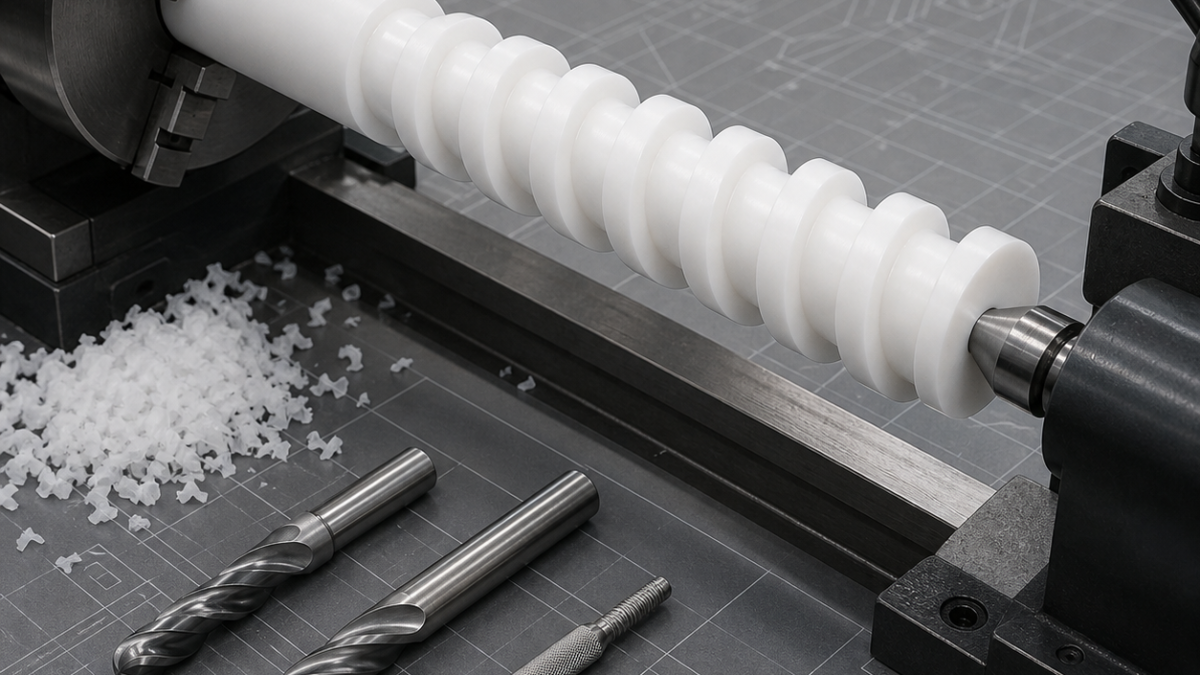
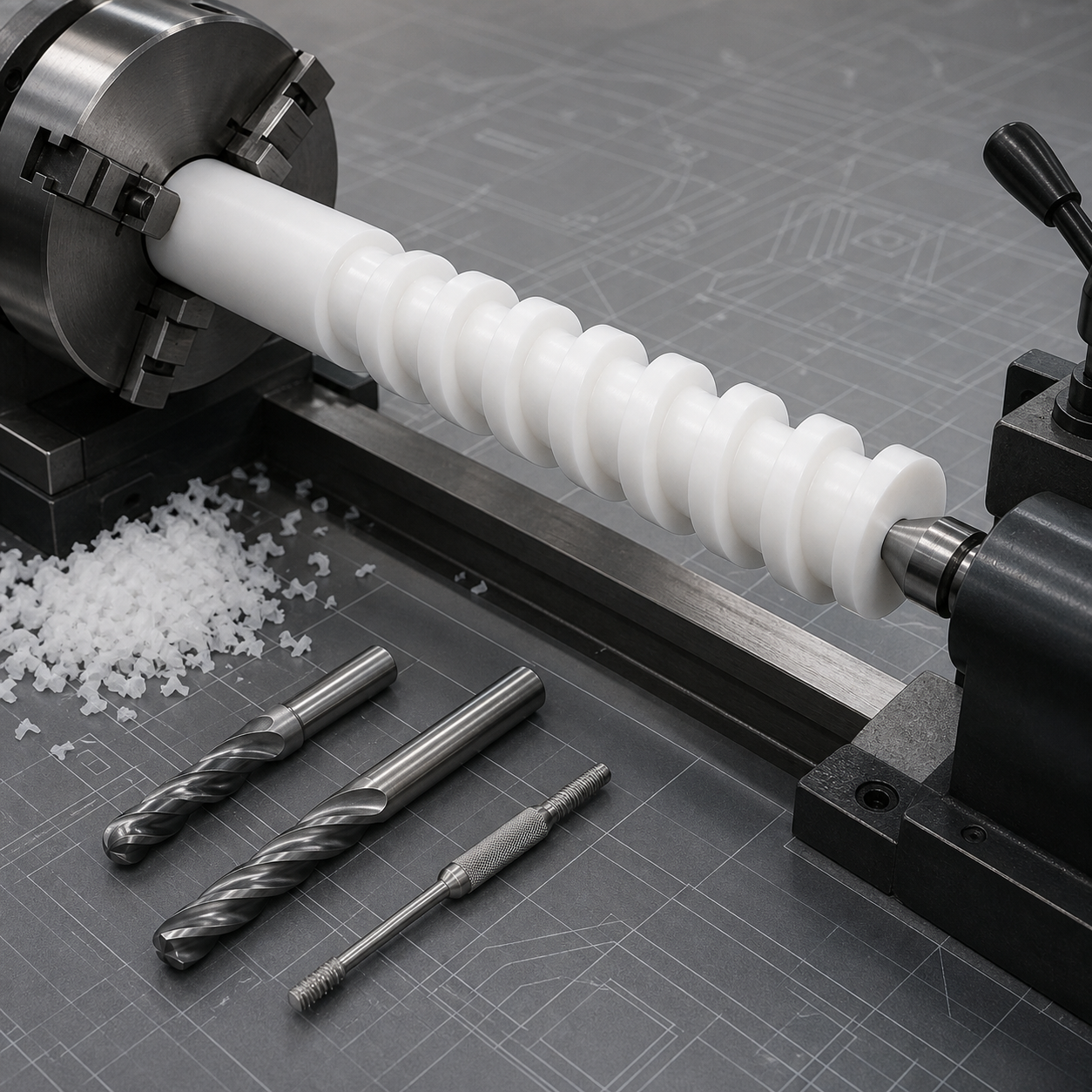
This hypothetical part has a long bearing journal, a deep helical metering channel, changing root diameter, controlled crest width and end drive features. The drawing should be interpreted as a functional profile: pitch, root depth, crest thickness and runout to the journals interact with feed consistency and cannot be inspected as isolated dimensions.
Datums and feature map
Use the two finished journals to define the rotating axis and an end face to clock the helical start. Mark the root transition and channel exit as burr-critical zones. Confirm whether profile tolerance applies in the free state and whether the lead is constant or intentionally variable before programming rotary interpolation.
Sharp carbide tool package
Turn journals with a polished positive-rake insert. Rough the channel with a short sharp carbide end mill where access permits, then use a reduced-neck ball-nose or radiused end mill for the root and sidewalls. A dedicated plastic-cutting chamfer tool should break edges without pushing a feather burr back into the channel.
Support and toolpath sequence
Keep generous support diameters while establishing journals, then mount between a collet and live center or on a rigid rotary support. Rough the helix in multiple constant-engagement passes, alternating axial zones to limit heat. Finish both channel flanks from the same rotary datum, then complete end features and remove support stock with low clamping force.
Chip, heat and inspection risks
UHMWPE produces continuous stringy chips that can wrap around the part and re-cut the surface. Use polished flutes, air evacuation or approved coolant, and programmed chip-clearing retracts without dwelling on the finish wall. Inspect lead and root profile on a rotary scan or sampled sections after temperature stabilization; high clamping force can temporarily hide straightness error.
FAQ
Why not use one full-depth form cutter?
A wide form cut raises force, heat and chip-packing risk; staged milling gives better profile correction and evacuation.
Should feeds be reduced to prevent melting?
Not automatically. Too little chip thickness causes rubbing; use a sharp edge, real chip load and effective evacuation.
中文:解读 UHMWPE 计量螺杆图纸
本假设零件包含长支承轴颈、深螺旋计量槽、变化的槽底直径、受控齿顶宽度和端部驱动特征。图纸应按功能轮廓理解:导程、槽深、齿顶厚度及其相对轴颈的跳动共同影响输送稳定性,不能孤立验收。
基准与特征映射
以两个精加工轴颈建立旋转轴线,以端面确定螺旋起点角向位置。槽底过渡和出口应标记为毛刺关键区。编程前确认轮廓公差是否在自由状态检验,以及导程是恒定还是有意变化。
锋利硬质合金刀具组合
轴颈车削采用抛光正前角刀片。可达区域用短型锋利硬质合金立铣刀分层粗加工,槽底和侧壁再用缩颈球头刀或圆角刀完成。塑料专用倒角刀用于切断薄毛刺,避免把毛边推回槽内。
支承、装夹与刀路
建立轴颈时保留足够支承直径,随后用筒夹与活动顶尖或刚性转台支承。螺旋槽采用多层恒定负载刀路,并交替加工轴向区域以控制温升。两侧壁从同一旋转基准精加工,最后完成端部特征并以低夹紧力去除支承余量。
缠屑、热量与检测风险
UHMWPE 易形成连续带状切屑,缠绕后会二次划伤表面。应采用抛光排屑槽、气流或经批准的冷却方式,并安排退刀清屑但不能在精加工壁上停顿。温度稳定后使用旋转扫描或分段采样检查导程和槽底轮廓,过大的夹紧力会暂时掩盖直线度误差。
常见问题
为什么不使用一把全深成形刀?
宽刃满槽切削会显著提高切削力、热量和堵屑风险,分层铣削更容易修正轮廓。
为了防止熔化是否应大幅降低进给?
不一定;切屑厚度过小会产生擦削,应保持锋利刀刃、有效切屑负载和顺畅排屑。
Français : lire le plan de la vis doseuse en UHMWPE
Cette vis hypothétique associe des portées longues, un canal hélicoïdal profond, un diamètre de fond variable et une largeur de crête contrôlée. Le pas, la profondeur, la crête et le faux-rond par rapport aux portées forment un profil fonctionnel unique.
Références et profil
Les deux portées définissent l’axe et une face positionne le départ de l’hélice. Les transitions et la sortie du canal sont critiques pour les bavures; il faut confirmer le pas constant ou variable avant l’interpolation rotative.
Outils carbure polis
Une plaquette positive polie tourne les portées. Une fraise courte ébauche le canal, puis une fraise boule ou torique à col dégagé finit le fond et les flancs. Un outil vif pour plastiques coupe les bavures sans les rabattre.
Support et trajectoire
Maintenir la pièce entre pince et pointe ou sur un axe rotatif soutenu. Ébaucher en passes à engagement constant, finir les deux flancs depuis la même origine angulaire et enlever les surépaisseurs de support sous faible serrage.
Copeaux et contrôle
Les copeaux filants peuvent s’enrouler et rayer la surface. Employer des goujures polies, une évacuation dirigée et des retraits de nettoyage. Contrôler le profil après stabilisation thermique et sans déformation de bridage.
FAQ
Pourquoi éviter une fraise de forme pleine largeur ?
Elle augmente l’effort, la chaleur et le bourrage; plusieurs passes facilitent la correction.
Une avance très faible évite-t-elle la fusion ?
Non, elle peut provoquer du frottement; une arête vive et une vraie épaisseur de copeau sont nécessaires.
Русский: чтение чертежа дозирующего шнека из UHMWPE
Условный шнек содержит длинные шейки, глубокий винтовой канал, переменный диаметр впадины и контролируемую ширину гребня. Шаг, глубина, толщина гребня и биение относительно шеек образуют единую функциональную геометрию.
Базы и профиль
Две шейки задают ось, торец — угловое начало винтовой линии. Переходы и выход канала считаются зонами риска заусенца; до программирования уточняют постоянный или переменный шаг.
Острый твердосплавный инструмент
Шейки точат полированной положительной пластиной. Канал черновят короткой фрезой, а дно и стенки чистят сферической или радиусной фрезой с утоненной шейкой.
Опора и траектория
Деталь поддерживают цангой и вращающимся центром. Канал выбирают несколькими проходами с постоянной нагрузкой, обе стенки чистят от одной угловой базы, затем снимают опорный припуск при малом зажиме.
Стружка и контроль
Длинная стружка наматывается и царапает поверхность. Нужны полированные канавки, направленный отвод и циклы очистки. Профиль проверяют после температурной стабилизации в свободном состоянии.
FAQ
Почему не применять широкую профильную фрезу?
Она повышает силу, нагрев и риск забивания стружкой.
Полезна ли очень малая подача?
Нет, она вызывает трение; нужна реальная толщина стружки.