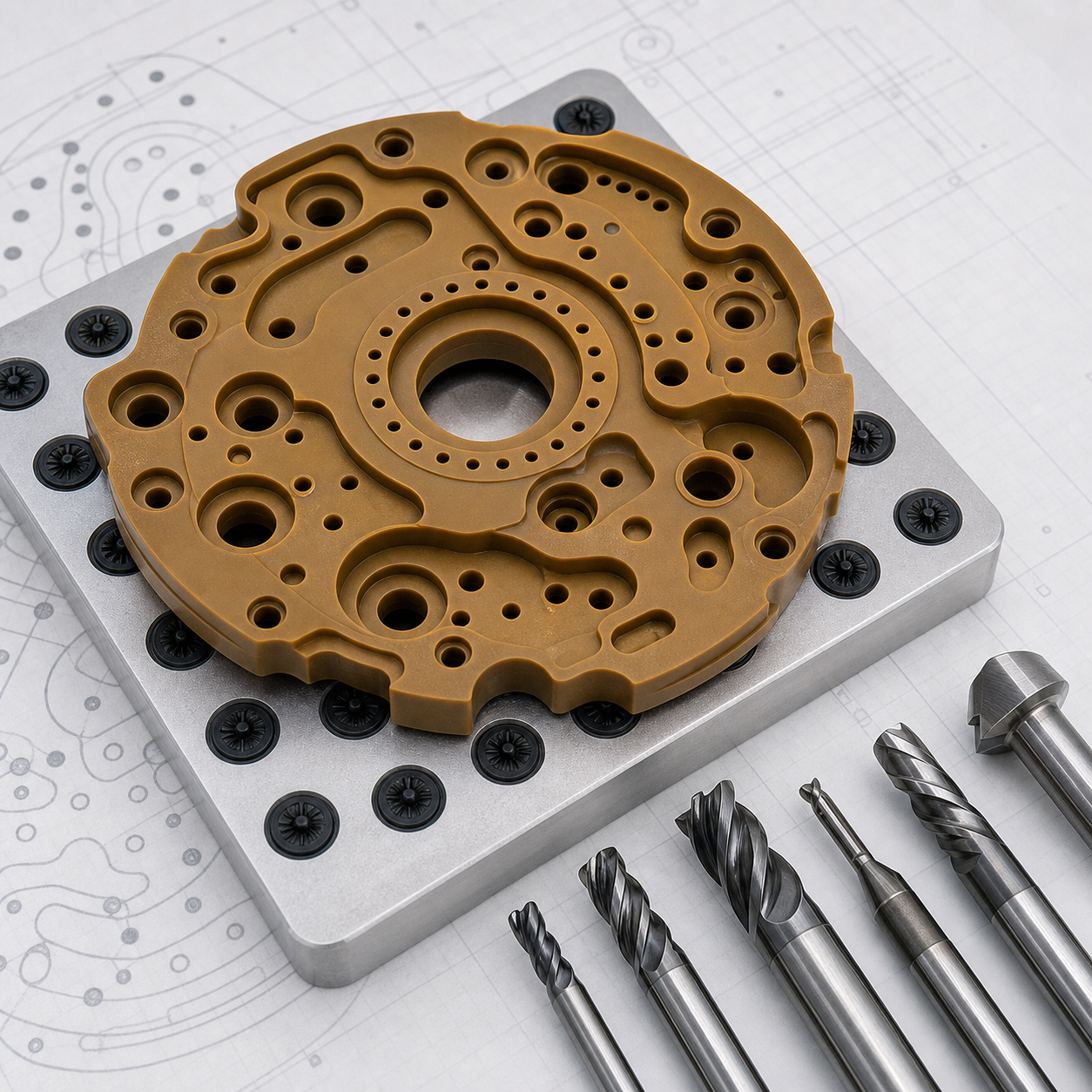
English: interpreting the Torlon valve-plate drawing
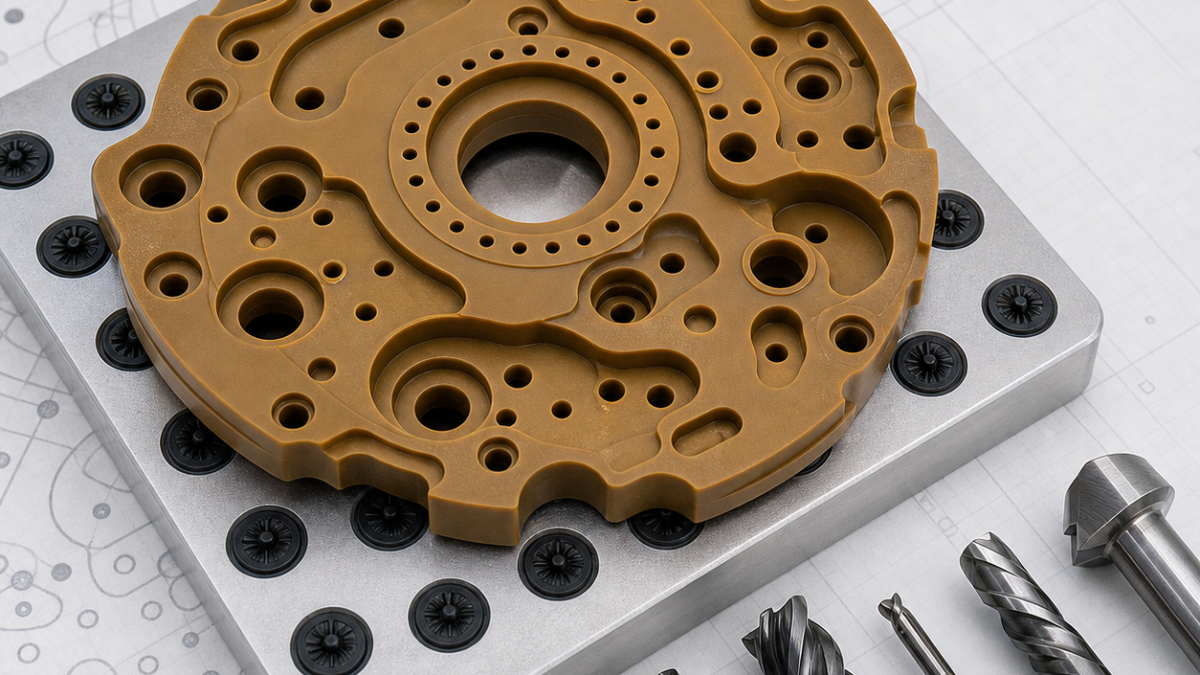
This hypothetical Torlon PAI compressor valve plate has two flat functional faces, shallow flow pockets, narrow sealing lands, many small holes and selected counterbores. The challenge is to preserve flatness and crisp land edges while preventing local heat from changing dimensions. Polymer stock condition, moisture history and inspection temperature should be controlled before machining begins.
Support and datum strategy
Skim the first face on a broad sacrificial plate, then establish that face as datum A. For the pocket side, use a vacuum fixture with distributed support under the sealing lands and mechanical edge stops for shear load. Keep vacuum channels away from small through-holes. If vacuum area is insufficient, add light peripheral clamps over supported zones rather than bending the plate.
Tools matched to delicate features
- A polished single- or two-flute carbide end mill roughs pockets with ample chip space.
- A fresh small-diameter finisher traces sealing-land walls with low radial engagement.
- Stub carbide drills make small holes in size groups, with frequent chip evacuation.
- A sharp reamer is reserved for holes whose fit cannot be achieved reliably by drilling.
- A controlled chamfer tool removes only the specified edge break without widening the sealing land.
Thermal and dimensional control
Use sharp tools, moderate spindle speed, air or clean compatible coolant, and toolpaths that distribute heat around the plate. Rough symmetric pocket groups, allow the plate to return to a stable temperature, then finish both faces with minimal stock removal. Do not measure immediately after a warm cut. Inspect overall thickness, flatness on a defined support, sealing-land width, small-hole true position, counterbore depth and edge condition under magnification.
Related reading: PEEK machining heat and burr control and vacuum fixturing for thin parts.
中文:Torlon PAI压缩机阀板薄密封筋加工
该假设阀板具有两侧功能平面、浅流道腔、狭窄密封筋、大量小孔和局部沉孔。加工前应控制材料状态、吸湿历史和检测温度。先轻铣一面建立基准A,第二面采用分布式支撑的真空夹具,使支撑点位于密封筋下方,并避开通孔区域。
刀具与温度控制
抛光单刃或双刃硬质合金立铣刀提供足够排屑空间,小直径锋利精加工刀以低径向吃刀量修整密封筋。小孔按直径分组使用短钻加工,精密配合孔再用专用铰刀。刀路应分散热量并对称粗加工,零件恢复到稳定温度后再轻量精加工和检测。重点检查平面度、密封筋宽度、小孔位置度、沉孔深度及边缘质量。
Français : plaque de clapet en Torlon PAI
La plaque hypothétique possède deux faces fonctionnelles, des poches peu profondes, des lèvres d’étanchéité fines et de nombreux petits trous. Une semelle sacrificielle établit le datum A, puis un montage à vide soutient les zones situées sous les lèvres sans ouvrir les circuits de vide dans les trous.
Outils et stabilité thermique
Des fraises carbure polies à une ou deux dents évacuent bien les copeaux. Un outil neuf finit les lèvres avec un faible engagement radial. Les petits trous sont percés par groupes et les ajustements précis sont alésés. Il faut répartir la chaleur, laisser la pièce revenir à température stable et contrôler la planéité, la largeur des lèvres, la position des trous et les profondeurs.
Русский: клапанная плита из Torlon PAI
Условная плита имеет две рабочие плоскости, неглубокие карманы, тонкие уплотнительные перемычки, множество малых отверстий и цековки. Первую плоскость слегка фрезеруют как базу A, затем применяют вакуумное приспособление с распределённой опорой под перемычками.
Инструменты и температура
Полированные одно- или двухзубые твердосплавные фрезы обеспечивают свободный выход стружки. Новая концевая фреза чистит тонкие стенки с малым радиальным зацеплением. Короткие сверла обрабатывают группы отверстий, а точные посадки развёртывают. Деталь измеряют после температурной стабилизации, проверяя плоскостность, ширину перемычек, координаты отверстий и глубину цековок.
FAQ
Why support directly beneath sealing lands?
Distributed support prevents cutting and clamping forces from flexing the narrow functional surfaces.
Why delay inspection after machining?
Torlon dimensions can shift with temperature, so warm measurements may not represent the stabilized part.