Related tooling references: G10 Epoxy Glass Manifold Plate CNC Tool Selection for Sealed Channels and Counterbored Holes and 96% Alumina Ceramic Nozzle Plate CNC Tool Selection for Micro Orifices and Inlet Pockets.
English: PEEK-GF30 Rotary Valve Rotor Tooling for Seal Lands and Metering Slots
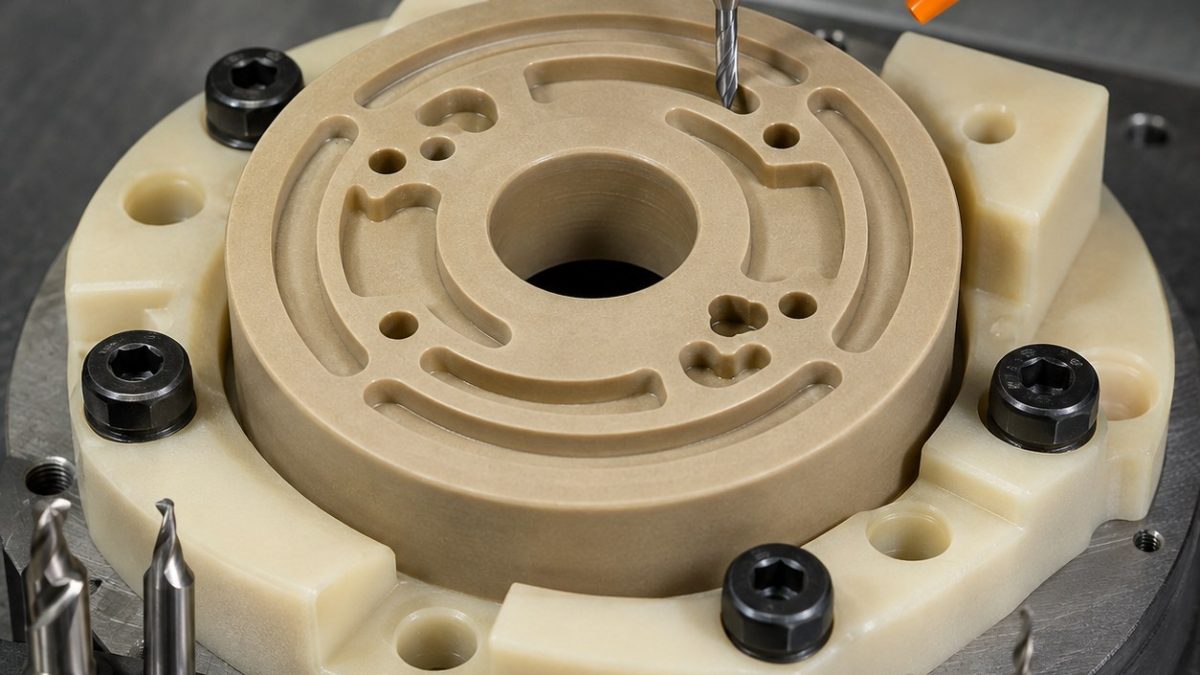
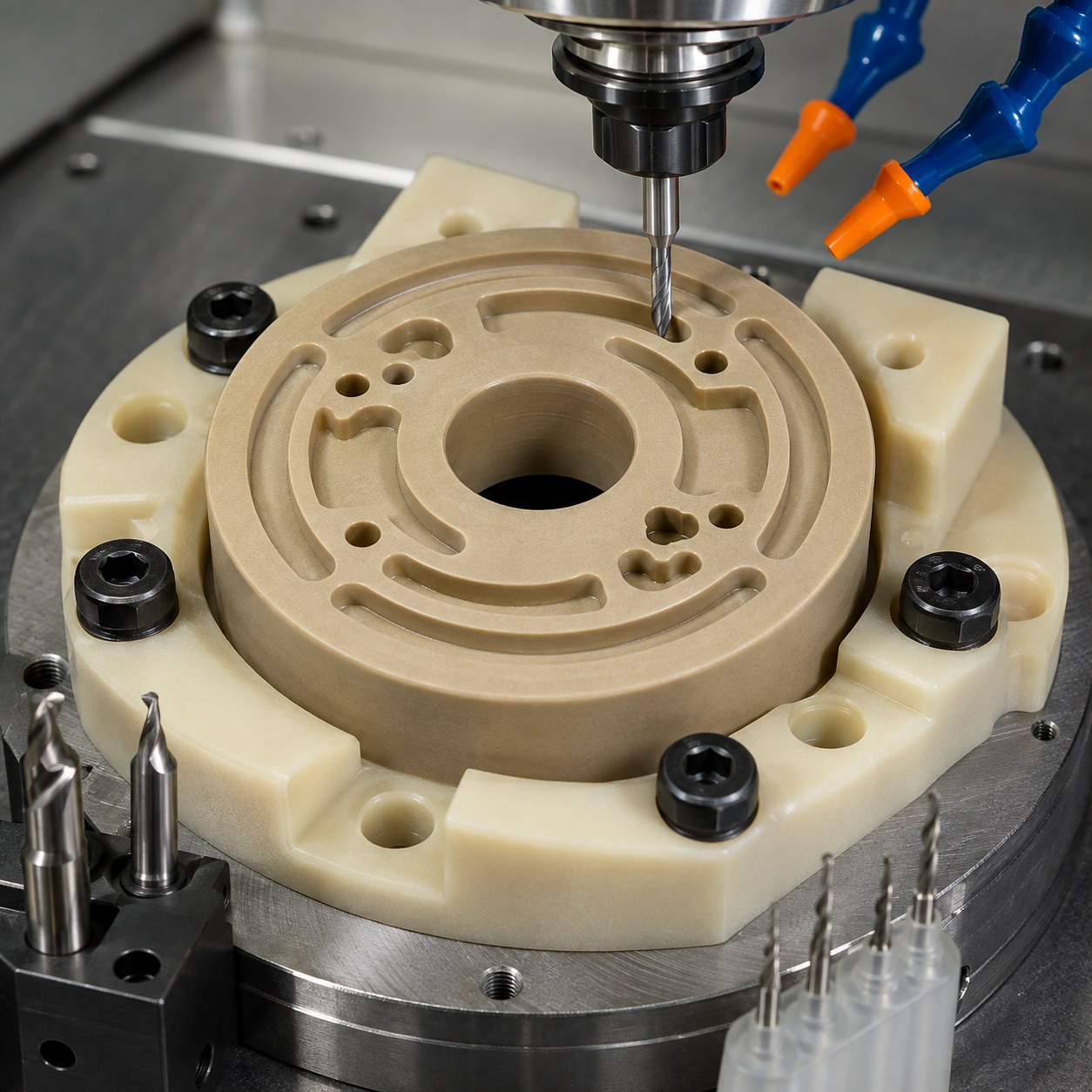
The useful search intent here is practical PEEK-GF30 tool selection for a valve rotor where seal lands must stay flat and glass fibers cannot bridge a metering slot. The drawing is interpreted by function: sealing, dosing, port transfer and free-state roundness.
Drawing zones and tool decisions
| Feature on the drawing | Selected tool package | Reason and rejected alternative |
|---|---|---|
| Hub bore | Sharp single-flute boring tool with polished carbide insert | Keeps roundness under low clamp force; interpolation with a dull tool would heat the polymer. |
| Radial seal lands | 6 mm single-flute polished carbide, uncoated, air assist | Maintains flat sealing bands without smearing glass-filled PEEK. |
| Curved metering slots | 2.5 mm two-flute polished necked end mill, high-accuracy collet | Reaches curved slots while keeping chip space and low side force. |
| Cross ports | Carbide micro drill over sacrificial PEEK support | Prevents exit fiber breakout into the metering slot. |
| Edge break | Single-flute 90-degree chamfer tool plus soft brushing | Removes fibers without rounding the seal land. |
Machining sequence and fixture logic
Use a soft nest that supports the ring and hub separately. Bore the hub first, mill seal lands with light axial stock, open metering slots in balanced angular order, then drill cross ports into backed cavities. Edge break follows inspection, not before, so a burr is not hidden by over-rounding.
Material-specific chip, burr and tool-life controls
Glass-filled PEEK cuts hotter than unfilled PEEK and leaves springy fibers. Use sharp polished tools, air assist and short engagement. Stop when fiber whiskers lengthen or seal-land gloss changes; do not solve fuzz by pressing a dull chamfer tool harder.
Inspection plan tied to the tolerance stack
Inspect hub roundness, seal-land flatness, metering-slot width, cross-port openness and free-state rocking. A low-pressure air-flow check catches fibers that a CMM cannot see.
FAQ
Why use uncoated polished carbide on PEEK-GF30?
A sharp low-friction edge cuts fibers with less heat than a thick coated edge.
Can the seal land be hand deburred?
Only outside the sealing track; hand work on the land risks leakage.
Why drill ports after slots?
The slot geometry gives a supported breakout target and makes fiber inspection easier.
中文: PEEK-GF30旋转阀转子密封面与计量弧槽配刀
这个搜索意图是PEEK-GF30阀转子实用配刀:密封面要平,玻纤不能跨到计量槽里。图纸按功能分为密封、计量、端口转换和自由状态圆度。
图纸区域与配刀决策
| 图纸特征 | 选定刀具组合 | 选择理由与淘汰方案 |
|---|---|---|
| 轮毂孔 | 单刃抛光硬质合金镗刀,锋利刃口 | 低夹紧力下保持圆度;钝刀插补会加热聚合物。 |
| 径向密封面 | 6 mm单刃未涂层抛光刀,空气辅助 | 保持密封带平面,不涂抹玻纤PEEK。 |
| 计量弧槽 | 2.5 mm两刃抛光缩颈刀,高精度夹头 | 兼顾弧槽伸入、排屑和低侧向力。 |
| 交叉小孔 | 硬质合金微钻配PEEK牺牲支撑 | 避免出口玻纤毛刺进入计量槽。 |
| 边缘处理 | 单刃90度倒角刀加软刷 | 去玻纤不圆化密封面。 |
加工顺序与夹具逻辑
软夹具分别支撑外环和轮毂。先镗轮毂孔,再轻切密封面,计量弧槽按角度平衡顺序开槽,然后在背衬支撑下钻交叉孔。倒边放在检测后,避免过度圆化遮住毛刺。
材料相关排屑、毛刺和寿命控制
玻纤PEEK比纯PEEK更热、更容易留弹性毛丝。使用锋利抛光刀、空气辅助和短接触;纤维长度变长或密封面光泽变化即停刀。
对应公差链的检测方案
检测轮毂圆度、密封面平面度、计量槽宽度、交叉孔通畅和自由状态摇摆;低压气流测试能发现CMM看不到的纤维。
常见问题
为什么PEEK-GF30用未涂层抛光刀?
锋利低摩擦刃比厚涂层刃更少发热,更能切断玻纤。
密封面能手工去毛刺吗?
密封轨迹外可以,密封面本身手修会带来泄漏风险。
为什么先开槽后钻孔?
槽能提供受控出口目标,也方便检查玻纤毛刺。
Español: Herramientas para rotor PEEK-GF30 con tierras de sello
La intención es elegir herramienta para un rotor PEEK-GF30 donde las tierras sellan y las fibras no deben entrar en la ranura dosificadora.
Zonas del plano y decisión de herramienta
| Elemento del plano | Paquete de herramienta elegido | Motivo y alternativa descartada |
|---|---|---|
| Agujero del cubo | Mandrinador de un labio con inserto pulido | Mantiene redondez con baja presión. |
| Tierras de sello | Fresa 6 mm de un labio, pulida y sin recubrimiento | Evita frotamiento y manchas en PEEK con fibra. |
| Ranuras curvas | Fresa 2,5 mm de dos labios con cuello reducido | Aporta alcance y espacio de viruta. |
| Puertos cruzados | Microbroca de carburo sobre respaldo PEEK | Evita fibras en la ranura. |
| Aristas | Chaflanador mono-labio y cepillado suave | Quita fibra sin redondear sello. |
Secuencia de mecanizado y sujeción
Usar nido blando, mandrinar cubo, acabar tierras, abrir ranuras en orden angular equilibrado y taladrar puertos con respaldo. El chaflán se hace después de inspeccionar.
Viruta, rebaba y vida según material
PEEK-GF30 deja fibras elásticas. Herramientas pulidas, aire y contacto corto; parar por brillo de sello o fibras largas.
Inspección conectada a tolerancias
Medir redondez, planitud de sello, ancho de ranura, apertura de puertos y estado libre. Flujo de aire bajo detecta fibras.
Preguntas frecuentes
¿Por qué carburo pulido sin recubrimiento?
Corta fibras con menos calor.
¿Desbarbado manual?
No sobre la tierra de sello.
¿Por qué puertos después?
La ranura da salida controlada.
Français: Outils pour rotor PEEK-GF30 à portées d’étanchéité
L’objectif est de choisir les outils pour un rotor PEEK-GF30 dont les portées doivent rester planes et sans fibre dans les rainures.
Zones du plan et choix d’outils
| Élément du plan | Ensemble d’outils retenu | Raison et option écartée |
|---|---|---|
| Alésage central | Outil d’alésage mono-dent à insert poli | Tient la rondeur avec faible serrage. |
| Portées de joint | Fraise polie 6 mm mono-dent sans revêtement | Évite frottement et échauffement du PEEK chargé. |
| Rainures courbes | Fraise 2,5 mm à 2 dents et col réduit | Donne accès et espace copeau. |
| Trous croisés | Micro-foret carbure sur martyr PEEK | Évite la fibre de sortie. |
| Arêtes | Chanfreineur mono-dent et brossage doux | Retire les fibres sans arrondir le joint. |
Séquence d’usinage et logique de montage
Nid souple, alésage central, finition des portées, rainures en ordre angulaire équilibré puis trous croisés sur martyr. Chanfrein après contrôle.
Copeaux, bavures et durée de vie selon matière
PEEK-GF30 chauffe et laisse des fibres. Outils polis, air et engagement court; arrêt si fibres ou brillance changent.
Contrôle lié aux tolérances
Contrôle rondeur, planéité, largeur, ouverture des ports et état libre; essai d’air basse pression.
Questions fréquentes
Pourquoi carbure poli non revêtu ?
Il coupe les fibres avec moins de chaleur.
Ébavurage manuel ?
Pas sur la portée de joint.
Pourquoi percer après rainure ?
La rainure donne une sortie contrôlée.
Русский: Инструмент для ротора клапана PEEK-GF30
Цель — инструмент для ротора PEEK-GF30: пояски должны уплотнять, а волокна не должны попадать в дозирующие канавки.
Зоны чертежа и выбор инструмента
| Элемент чертежа | Выбранный инструмент | Причина и отклоненная замена |
|---|---|---|
| Ступичное отверстие | Однозубый расточной инструмент с полированной пластиной | Круглость при малом зажиме. |
| Уплотнительные пояски | 6 мм однозубая полированная фреза без покрытия | Нет размазывания PEEK-GF30. |
| Дозирующие канавки | 2,5 мм двухзубая фреза с шейкой | Доступ и место для стружки. |
| Поперечные порты | Карбидное микросверло на подкладке PEEK | Нет волокон на выходе. |
| Кромки | Однозубая фасочная фреза и мягкая щетка | Убирает волокно без скругления. |
Последовательность и базирование
Мягкое ложе, расточка ступицы, чистовая поясков, канавки в сбалансированном угловом порядке, затем поперечные отверстия на подкладке.
Стружка, заусенцы и ресурс
PEEK-GF30 нагревается и оставляет волокна. Полированные острые инструменты, воздух и малый контакт.
Контроль по цепи допусков
Контроль круглости, плоскостности, ширины канавок, открытости портов и свободного состояния; низкое давление воздуха выявляет волокна.
Вопросы
Почему полированный карбид без покрытия?
Он режет волокна с меньшим теплом.
Можно вручную снимать заусенцы?
Не на уплотнительном пояске.
Почему порты после канавок?
Канавка дает контролируемый выход.