English: Monel K-500 Closed Impeller CNC Case: Five-Axis Vane Passages and Tool-Life Control
Direct answer: a Monel K-500 closed impeller needs a hub-first datum scheme, collision-proven five-axis access, constant chip thickness and staged vane finishing; dwelling or rubbing work-hardens the nickel-copper alloy and destroys both tool life and blend quality. This hypothetical case centers on accessibility and load continuity.
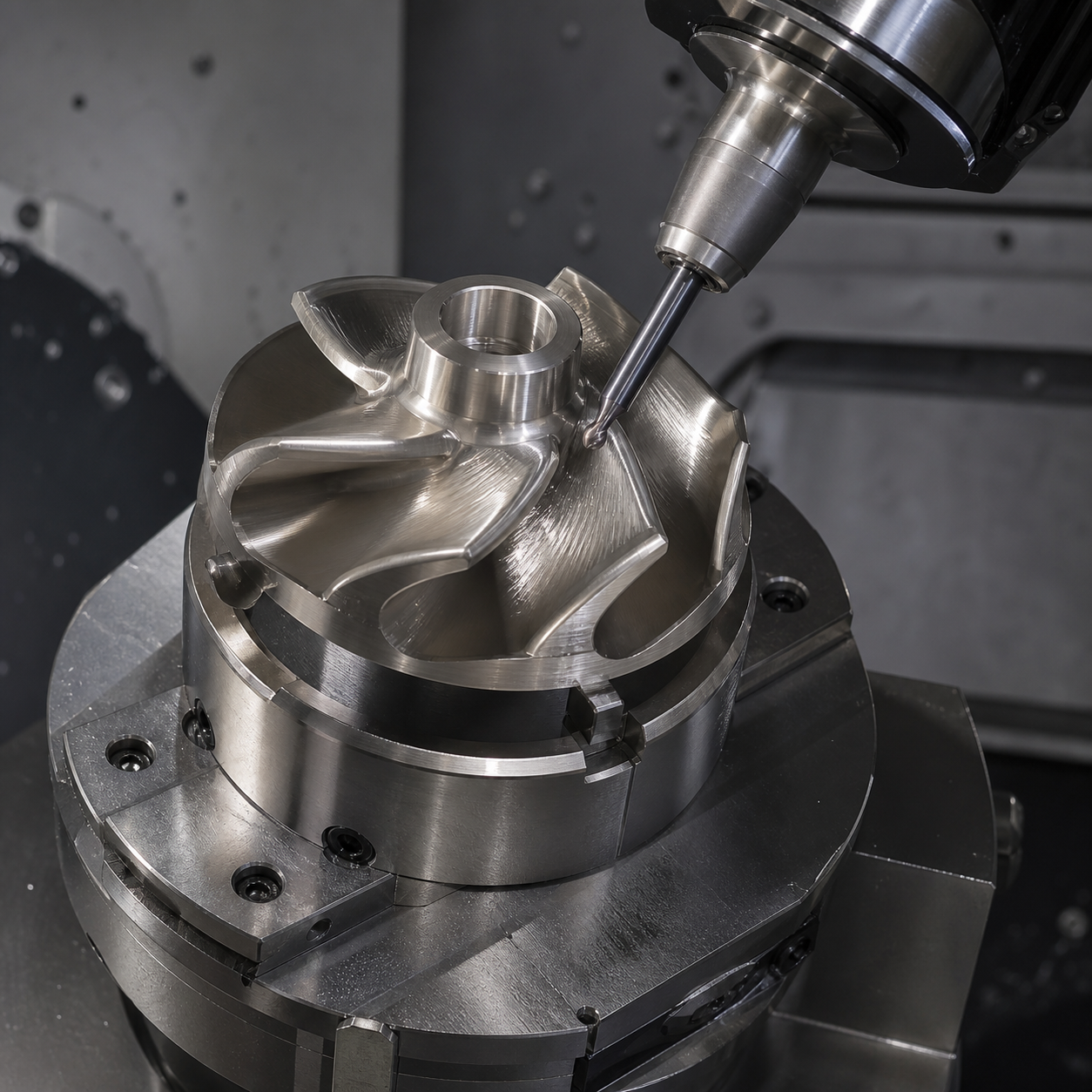
Can the drawing actually be cut?
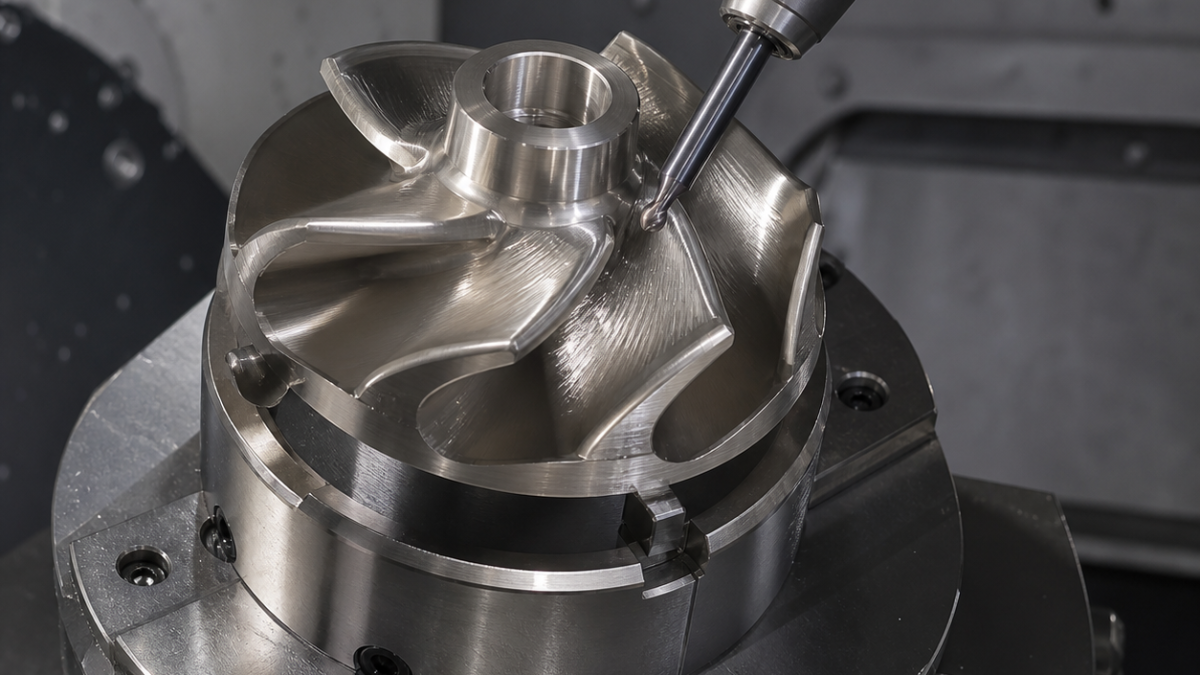
The Ø148 mm impeller has seven swept passages, a Ø32 H6 bore, 0.8 mm trailing edges, 0.04 mm bore-to-shroud runout, profile 0.08 mm and Ra 1.6 µm on wetted surfaces. A is the bore axis, B the rear hub face and C one balance index. Before stock is ordered, section views are checked for minimum cutter diameter, holder clearance and probe visibility. The shroud opening, not nominal vane spacing, sets the reachable tool envelope.
A load map chooses the carbide
A tough PVD-coated carbide insert roughs the forged skin; positive high-helix solid-carbide barrel and tapered ball tools finish the passages. Variable pitch limits harmonics, while through-tool high-pressure coolant reaches the blind side. Tools are grouped by effective cutting radius because five-axis contact point changes surface speed. No tool is allowed to dwell at the leading edge.
Fixture and process follow the bore
Soft jaws first create B and a semi-finished bore. A dual-contact expanding arbor then locates the bore and supports the hub face without squeezing the shroud. A balance index pin preserves C. Plunge roughing opens every second passage, then the remaining passages, leaving 0.7 mm on vanes and 0.4 mm on hub/shroud. This alternating pattern distributes force. Five-axis morphing passes keep engagement constant and direct coolant through the exit.
Finishing without witness bands
Vanes are semi-finished from hub to shroud and inspected for springback. A barrel cutter finishes broad surfaces; a tapered ball tool blends fillets with overlap placed outside the highest-flow zone. Tool-axis smoothing prevents rotary reversals that would mark the surface. Trailing edges are brought to 0.8 mm only after both adjacent passages are stable. Burrs are removed with programmed low-force edge passes, not freehand grinding.
Work hardening, balance and inspection
Rising torque, blue-grey rubbing or a widening blend band triggers an insert check. Feed stays engaged through corners, and interrupted re-entry uses a prepared lead. A CMM on a rotary table reconstructs A-B-C and scans vane profile, throat area and runout. Bore H6 is air-gauged at three depths; roughness is sampled along flow direction. A low-speed balance check identifies material correction zones, but final high-speed acceptance belongs to the specified downstream process.
FAQ
Why does Monel K-500 shorten carbide tool life?
High toughness, heat retention and work hardening punish rubbing; positive geometry, coolant delivery and continuous chip formation are essential.
Which five-axis toolpath suits closed impeller vanes?
A collision-checked morphing path with smoothed tool axis and controlled engagement suits this geometry.
How are impeller passages inspected?
Scan vane profile and throat area from the functional bore datum, then correlate with runout, roughness and balance data.
Related: nickel-alloy cutting risk and indexed bore-axis control.
中文: Monel K-500闭式叶轮加工:五轴叶道与刀寿命控制
先给结论:Monel K-500闭式叶轮应以内孔和后端面建立功能基准,先验证五轴刀具与刀柄可达性,再用恒定切屑厚度分阶段加工叶片;停顿和擦削会加工硬化,迅速恶化刀寿命与接刀纹。本案例为独立假设。
先验证图纸可加工性
叶轮Ø148 mm、七条弯曲叶道、内孔Ø32 H6、尾缘0.8 mm;孔轴对盖板跳动0.04 mm,叶型轮廓度0.08 mm,过流面Ra 1.6 µm。A为孔轴,B为后端面,C为平衡索引。截面需核对最小刀径、刀柄避让和测头视线,实际瓶颈是盖板开口。
刀具负载和夹具共同设计
韧性PVD涂层硬质合金刀片先去锻皮,正前角变螺旋整体硬质合金桶形刀和锥形球刀精叶道;内冷高压切削液必须到达盲侧。软爪先加工B和半精孔,再用双接触胀轴以内孔定位、端面承托轮毂,避免夹紧盖板。
交错开粗和无痕精加工
先开每隔一条的叶道,再加工其余叶道,叶片留0.7 mm、轮毂和盖板留0.4 mm。五轴渐变刀路保持接触负载并把冷却液导向出口。半精后测回弹;桶形刀精大面,锥球刀清根,重叠区避开高流速区。旋转轴平滑化避免换向停痕,尾缘在两侧稳定后才做到0.8 mm。
加工硬化与检验
扭矩上升、蓝灰擦痕或接刀带变宽都要求检查刀刃。转角保持有效进给,重新切入使用预设引入。转台三坐标从A-B-C扫描叶型、喉部面积和跳动;内孔在三处气测,粗糙度沿流向取样。低速平衡只确定修正区,最终高速验收遵循后续规范。
常见问题
Monel K-500为何伤刀?
韧性、积热和加工硬化会放大擦削,需正前角、稳定切屑和有效内冷。
闭式叶轮适合什么刀路?
本案例采用经防碰撞验证、刀轴平滑且吃刀稳定的五轴渐变刀路。
叶道怎么检测?
以内孔功能基准扫描叶型和喉部面积,再关联跳动、粗糙度和平衡数据。
Français: Roue fermée Monel K-500 : canaux cinq axes et durée d’outil
Réponse directe : cette roue exige des références construites depuis l’alésage, une accessibilité cinq axes prouvée, une épaisseur de copeau constante et une finition progressive. Le frottement écrouit le Monel K-500 et dégrade outil et raccord.
Accessibilité du plan
La roue Ø148 mm comporte sept canaux, un alésage Ø32 H6 et des bords de fuite de 0,8 mm. Le faux-rond vaut 0,04 mm, le profil 0,08 mm et les surfaces mouillées Ra 1,6 µm. A est l’axe, B la face arrière, C l’index d’équilibrage. L’ouverture du flasque commande le diamètre et le dégagement du porte-outil.
Carbure, montage et ébauche
Une plaquette carbure PVD tenace enlève la peau; des fraises tonneau et coniques carbure positives finissent sous arrosage interne. Des mors doux créent B et l’avant-alésage, puis un mandrin expansible soutient le moyeu. L’ébauche ouvre un canal sur deux, puis les autres, avec 0,7 mm sur aubes et 0,4 mm sur moyeu-flasque.
Finition et contrôle
Les trajectoires morphées stabilisent l’engagement. Une fraise tonneau couvre les grandes surfaces et une boule conique raccorde les congés hors de la zone de débit maximal. Les axes rotatifs sont lissés; le bord de fuite vient en dernier. La MMT rotative scanne profil, section de gorge et faux-rond depuis A-B-C; l’alésage est mesuré pneumatiquement et la rugosité suivant l’écoulement.
FAQ
Pourquoi le K-500 use-t-il le carbure ?
Ténacité, chaleur et écrouissage sanctionnent tout frottement.
Quelle trajectoire cinq axes ?
Une trajectoire morphée, anticollision, à axe lissé et engagement régulier.
Comment contrôler les canaux ?
Scanner profil et gorge depuis l’alésage, puis rapprocher rugosité et équilibrage.
Voir l’usinage des alliages nickel et le contrôle d’axe indexé.
Русский: Закрытое колесо K-500: пятиосевые каналы и ресурс
Краткий ответ: закрытое колесо Monel K-500 требует базирования от отверстия, доказанного доступа пяти осей, постоянной толщины стружки и поэтапной чистовой обработки. Трение наклёпывает сплав и портит сопряжения.
Проверка доступности
Диаметр 148 мм, семь каналов, отверстие Ø32 H6, выходная кромка 0,8 мм. Биение 0,04 мм, профиль 0,08 мм, Ra 1,6 мкм. A — ось, B — задний торец, C — индекс балансировки. Размер входа в канал определяет фрезу и оправку.
Твёрдый сплав и установка
Прочная PVD-пластина снимает корку; позитивные твердосплавные бочковые и конические шаровые фрезы работают с внутренней подачей жидкости. Мягкие кулачки создают B и полуотверстие, затем разжимная оправка опирает ступицу. Сначала открывают каналы через один, оставляя 0,7 мм на лопатках и 0,4 мм на дисках.
Чистовая обработка и приёмка
Морфированные проходы удерживают нагрузку. Бочковая фреза заканчивает поверхности, шаровая — галтели; оси сглаживают, кромку доводят последней. КИМ сканирует профиль, горловину и биение от A-B-C; H6 проверяют в трёх сечениях, шероховатость — вдоль потока.
Вопросы
Почему K-500 изнашивает фрезу?
Вязкость, тепло и наклёп усиливают последствия трения.
Какой пятиосевой путь нужен?
Проверенный на столкновения морфированный путь с плавной осью.
Как измерять каналы?
Сканировать профиль и горловину от рабочего отверстия и сопоставлять с балансом.
Смотрите риски никелевых сплавов и индексированную ось.