Related tooling references: Polycarbonate Optical Light Pipe CNC Tool Selection for Polished V-Grooves and Snap Tabs and Monel K-500 Marine Clevis CNC Tool Selection for Fork Slot, Pin Bore and Fillet Relief.
English: Maraging 300 Latch Hook Tooling for Thin Profile and Pivot Bore
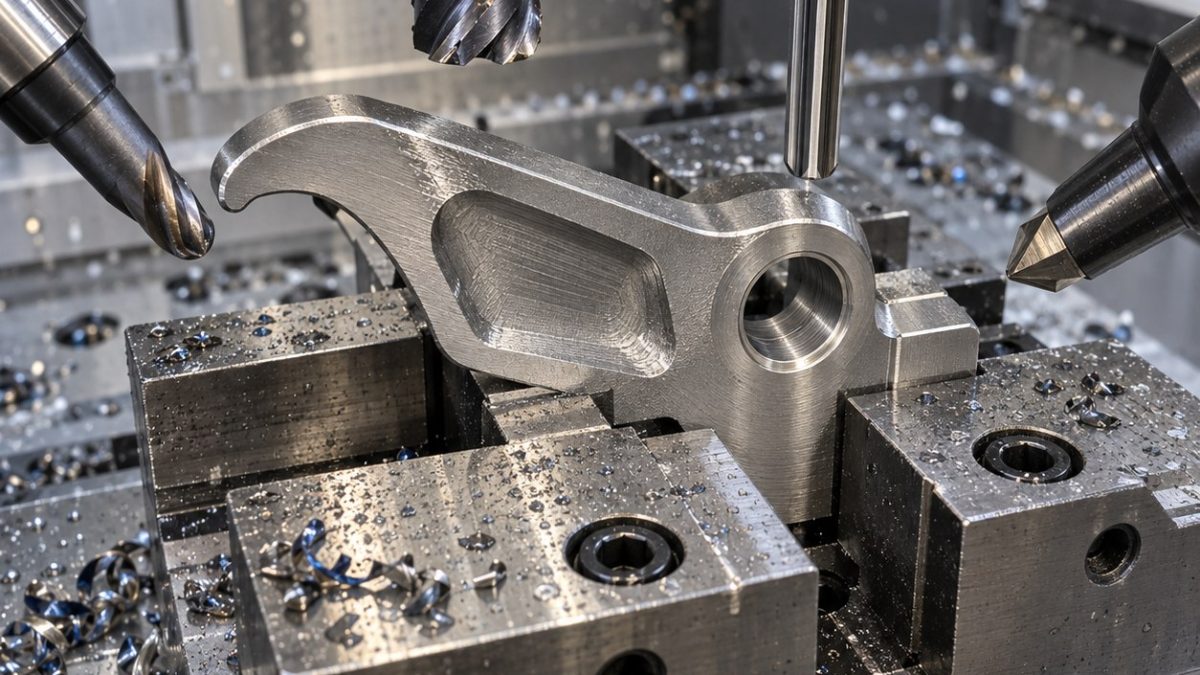
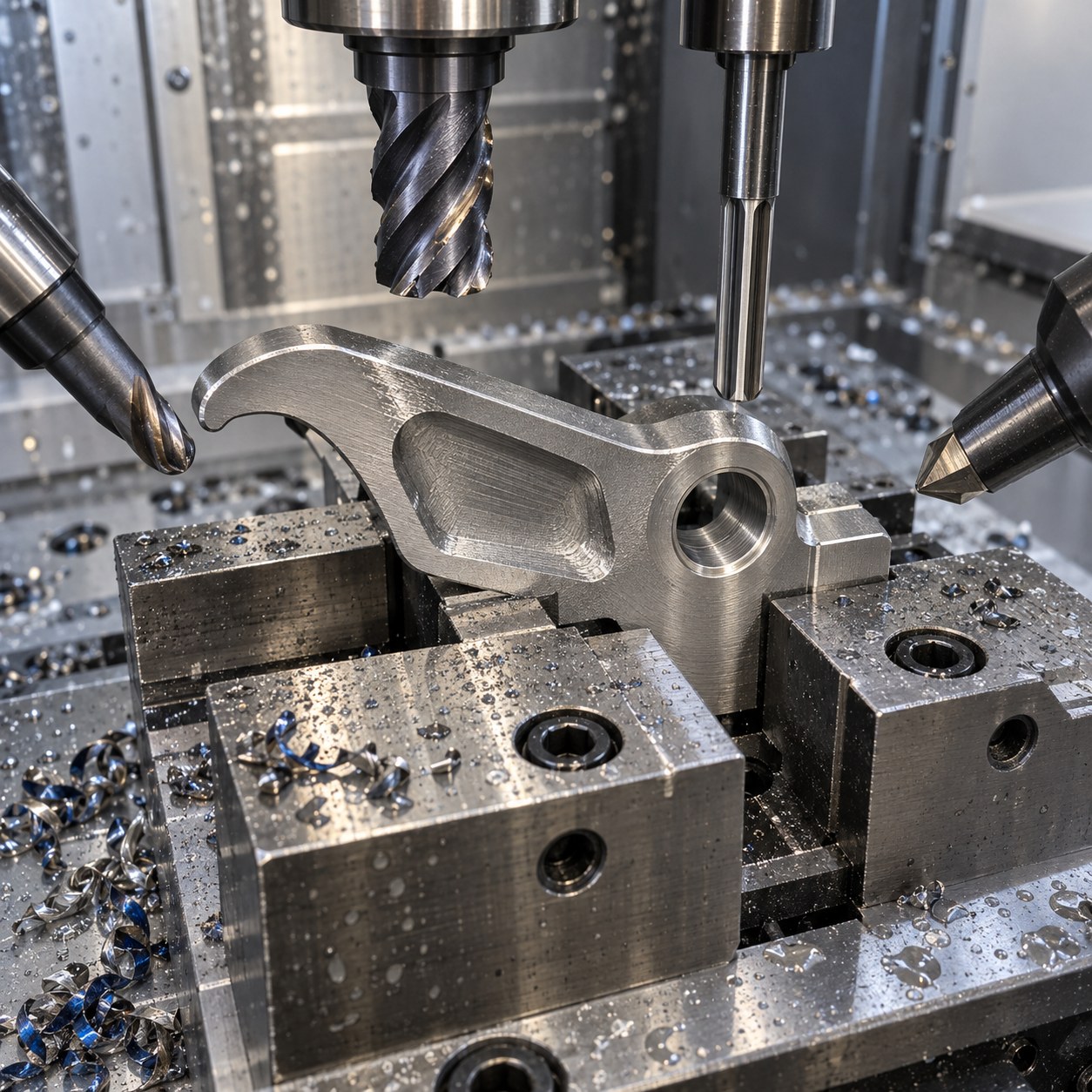
This latch-hook case is about Maraging 300 tool selection where a thin load hook, pivot bore and stop face all move differently through aging. The drawing is read around latch timing, not around the largest stock-removal feature.
Latch-hook geometry converted to tools
| Functional area | Chosen cutter or hole tool | Why another path is avoided |
|---|---|---|
| Thin hook nose | 6 mm high-feed carbide rougher then 3 mm finishing end mill | Leaves stock until pivot bore is stable; full-depth profile finishing is rejected. |
| Pivot bore | Carbide drill, semi-bore, machine reamer, then hone allowance check | Reaming works only after location is corrected by boring. |
| Stop face | 10 mm sharp corner carbide end mill in rigid collet | Holds latch contact geometry; hand fitting changes release timing. |
| Root radius | 4 mm ball end mill with small stepdown | Protects fatigue strength and avoids EDM recast. |
| Heat-treat datum pads | Face mill witness pads before aging | Gives repeatable comparison after dimensional movement. |
Machine stock before aging distortion
Machine witness datums, rough the hook with a safety stock band, semi-finish the pivot bore, then finish contact areas in a setup that supports the hook throat. After aging, only light bore and stop-face corrections are planned.
Radius finish, bore heat and edge control
Maraging steel rewards sharp carbide before aging but still builds heat at the hook root. Ball finishing uses small stepdown, no dwell at the nose and stable coolant. Reaming is rejected until a boring pass confirms the pivot axis.
Inspection before and after aging
Inspection records the pre-aging datum map, hook profile, stop-face angle and pivot bore size. Final acceptance compares aged movement against the allowed latch engagement window.
Manufacturing FAQ
Why not ream the pivot bore directly?
A reamer follows the existing axis; boring first corrects position before size finishing.
Where is heat-treatment allowance left?
At contact faces and bore stock that can be corrected without changing the hook profile.
Why avoid EDM for the hook root?
The case assumes a machined fatigue radius; EDM recast would need a separate removal allowance.
中文: Maraging 300锁钩薄轮廓与枢轴孔配刀
这个锁钩案例关注Maraging 300配刀:薄承载钩、枢轴孔和止挡面在时效过程中移动不同。读图重点是锁止时序,而不是最大去料区域。
锁钩几何到刀具选择
| 功能区域 | 选定刀具或孔加工刀 | 避开的方案 |
|---|---|---|
| 薄钩头 | 6 mm高进给硬质合金粗刀后接3 mm精刀 | 枢轴孔稳定前保留余量;拒绝一次全深精轮廓。 |
| 枢轴孔 | 硬质合金钻、半精镗、机用铰刀、珩磨余量确认 | 铰孔只在镗削修正位置后才可靠。 |
| 止挡面 | 10 mm锋利方肩硬质合金刀,刚性夹头 | 保持锁止接触;手工修配会改变释放时序。 |
| 根部圆角 | 4 mm球刀小步距 | 保护疲劳强度并避免EDM重铸层。 |
| 热处理基准垫 | 时效前面铣见证垫 | 便于时效后比较尺寸漂移。 |
时效变形前的毛坯加工
先加工见证基准,钩形粗加工保留安全余量带,枢轴孔半精加工,然后在支撑钩喉的位置精修接触面。时效后只计划轻量孔和止挡面修正。
圆角精修、孔热量和边缘控制
Maraging钢在时效前适合锋利硬质合金,但钩根仍会积热。球刀精修采用小步距,钩头不允许停顿,冷却稳定;枢轴孔必须先镗正轴线再铰。
时效前后检测
检测记录时效前基准图、钩形轮廓、止挡角度和枢轴孔尺寸。最终验收比较时效后移动量是否仍在锁止啮合窗口内。
制造问答
为什么枢轴孔不能直接铰?
铰刀会跟随已有轴线,必须先镗削修正位置再定尺寸。
热处理余量留在哪里?
留在接触面和孔余量上,便于修正而不改变钩形轮廓。
为什么不用EDM做钩根?
本案例要求机加工疲劳圆角;EDM重铸层还要另留去除余量。
Español: Herramientas para gancho Maraging 300 y agujero pivote
El gancho Maraging 300 se lee por sincronía de cierre: perfil delgado, pivote y cara de tope se mueven con el envejecido.
Geometría de gancho convertida en herramientas
| Zona funcional | Herramienta elegida | Camino evitado |
|---|---|---|
| Nariz del gancho | Desbaste alto avance 6 mm y acabado 3 mm | Conserva stock hasta estabilizar pivote. |
| Agujero pivote | Broca, semi-mandrinado, escariador y control de hone | El escariado sigue una posición ya corregida. |
| Cara de tope | Fresa de esquina 10 mm | Evita ajuste manual variable. |
| Radio raíz | Bola 4 mm con paso pequeño | Protege fatiga. |
| Pads datum | Planeado testigo antes de envejecido | Compara movimiento posterior. |
Mecanizado antes del envejecido
Se hacen datums testigo, se deja banda de stock en el gancho, se semiacaba el pivote y se terminan contactos con la garganta soportada.
Radio, calor de agujero y arista
Antes del envejecido el carburo afilado funciona, pero la raíz calienta. La bola no debe detenerse y el escariador espera a que el mandrinado confirme eje.
Control antes y después
Se registra mapa previo, perfil, ángulo de tope y agujero. La aceptación compara movimiento envejecido con ventana de enganche.
FAQ de fabricación
¿Por qué no escariar directo?
El escariador sigue el eje existente.
¿Dónde dejar sobremetal?
En caras de contacto y bore corregible.
¿Por qué no EDM?
El recast exige otra remoción.
Français: Outils pour crochet Maraging 300 et alésage pivot
Le crochet Maraging 300 se lit par la cinématique de verrouillage: profil fin, pivot et butée bougent au vieillissement.
Géométrie du crochet vers les outils
| Zone utile | Outil retenu | Option évitée |
|---|---|---|
| Bec du crochet | Ébauche haut avance 6 mm puis finition 3 mm | Garde du stock avant pivot. |
| Alésage pivot | Foret, semi-alésage, alésoir et marge de rodage | L’alésoir suit une position corrigée. |
| Butée | Fraise angle vif 10 mm | Évite l’ajustage manuel. |
| Rayon racine | Boule 4 mm petit pas | Protège fatigue. |
| Plots datum | Surfaçage témoin avant vieillissement | Mesure le déplacement. |
Usiner avant vieillissement
On usine des témoins, on garde du stock au crochet, on semi-finit le pivot puis les contacts avec gorge supportée.
Rayon, chaleur d’alésage et arête
Avant vieillissement, le carbure affûté convient mais la racine chauffe. La boule travaille sans arrêt et l’alésoir attend l’axe corrigé.
Contrôle avant et après
Contrôle du plan avant vieillissement, profil, angle de butée et alésage. L’acceptation compare le déplacement à la fenêtre d’engagement.
FAQ fabrication
Pourquoi pas aléser direct ?
L’alésoir suit l’axe existant.
Où laisser du stock ?
Contacts et alésage corrigeable.
Pourquoi éviter EDM ?
La recouche doit être retirée.
Русский: Инструмент для крюка Maraging 300
Крюк Maraging 300 читают через работу замка: тонкий профиль, отверстие оси и упор движутся при старении.
Геометрия крюка и выбор инструмента
| Зона | Инструмент | Что отклонено |
|---|---|---|
| Носик крюка | Высокоподачная 6 мм и чистовая 3 мм | Оставляет припуск до стабильного отверстия. |
| Ось pivот | Сверло, расточка, развертка и припуск на доводку | Развертка идет после коррекции. |
| Упор | Острая фреза 10 мм | Без ручной подгонки. |
| Корневой радиус | Шаровая 4 мм малый шаг | Защита от усталости. |
| Базовые площадки | Свидетельные площадки до старения | Сравнение после движения. |
Обработка до старения
Делают базовые свидетели, оставляют припуск на крюке, получистят ось и чистят контакты при поддержке горла.
Радиус, тепло отверстия и кромка
До старения острый карбид эффективен, но корень греется. Шаровая идет без остановок, развертка только после расточки оси.
Контроль до и после старения
Фиксируют карту до старения, профиль, угол упора и отверстие. Приемка сравнивает движение с окном зацепления.
Вопросы
Почему не развертка сразу?
Она повторяет старую ось.
Где оставить припуск?
На контактах и отверстии.
Почему не EDM?
Нужен съем переплава.