Related tooling references: Polycarbonate Optical Light Pipe CNC Tool Selection for Polished V-Grooves and Snap Tabs and Monel K-500 Marine Clevis CNC Tool Selection for Fork Slot, Pin Bore and Fillet Relief.
English: 17-4PH Drone Motor Mount Tooling for Thin Webs and Cooling Slots
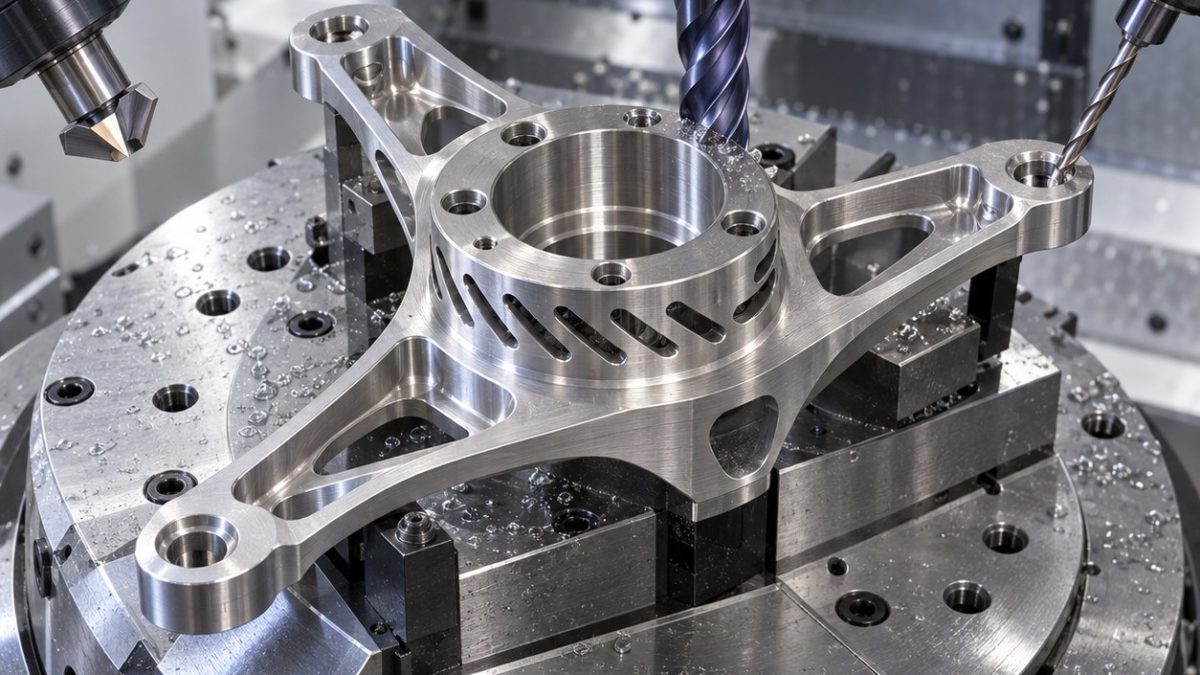
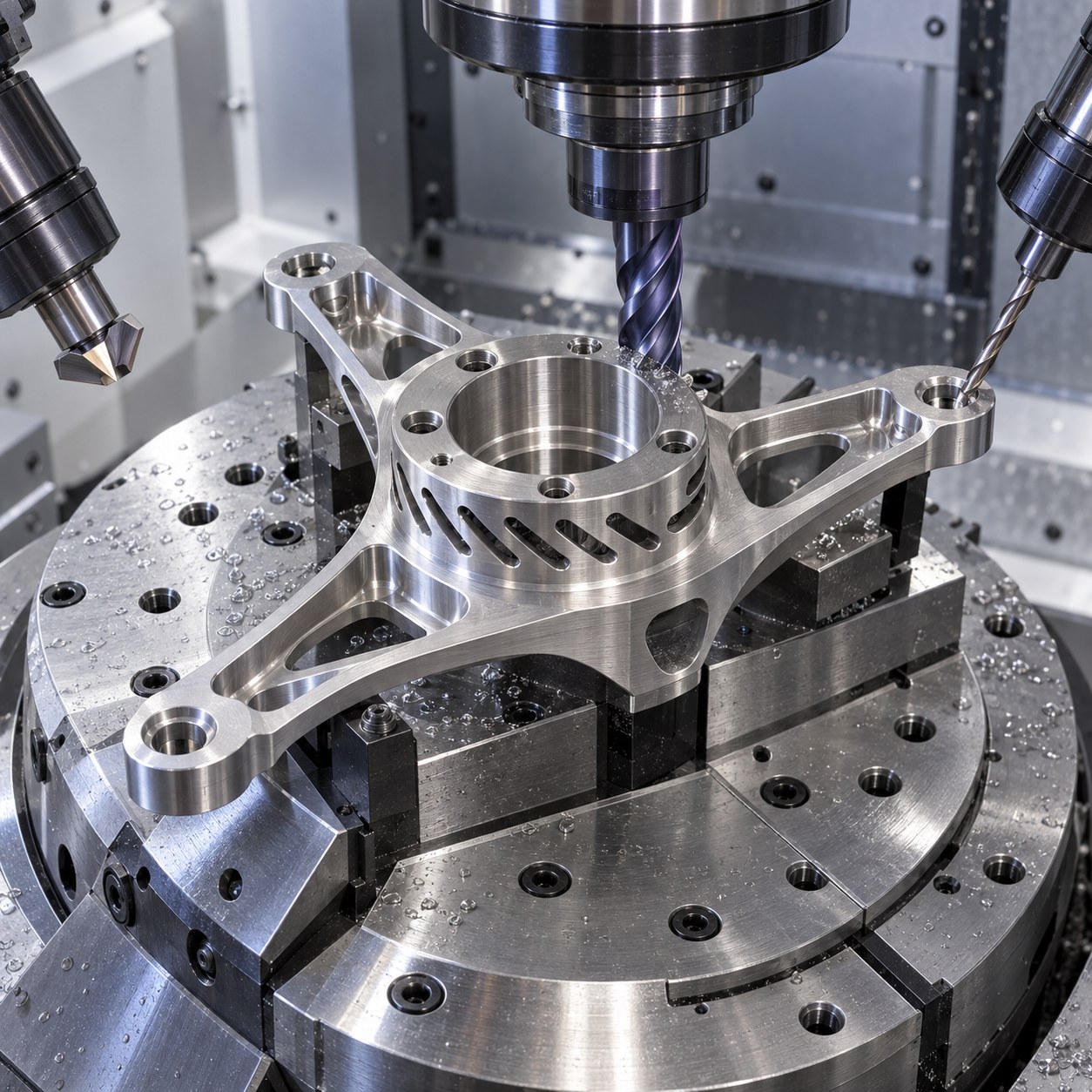
This motor-mount case targets a long-tail production question: how to select carbide tools when a 17-4PH drawing combines a flat motor boss, thin web arms and curved cooling slots. The part is small, but the tool decision is governed by stiffness loss after pocketing.
Thin-web drawing features into stable tool choices
| Drawing callout | Tool and holder | Decision tradeoff |
|---|---|---|
| Motor boss top face | 40 mm positive carbide face mill, TiAlN, hydraulic arbor | Finishes flatness before web thinning; a heavy negative mill would push the arms. |
| Thin web pockets | 8 mm variable-pitch carbide rougher, 5 flute, corner radius | Keeps engagement smooth; a two-flute slotting pass leaves chatter on webs. |
| Helical cooling slots | 3 mm necked carbide end mill, AlCrN, shrink holder | Reach and stiffness are balanced; wire EDM is rejected for burr direction and setup time. |
| Counterbored screw holes | Carbide drill, piloted counterbore and 90° chamfer mill | Separates hole location from seating flatness. |
| Edge weight relief | 4 mm ball end mill, short flute | Blends ribs without thinning the motor boss. |
Balanced roughing before web release
Rough the outside while leaving bridge tabs, finish the motor boss early, then open web pockets in mirrored order. Cooling slots are cut after the arms are semi-supported, and counterbores are finished after final probing so screw seats do not inherit roughing distortion.
17-4PH chatter, burr and tool-life controls
17-4PH chips well only when the edge stays engaged. Light rubbing at slot exit creates burrs and work-hardened lips; the process uses short axial engagement, climb finishing and a tool-life stop based on web chatter marks.
Motor-boss and slot inspection
CMM checks boss flatness, arm height and counterbore position. A pin sweep through the motor bolt circle verifies that cooling-slot burr removal did not bend the webs.
Practical tooling FAQ
Why finish the boss before the thin webs are fully open?
The boss is the motor datum; once the webs are thin, clamp and cutter forces can tilt it.
What limits the 3 mm slot tool life?
Chatter at slot exit and burr growth are more useful than a fixed minutes counter.
Can the cooling slots be deburred by hand?
Only with a supported web and after checking that the bolt circle has not moved.
中文: 17-4PH无人机电机座薄筋与螺旋散热槽配刀
这个电机座案例针对一个长尾问题:17-4PH图纸同时有平面电机凸台、薄筋支臂和弯曲散热槽时,硬质合金刀具怎么选。零件不大,但配刀由开腔后刚性损失决定。
薄筋图纸特征到稳定配刀
| 图纸标注 | 刀具与刀柄 | 取舍逻辑 |
|---|---|---|
| 电机凸台顶面 | 40 mm正前角TiAlN硬质合金面铣刀,液压刀杆 | 薄筋削弱前完成平面度;重负前角刀会推弯支臂。 |
| 薄筋口袋 | 8 mm五刃变齿距圆角硬质合金粗铣刀 | 保持接触平顺;两刃满槽会在薄筋上留下振纹。 |
| 螺旋散热槽 | 3 mm缩颈AlCrN硬质合金刀,热缩刀柄 | 兼顾伸长和刚性;线割因毛刺方向和装夹时间被淘汰。 |
| 沉头螺钉孔 | 硬质合金钻、导向沉孔刀、90度倒角刀 | 把孔位和座面平面度分开控制。 |
| 减重圆角 | 4 mm短刃球刀 | 融合筋位但不削弱中心凸台。 |
薄筋释放前的平衡粗加工
外形先留连接桥,电机凸台早精修,薄筋口袋按镜像顺序打开。散热槽在支臂仍有半支撑时加工,沉孔在最终探测后精修,避免螺钉座继承粗加工变形。
17-4PH振纹、毛刺和寿命控制
17-4PH只有保持真实切削时才稳定。槽出口轻微摩擦会形成毛刺和加工硬化边;流程采用短轴向接触、顺铣精修,并按薄筋振纹趋势换刀。
电机凸台与槽位检测
CMM检测凸台平面度、支臂高度和沉孔位置。电机螺栓圆用销规扫查,确认去散热槽毛刺没有弯曲薄筋。
实用配刀问答
为什么薄筋完全打开前先精修凸台?
凸台是电机基准;薄筋变薄后,夹紧力和切削力都可能使其倾斜。
3 mm槽刀寿命看什么?
槽出口振纹和毛刺增长比固定分钟数更可靠。
散热槽能手工去毛刺吗?
必须支撑薄筋,并确认螺栓圆没有移动后才可以。
Español: Herramientas para soporte de motor 17-4PH con ranuras
Este soporte de motor 17-4PH responde cómo elegir carburo cuando el plano une boss plano, brazos finos y ranuras de enfriamiento. La clave es la pérdida de rigidez tras abrir bolsillos.
Del plano de nervios a herramienta estable
| Cota del plano | Herramienta y porta | Decisión |
|---|---|---|
| Cara del boss | Fresa frontal positiva 40 mm TiAlN | Acaba planitud antes de adelgazar brazos. |
| Bolsillos finos | Fresa carburo 8 mm, 5 labios, paso variable | Reduce vibración frente a ranurado simple. |
| Ranuras helicoidales | Fresa 3 mm con cuello y AlCrN | Equilibra alcance y rigidez. |
| Avellanados | Broca carburo, lamador piloto y chaflán | Separa posición y asiento. |
| Alivios | Bola 4 mm de filo corto | Mezcla radios sin debilitar boss. |
Desbaste equilibrado antes de liberar nervios
Se desbasta dejando puentes, se acaba el boss temprano y los bolsillos se abren en orden espejo. Las ranuras se cortan con soporte parcial y los avellanados tras palpar.
Vibración, rebaba y vida en 17-4PH
17-4PH exige corte real. El roce en salida endurece y forma rebaba; se usa poca profundidad axial, acabado en concordancia y cambio por marcas de vibración.
Inspección del boss y ranuras
MMT para planitud, altura y posiciones. Un barrido con pasador confirma que el desbarbado no dobló nervios.
FAQ práctica
¿Por qué acabar el boss primero?
Es el datum del motor y puede inclinarse cuando los nervios quedan finos.
¿Qué limita la fresa 3 mm?
Vibración y rebaba en salida.
¿Desbarbado manual?
Solo con nervio apoyado y círculo verificado.
Français: Outils pour support moteur 17-4PH à nervures fines
Ce support moteur 17-4PH traite le choix carbure quand le plan combine boss plat, bras fins et rainures de refroidissement. La perte de rigidité après poches guide la gamme.
Du plan de nervures au choix stable
| Cote du plan | Outil et porte-outil | Arbitrage |
|---|---|---|
| Face du boss | Fraise frontale positive 40 mm TiAlN | Finit la planéité avant les bras fins. |
| Poches fines | Fraise carbure 8 mm, 5 dents, pas variable | Limite les vibrations. |
| Rainures hélicoïdales | Fraise 3 mm à col réduit AlCrN | Compromis portée rigidité. |
| Lamages | Foret carbure, lamoir guidé et chanfrein | Sépare position et assise. |
| Allégement | Boule 4 mm courte | Raccorde sans affaiblir. |
Ébauche équilibrée avant libération
On ébauche avec ponts, on finit le boss tôt, puis les poches en miroir. Les rainures sont usinées avec appui partiel et les lamages après palpage.
Vibration, bavure et durée en 17-4PH
Le 17-4PH veut une vraie coupe. Le frottement en sortie écrouit et crée bavure; faible engagement axial, finition en avalant et changement par traces de vibration.
Contrôle boss moteur et rainures
MMT pour planéité, hauteur et positions. Un contrôle au pion confirme que l’ébavurage n’a pas plié les bras.
FAQ pratique
Pourquoi finir le boss tôt ?
C’est le datum moteur; les bras fins peuvent l’incliner.
Limite de l’outil 3 mm ?
Vibration et bavure de sortie.
Ébavurage manuel ?
Avec bras supporté et cercle vérifié.
Русский: Инструмент для кронштейна 17-4PH
Кронштейн 17-4PH требует выбора карбида для плоской бобышки, тонких лучей и пазов охлаждения. Главный фактор — потеря жесткости после карманов.
Тонкие ребра и стабильный инструмент
| Размер чертежа | Инструмент и оправка | Выбор |
|---|---|---|
| Плоскость бобышки | Позитивная фреза 40 мм TiAlN | Чистит плоскость до ослабления лучей. |
| Тонкие карманы | Карбид 8 мм, 5 зубьев, переменный шаг | Снижает вибрацию. |
| Спиральные пазы | Карбид 3 мм с шейкой AlCrN | Баланс вылета и жесткости. |
| Цековки | Карбидное сверло, направленная цековка и фаска | Разделяет позицию и посадку. |
| Облегчение | Шаровая 4 мм короткая | Не ослабляет центр. |
Симметричная черновая до разгрузки
Сначала оставляют перемычки, рано чистят бобышку, затем открывают карманы зеркально. Пазы режут при частичной опоре, цековки после измерения.
Вибрация, заусенцы и ресурс 17-4PH
17-4PH требует настоящей стружки. Трение на выходе дает наклеп и заусенец; применяют малую осевую глубину, попутную чистовую и замену по вибрации.
Контроль бобышки и пазов
КИМ проверяет плоскость, высоту и позиции. Проверка пальцем показывает, не погнуло ли ребра при снятии заусенцев.
Вопросы
Почему бобышку чистят рано?
Это база мотора, тонкие лучи могут ее наклонить.
Что ограничивает фрезу 3 мм?
Вибрация и заусенец на выходе.
Можно снять вручную?
Только при опоре и проверке окружности.