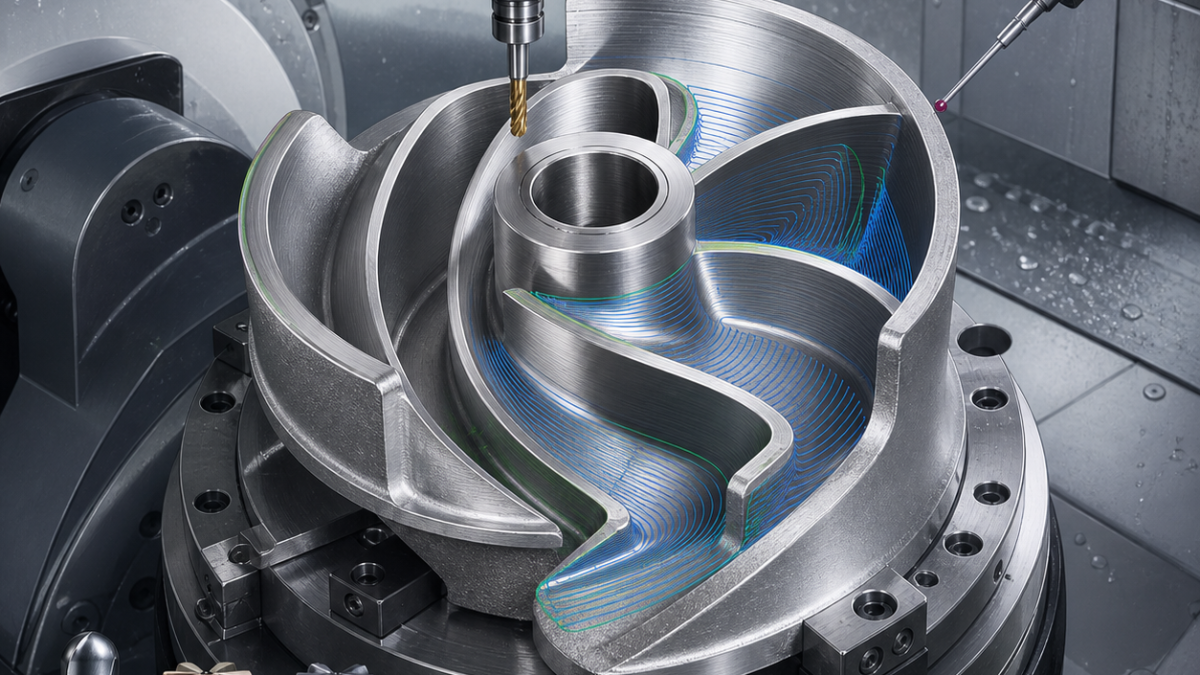
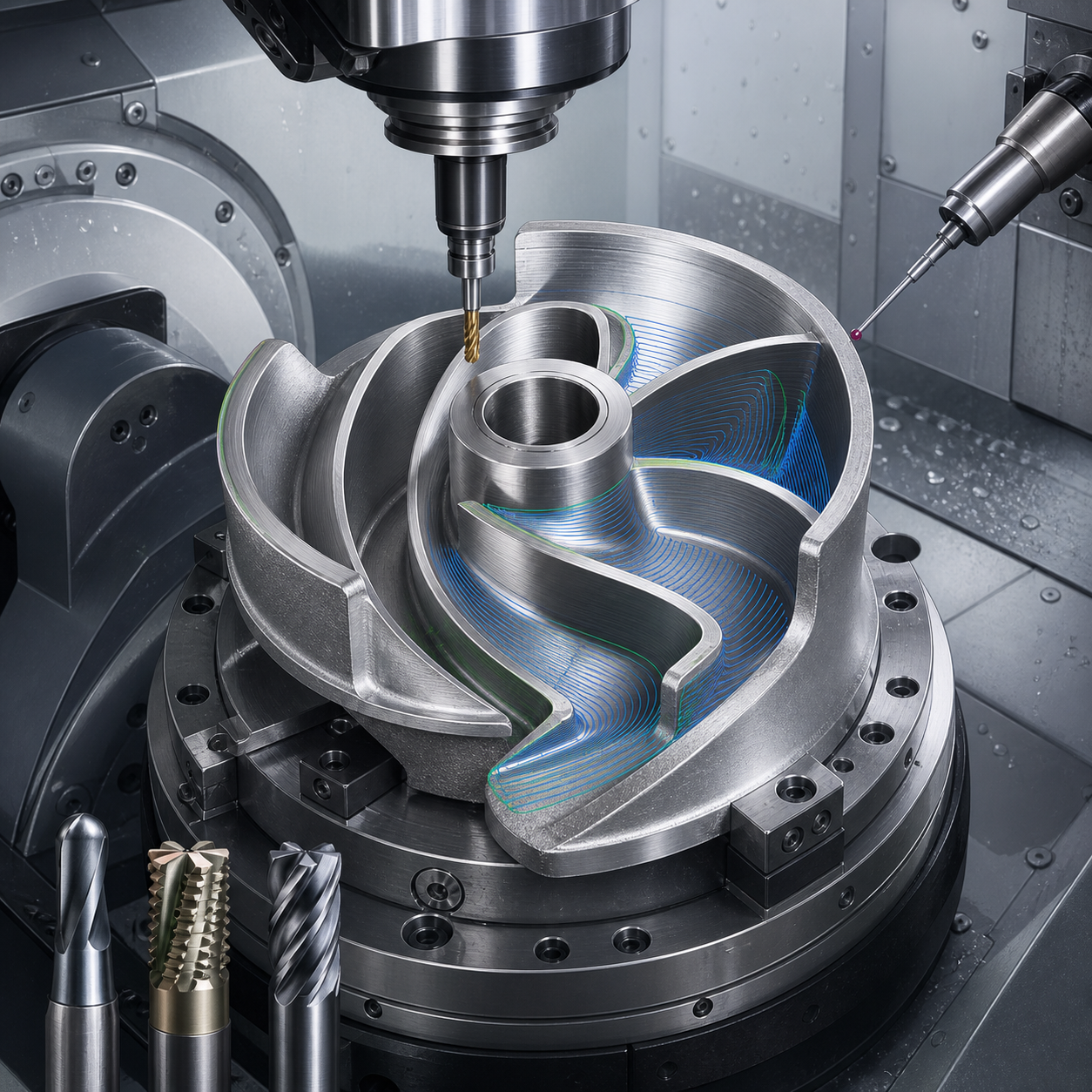
This duplex stainless steel pump impeller five-axis machining case addresses curved blade channels, hub concentricity, thin trailing edges and surface continuity. Duplex grades combine high strength with work-hardening behavior, so a successful process keeps the cutting edge engaged, controls heat and avoids repeated rubbing on semi-finished blades.
Drawing Review and Functional Priorities
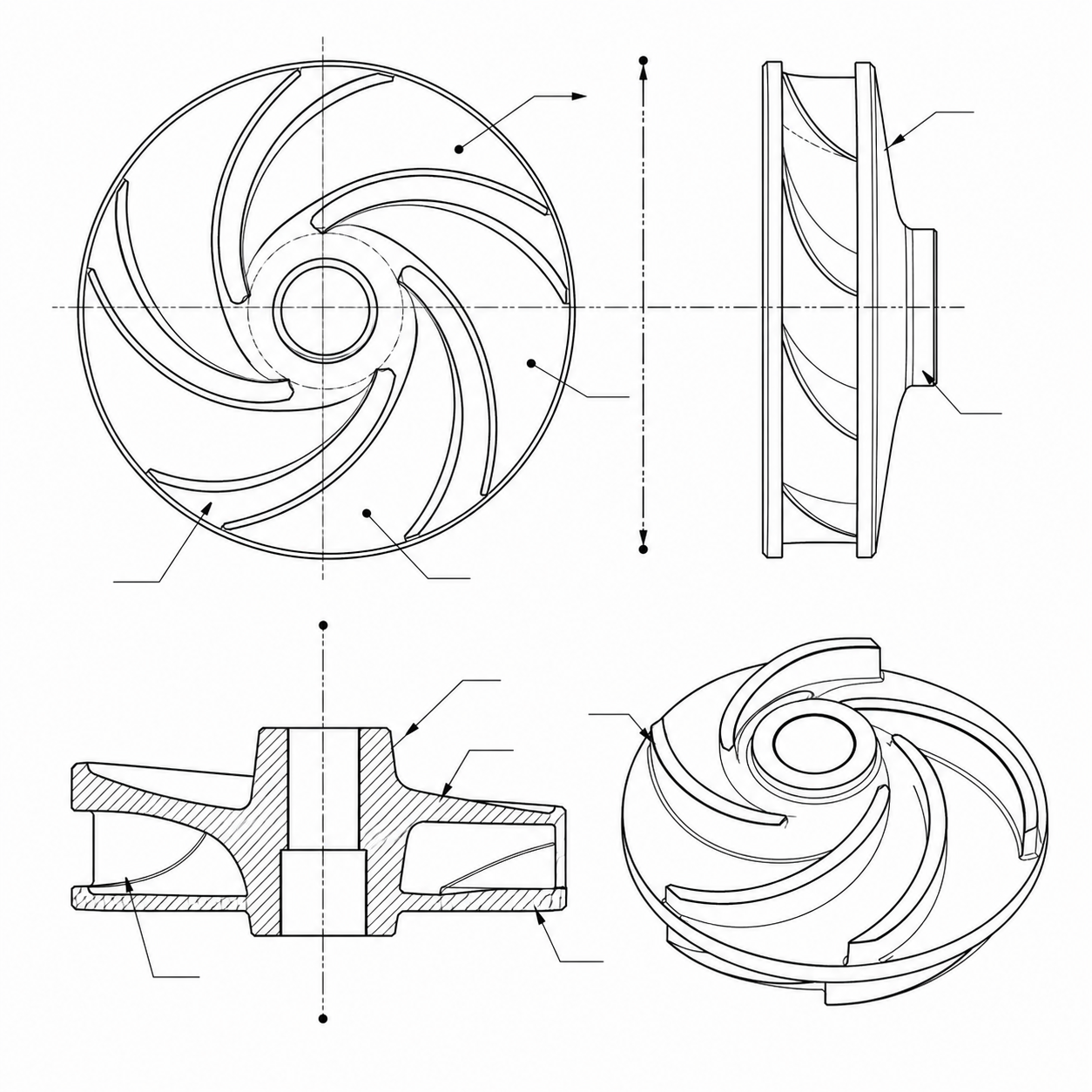
Confirm the material grade, solution-annealed condition and test certificates before cutting. Mark the rotational datum axis, hub bore, mounting face, blade leading/trailing edges, shroud boundaries and surfaces included in dynamic balancing. The flow surfaces may have profile and roughness requirements that are more important than a simple point-to-point dimension.
Workholding and Datum Transfer
Rough the blank with generous axial support and create the hub bore and mounting face as a repeatable datum pair. For blade work, use an expanding mandrel or qualified soft-jaw fixture that locates on these finished references. Probe the hub and face after loading. Keep enough stock or temporary support at blade tips until the channel roughing load has fallen; a thin blade finished too early can deflect and remain permanently twisted.
Five-Axis Tooling Matrix
| Operation | Tool | Key decision |
|---|---|---|
| Channel roughing | Variable-helix carbide end mill or tapered end mill | Constant engagement, short overhang and chip clearance |
| Hub/blade fillets | Tapered ball nose end mill | Rigidity and collision-safe tilt angle |
| Wide blade finishing | Barrel or lens cutter where geometry permits | Large effective radius and controlled scallop height |
| Leading/trailing edges | Small ball nose or lollipop cutter | Tool pressure, edge support and smooth linking |
| Hub bore and face | Fine boring tool and face mill | Concentricity to rotation axis and face runout |
Process Sequence
- Machine the mounting face and hub references; inspect runout before blade work.
- Rough channels in balanced order around the circumference rather than completing adjacent blades sequentially.
- Rest-rough hub fillets and deep regions with a smaller rigid tool.
- Semi-finish all blades with a uniform allowance and common tool-orientation rules.
- Finish pressure and suction surfaces using smooth five-axis motion and constant cusp control.
- Blend leading edges, trailing edges and fillets without dwell marks.
- Inspect profile and surface, deburr, passivate if specified, and perform dynamic balancing.
Cutting Data and Motion Quality
For coated carbide in duplex stainless, a conservative starting cutting-speed region of roughly 45-90 m/min is often more realistic than standard austenitic stainless data. Actual values depend on grade, hardness, tool coating, engagement and coolant. Maintain a positive chip load and avoid dwelling at blade tips. Use high-pressure coolant or accurately aimed flood coolant, and smooth rotary-axis motion so the controller does not create feed collapse at short linear segments.
Common Failure Modes
- Notch wear: vary axial engagement during roughing and avoid repeatedly cutting at one depth line.
- Work hardening: prevent rubbing, excessive runout and feed deceleration at entry.
- Blade deflection: finish in balanced order, retain support and use climb-cut finishing with controlled tool pressure.
- Striped surfaces: improve tool-vector smoothing, postprocessor tolerance and runout; do not hide motion errors with a smaller step-over.
- Balance correction overload: preserve machining symmetry and leave agreed correction zones.
Inspection Plan
Check hub bore, face runout and datum repeatability before scanning blades. Use CMM scanning or optical measurement for blade profile, leading-edge shape and channel consistency. Measure surface roughness in the direction specified by the drawing. Complete liquid-penetrant testing, ferrite/corrosion checks, passivation and dynamic balance only when required by the governing specification.
中文工艺方案
双相不锈钢叶轮加工的核心是五轴运动质量、叶片支撑和控热。先加工轮毂孔与安装端面建立旋转基准,装夹后用探头检查孔轴和端面跳动。叶道粗加工应按圆周均衡顺序进行,避免连续加工相邻叶片造成局部热量和应力集中。
粗加工采用变螺旋硬质合金立铣刀或锥度刀,并使用恒定吃刀量刀路;叶根圆角可用锥度球头刀,宽叶面在空间允许时可用鼓形刀提高效率。所有叶片先统一半精加工并留下均匀余量,再进行压力面、吸力面和前后缘精加工,避免某片叶片过早变薄。
双相不锈钢容易加工硬化和产生沟槽磨损,应保持正切削负载,避免停顿和进给骤降。最终检查包括轮毂同轴度、端面跳动、叶型扫描、表面粗糙度以及图纸要求的无损检测和动平衡。
Résumé français
L’usinage cinq axes d’une roue en acier inoxydable duplex exige un mouvement fluide, un support suffisant des aubes et une évacuation régulière de la chaleur. L’alésage du moyeu et la face de montage forment les références; ils sont palpés avant l’usinage des canaux.
Les canaux sont ébauchés dans un ordre équilibré avec une fraise carbure à hélice variable. Une fraise boule conique termine les raccordements, tandis qu’une fraise tonneau peut réduire le temps sur les grandes surfaces. Toutes les aubes sont semi-finies avant la finition. Le contrôle couvre le profil, le faux-rond, la rugosité et l’équilibrage dynamique.
Русское резюме
Пятиосевая обработка рабочего колеса из дуплексной нержавеющей стали требует плавного движения осей, опоры лопаток и контроля тепла. Посадочное отверстие ступицы и торец образуют технологические базы, которые проверяют щупом перед обработкой каналов.
Каналы черново обрабатывают в уравновешенной последовательности фрезой с переменной спиралью. Коническая шаровая фреза подходит для галтелей, а бочкообразная фреза ускоряет чистовую обработку широких поверхностей. Проверяют профиль лопаток, биение, шероховатость и динамическую балансировку.
FAQ
Why rough blades in a balanced circumferential order?
Alternating around the impeller distributes heat and stock removal more evenly, reducing local distortion and fixture load changes.
When is a barrel cutter useful?
On broad, accessible blade surfaces where collision clearance and machine kinematics allow its large effective radius to maintain the required scallop height.
Related CNC Cases
Review the five-axis tool-orientation guide and the stainless valve-body process case.