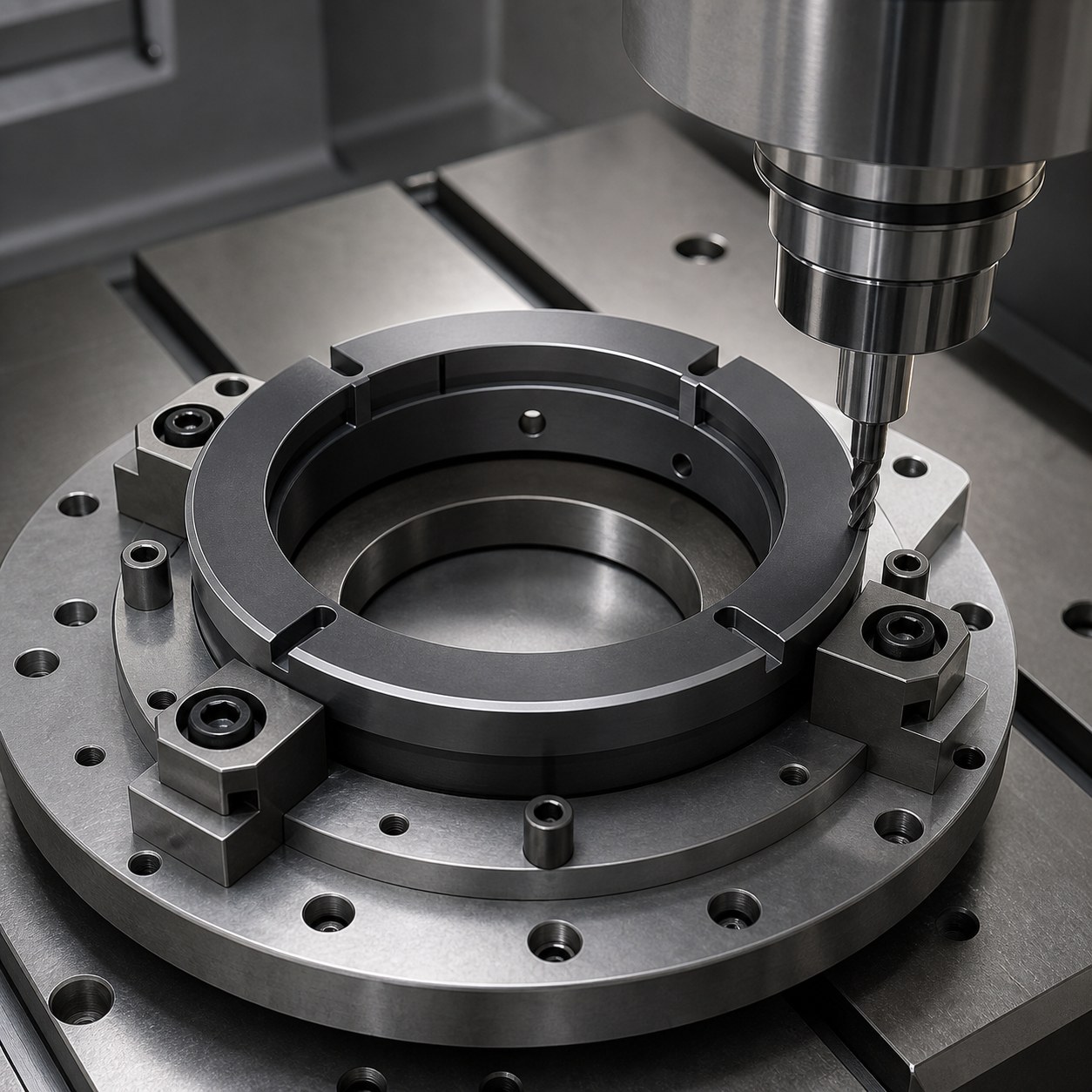
English: Invar 42 Optical Spacer Ring CNC Tool Selection for Thin Ribs
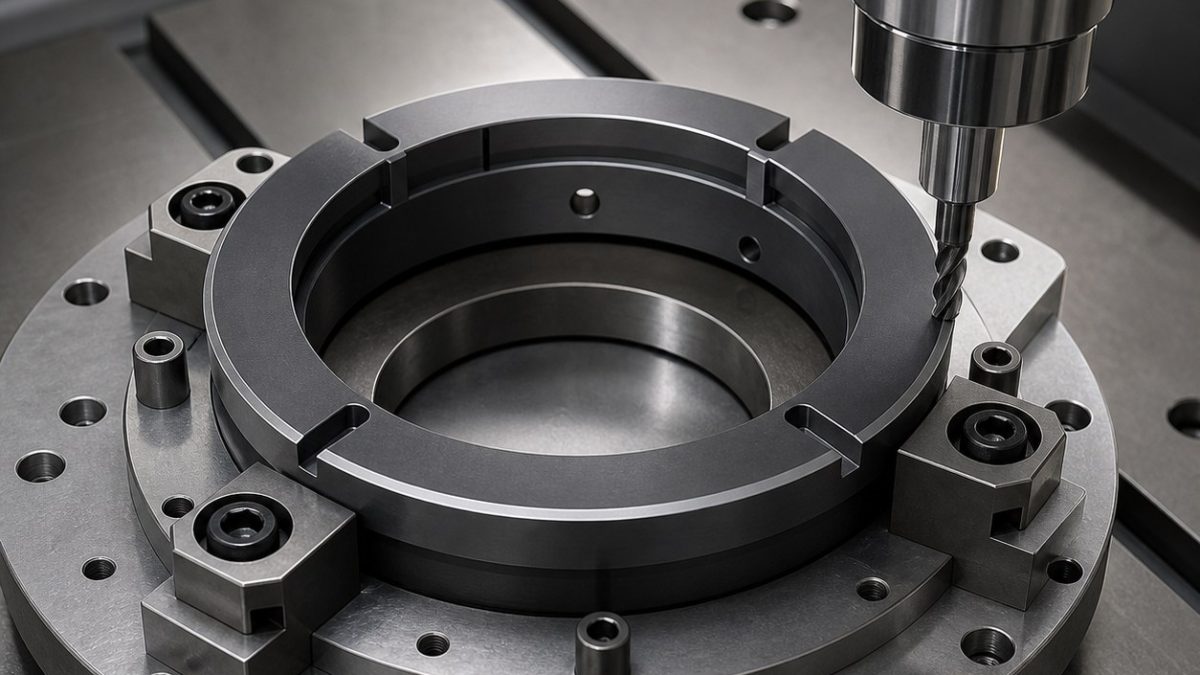
This hypothetical case is for readers searching how to machine an Invar 42 spacer ring when the drawing combines thin annular ribs, clocked dowel slots and a flatness-critical optical reference face. The low-expansion alloy is chosen for thermal stability, but the machining plan must still control residual stress, cutter pressure and slot burrs.
Drawing interpretation
The important chain is face flatness, rib height, dowel-slot clocking and free-state roundness. Roughing every groove before creating a stable reference can twist the ring. The case is related to Invar flatness and dense hole-pattern control, but this ring adds flexible annular ribs and radial clocking.
Feature-to-tool selection table
| Feature | Tool and holder | Decision logic |
|---|---|---|
| Reference face | Positive-rake 45-degree face mill, polished carbide inserts, hydraulic holder | Lower axial pressure protects flatness better than a heavy square-shoulder pass. |
| Annular rib relief | 6 mm 5-flute variable-helix carbide end mill, AlTiN, short flute | Small enough for relief width but rigid enough for semi-finishing. |
| Clocked dowel slots | 3 mm corner-radius end mill, shrink-fit holder | Wire EDM is unnecessary; a long-reach cutter is rejected because runout shifts slot phase. |
| Final rib flank | 4 mm sharp-finishing end mill, light radial stock | A rougher would tear edges and leave a burr toward the datum face. |
Process planning and inspection
The sequence alternates roughing and stress relief: skim one face, rough the opposite side, rest, finish datum pads, then machine slots in clocked groups. Coolant is steady but not excessive; thermal soaking before inspection matters because Invar hides small temperature errors. Surface finish is checked by profilometer on the reference face, while CMM checks slot clocking and rib height. Holder runout control follows the same logic described in shrink-fit holder stability.
FAQ
Why not use a high-feed rougher everywhere? It can move thin ribs and bury stress before final flatness is checked.
What coating works? A stable AlTiN or similar heat-tolerant coating is useful, but sharp geometry remains more important than coating alone.
What is inspected first? Free-state flatness and roundness before chasing local slot dimensions.