English: MP35N Stapler Anvil CNC Tool Selection for 0.45 mm Micro Pockets
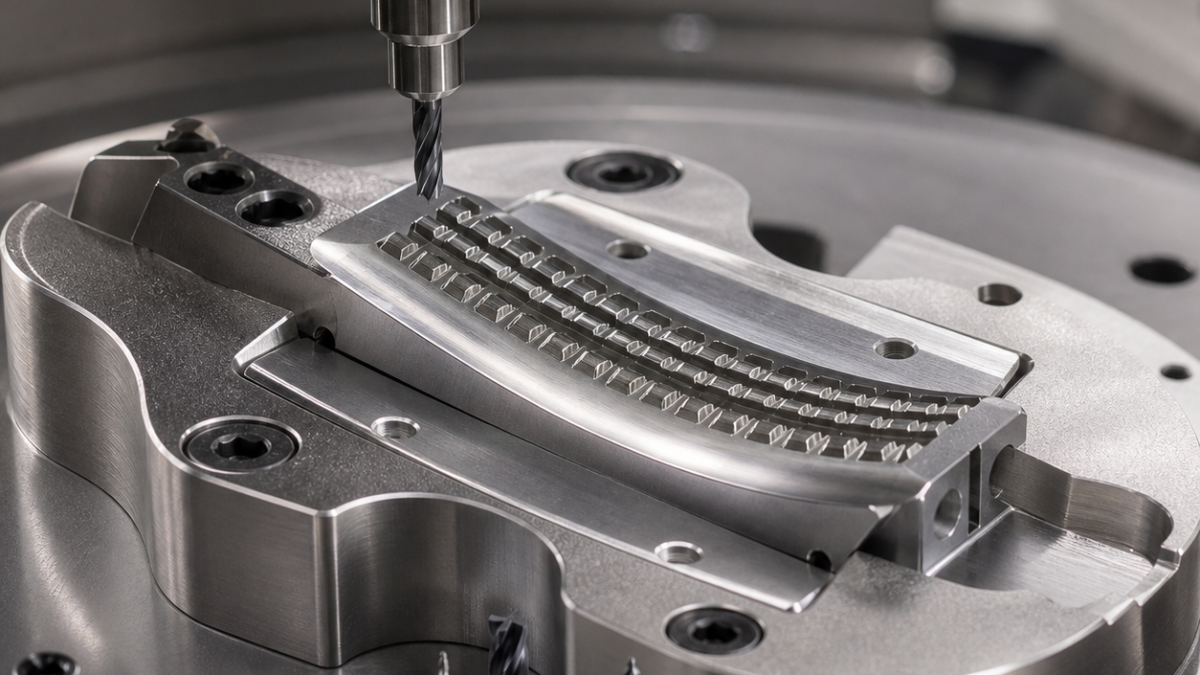
For a hypothetical MP35N stapler anvil, micro-tool runout decides the pocket result before feed rate does. The curved forming face is first stabilized with a Ø3 bull nose, then each small staple pocket is opened by a Ø0.45 coated carbide cutter held below 0.003 mm runout. Serrations, hinge slot and locating holes use separate tools so a worn edge never transfers work-hardened stock into the pocket array.
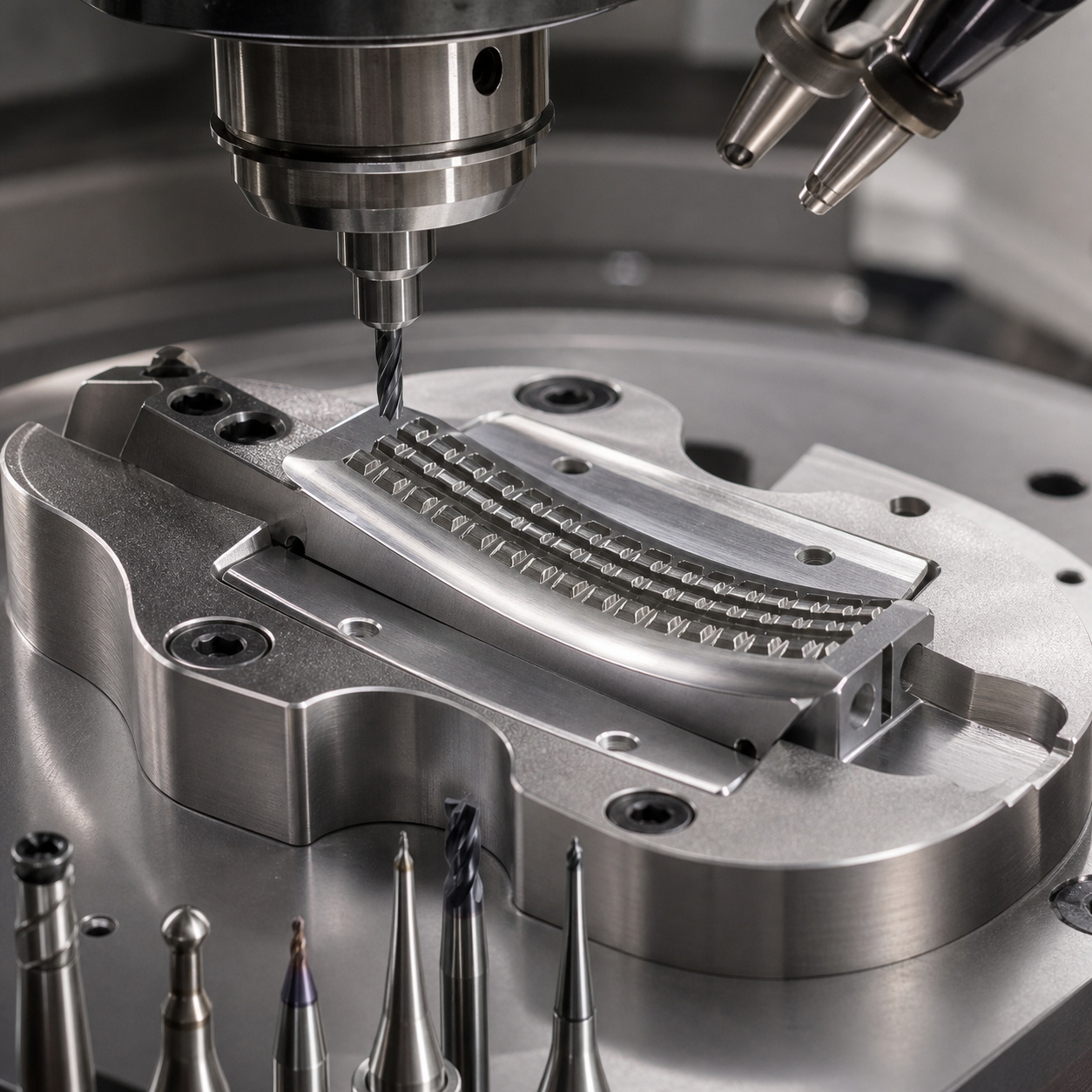
Drawing logic and the first-article gate
Curved face A, hinge bore B and side plane C define the array. Forty-eight hypothetical pockets are 0.55 mm wide, 0.32 mm deep and positioned within 0.020 mm; the face profile is 0.025 mm with Ra 0.4 µm. Serrations are 0.40 mm pitch and the hinge slot is 1.8 mm wide. The first three pockets form a release gate: they are inspected before the remaining array is machined.
Micro-tool map
| Feature | Selected carbide tool and holder | Control point |
|---|---|---|
| Forged blank roughing | Ø6 five-flute variable-pitch AlTiN micrograin carbide, R0.3, hydraulic holder | Adaptive path at low radial engagement; dedicated edge never enters micro pockets. |
| Curved face semifinish | Ø3 five-flute TiAlN bull nose R0.3, 12 mm reach, shrink holder | Leaves 0.08 mm normal stock with stable cusp. |
| Curved face finish | Ø2 four-flute AlCrN ball nose R1, polished flute, runout below 0.004 mm | Finishes along the forming direction without dwell. |
| Staple pockets | Ø0.45 two-flute AlTiN carbide, 1.2 mm cut, reinforced 0.01 mm edge, ultra-precision shrink holder | One helical entry and one finish orbit; tool is indexed by measured pocket count. |
| Fine serrations | Ø0.35 two-flute coated carbide slot tool, 0° helix, 0.8 mm cut | Straight flute limits lateral pull; a form cutter would load several teeth. |
| Hinge slot | Ø1.5 four-flute AlTiN end mill, necked 6 mm, hydraulic micro chuck | Trochoidal roughing and two compensated walls. |
| Locating holes | Ø1.8 through-coolant carbide drill, 140° point, followed by micro boring | Boring restores B position instead of relying on drill drift. |
Fixture and tool-life decisions
A contoured vacuum-assisted nest supports the back of A; two low clamps act outside the array. The face is semi-finished, thermalized and probed before the first three pockets. If their width, depth or corner condition fails, the runout, spindle growth and edge are corrected before release. The array proceeds in short blocks alternating left and right so heat does not walk along the curve.
MP35N work hardens when a micro cutter rubs. Every pocket entry remains in uncut stock, feed is maintained through arcs, and high-pressure filtered coolant reaches the active flute. A load increase, pocket-width drift or bright burnished floor retires the tool. No spring pass is allowed in the micro pockets.
Inspection and FAQ
White-light or qualified optical metrology measures pocket width, depth, corner and array position without probe force. A CMM checks A-B-C, hinge slot and bore; surface profilometry follows the curved forming direction. Final cleaning verifies no trapped microchips.
What runout is acceptable for a 0.45 mm pocket mill?
This route sets a process limit below 0.003 mm; the qualified limit must come from tool diameter, edge load and capability data.
Why inspect the first three pockets?
They reveal runout, thermal growth and work-hardening before the full array consumes tool life.
Why reject a spring pass in MP35N pockets?
A lightly loaded edge can rub and harden the floor, increasing wear without predictable size correction.
Compare medical micro-feature heat control and curved-face nickel-alloy tooling.