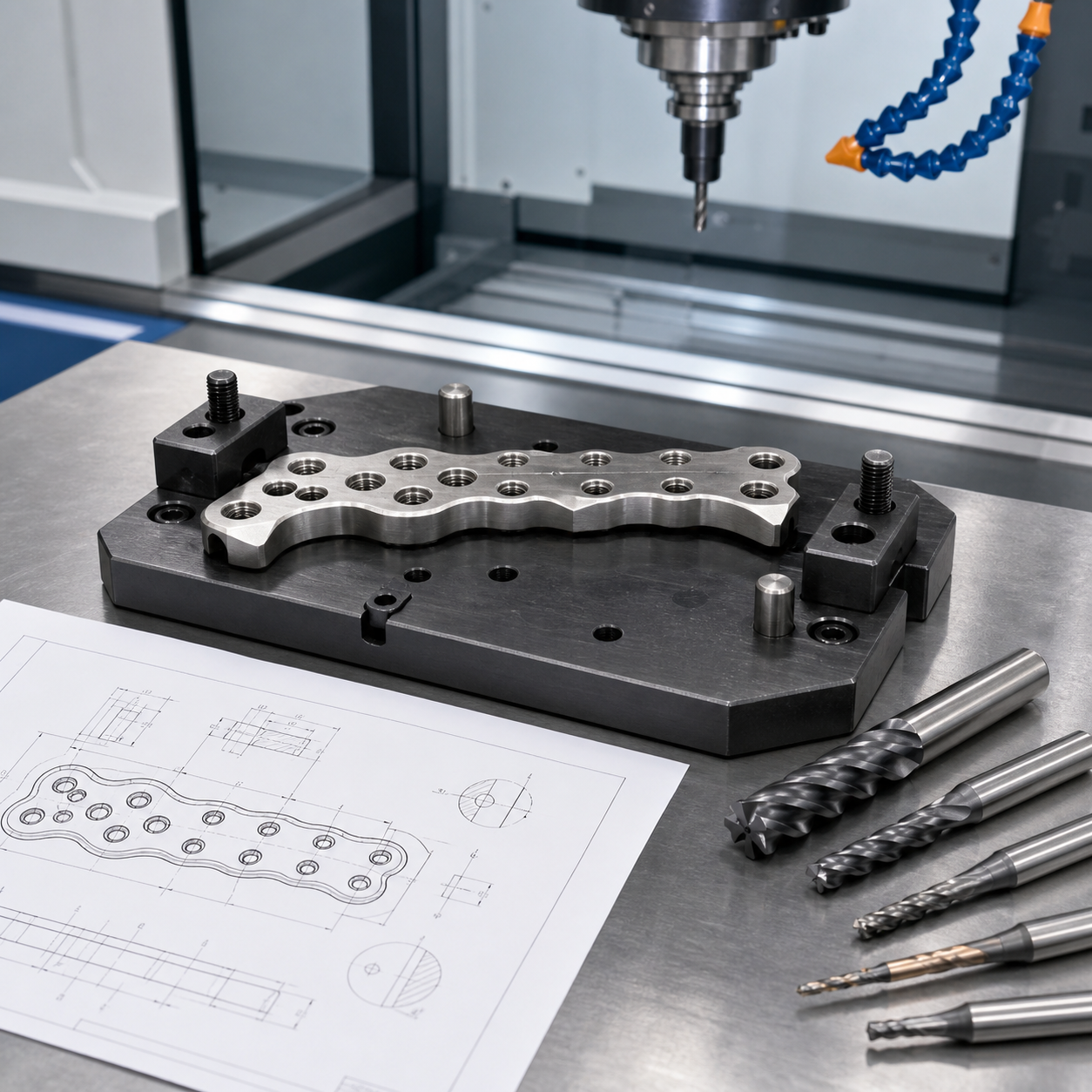
English: Drawing Requirements and Main Risks
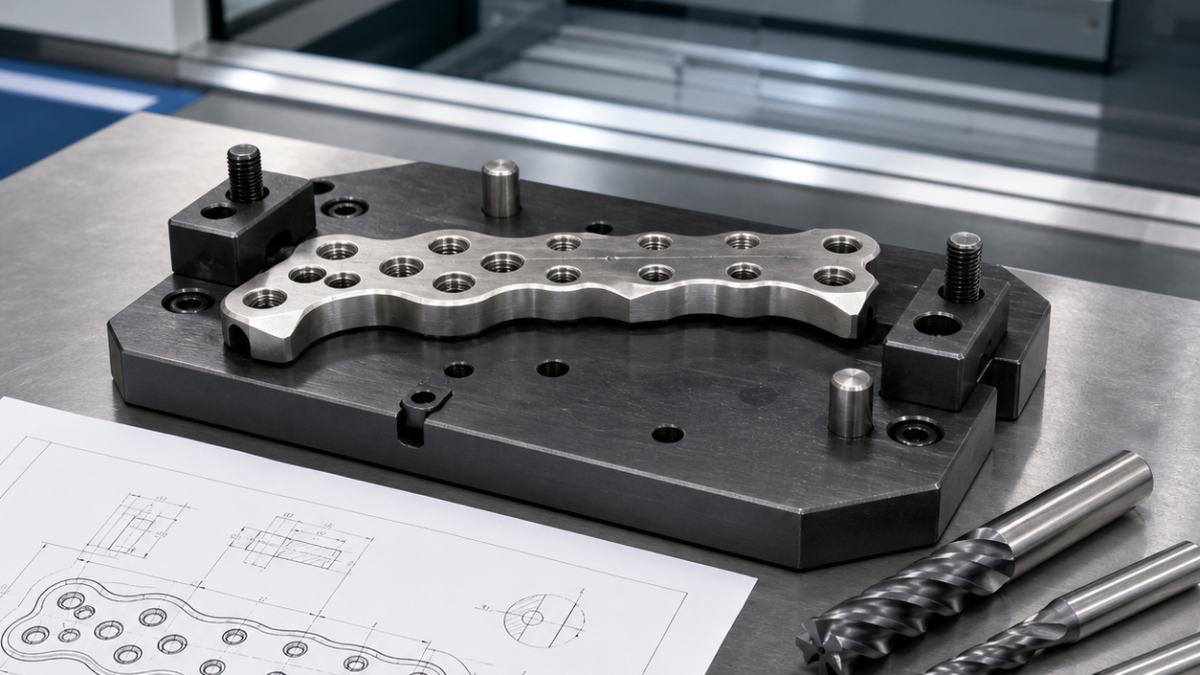
This CNC machining case studies a Ti-6Al-4V orthopedic bone plate with a curved outside profile, multiple countersunk screw holes, elongated slots and a final thickness of about 3.2 mm. The example drawing calls for 0.05 mm hole true position, smooth edge transitions, controlled countersink depth and a burr-free surface condition on every patient-contact edge. The exact medical requirements must always come from the approved customer drawing and quality plan; this article focuses on process planning and tool selection.
The machining challenge is not only titanium heat. A thin bone plate can lift from the fixture, chatter during contour finishing and create difficult secondary burrs around angled holes. The process must keep cutting edges sharp, support the part near every functional feature and avoid rubbing that hardens the surface before the final pass.
Fixture and Datum Plan
Start with oversize plate stock and create two protected locating holes plus a flat support face. The second setup should use a low-profile fixture with hardened locating pins, vacuum or distributed mechanical support, and small relief pockets beneath through holes. Clamping should avoid the final contour so the cutter can complete the outside profile without leaving witness marks.
For curved plates, a soft nest that follows the underside geometry reduces local bending. If the blank is flat and the final plate is later formed, machine the hole pattern before final contouring and leave enough tabs or sacrificial stock to maintain stiffness until the last operation.
Tool Selection
| Feature | Suggested tool | Reason |
|---|---|---|
| Rough contour | 4-flute variable-helix carbide end mill, AlTiN or similar coating | Stable engagement and heat resistance in titanium |
| Finish contour | Sharp 5-flute carbide end mill with small corner radius | Clean wall finish with lower edge chipping risk |
| Screw holes | Carbide drill followed by interpolation or reaming when required | Controls position, diameter and surface quality |
| Countersinks | Dedicated carbide countersink with controlled dwell-free feed | Maintains seat angle and reduces chatter rings |
| Edge break | Small ball end mill or programmed chamfer mill | Produces repeatable, inspection-friendly edges |
Starting Cutting Parameters
For a 6 mm carbide end mill in Ti-6Al-4V, a practical trial range is 45-70 m/min cutting speed, 0.025-0.055 mm feed per tooth and light radial engagement with strong coolant. Hole drilling may start near 35-55 m/min with pecking only when chip evacuation requires it. Countersinking should use positive feed, no dwell and a toolpath that enters cleanly without rubbing at the seat.
These are commissioning ranges, not universal settings. Final values depend on tool grade, holder runout, coolant pressure, machine rigidity and the heat-treatment condition of the material.
Process Sequence and Inspection
- Verify material certificate, blank thickness and grain direction requirements.
- Machine datum holes and support face while stock is still rigid.
- Rough holes and contour, leaving small stock on functional edges.
- Finish critical screw holes and countersinks before the outside profile becomes too flexible.
- Finish the contour with constant engagement and low radial force.
- Deburr under magnification using a controlled process, not aggressive hand scraping.
- Inspect hole position, countersink depth, edge radius, surface finish and final thickness.
For SEO and shop-floor usefulness, the important search theme is specific: Ti-6Al-4V bone plate CNC machining with fixture support, carbide tool selection and burr control. The article avoids pretending that one speed chart fits every medical part; traceability and validated inspection remain essential.
中文:Ti-6Al-4V 医疗骨板加工方案
本案例围绕 Ti-6Al-4V 医疗骨板的图纸、夹具和配刀展开。零件包含多组沉头孔、长圆槽和薄壁外形,重点是孔位稳定、沉头深度一致、边缘无毛刺和表面不能被刀具擦伤。建议先在毛坯刚性较好时加工定位孔和支撑面,再使用低轮廓专用夹具完成孔系、沉头和外形精加工。
配刀可采用变螺旋硬质合金立铣刀粗加工外形,锋利小圆角立铣刀精修轮廓,硬质合金钻头配合铣孔或铰孔控制孔径,专用沉头刀控制座面质量。钛合金加工要保持正切削厚度和充分冷却,避免停顿、摩擦和二次硬化。最终检测应覆盖孔位、沉头深度、边缘圆滑度、厚度和表面粗糙度。
Francais : Plaque osseuse Ti-6Al-4V
Ce cas d usinage CNC traite une plaque osseuse en Ti-6Al-4V avec trous fraises, lumiere oblongue et contour mince. La priorite est de maintenir la position des trous, la profondeur des fraisures et des arêtes sans bavure. Un montage bas avec appuis repartis limite la flexion pendant la finition.
Les outils recommandés sont des fraises carbure affutees, forets carbure, outil de fraisure dedie et petite fraise pour le rayon d arête. Les conditions de coupe doivent limiter la chaleur et eviter le frottement. Le controle final porte sur la position, la profondeur, la rugosite, l epaisseur et l etat des arêtes.
Русский: пластина Ti-6Al-4V
В этом примере рассматривается ЧПУ обработка костной пластины Ti-6Al-4V с группой отверстий, зенковками, пазами и тонким контуром. Главные риски: нагрев титана, вибрация тонкой детали и заусенцы вокруг отверстий. Низкая оснастка с распределенной опорой помогает сохранить геометрию.
Для процесса подходят острые твердосплавные фрезы, твердосплавные сверла, отдельный инструмент для зенковки и малые инструменты для контролируемого снятия кромки. Контроль должен подтверждать положение отверстий, глубину зенковки, толщину, шероховатость и отсутствие опасных заусенцев.
FAQ
Why finish holes before the outside profile is fully released?
The plate is stiffer before final profiling, so hole position and countersink depth are easier to control.
What causes most burr problems on titanium bone plates?
Rubbing, dull tools, unsupported exits and uncontrolled manual deburring are common causes.
Related reading: Titanium Aerospace Bracket and CNC Chamfering and Deburring.