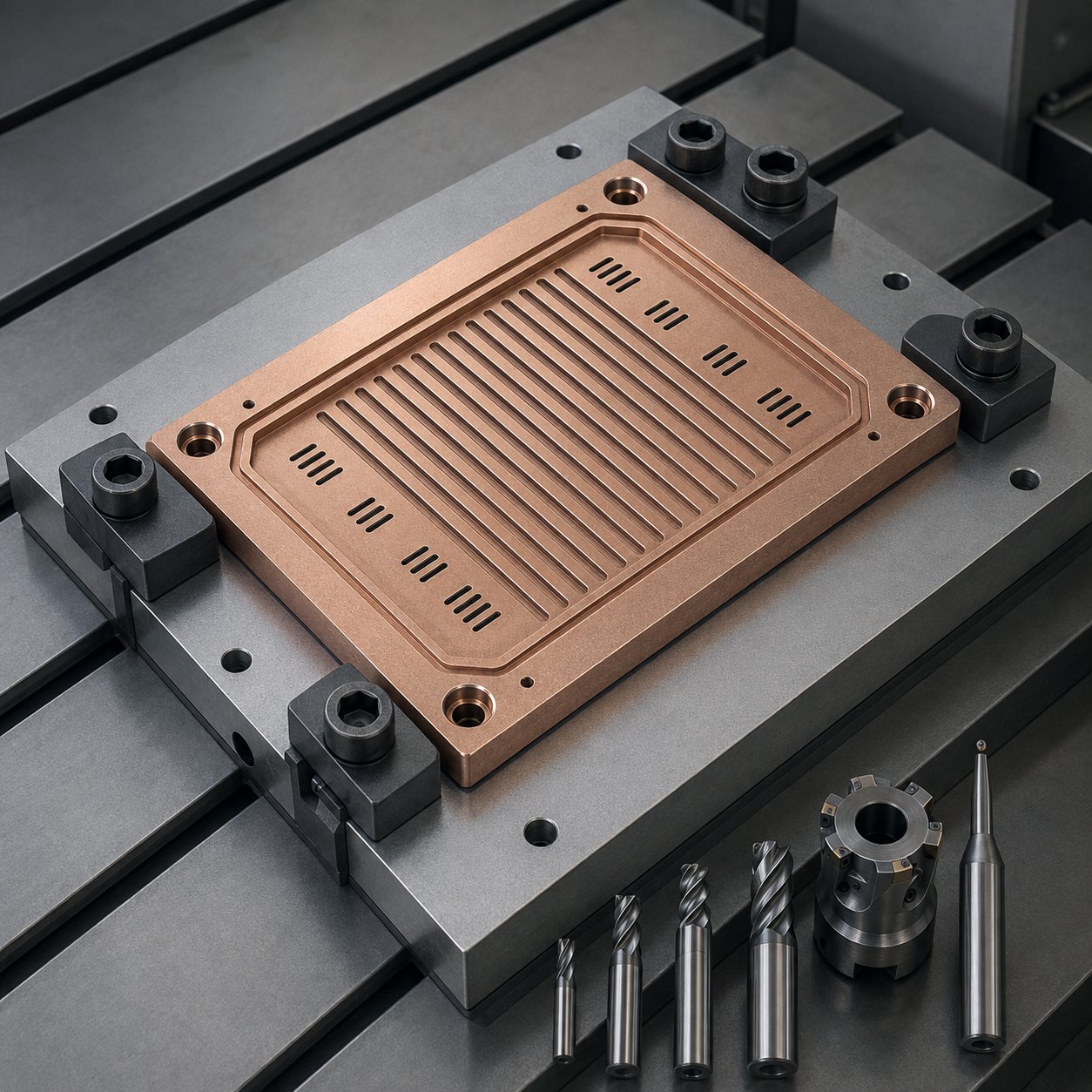
English: Molybdenum-Copper RF Heat Spreader Lid CNC Tool Selection for Gasket Moat and Vent Slots
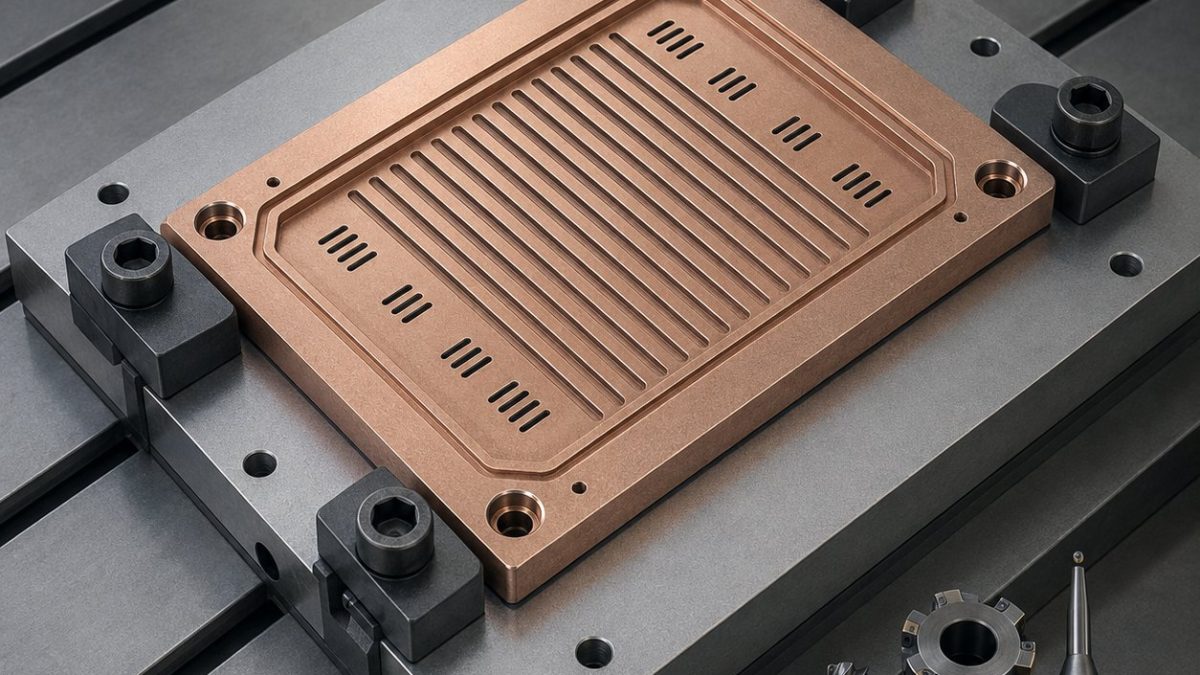
This hypothetical case targets a long-tail problem: choosing CNC tools for a molybdenum-copper RF heat spreader lid with a shallow gasket moat, thin thermal ribs and narrow vent slots. The part is not a simple copper plate; the composite has a copper-rich smear tendency and a hard molybdenum skeleton that punishes weak edges.
Drawing logic
The gasket moat sets compression, the rib field sets thermal contact, the vent slots prevent trapped gas and the counterbores define assembly height. Unlike the broader thermal flatness machining logic, this lid has many shallow interrupted features where floor finish and burr height matter more than bulk stock removal.
Feature-to-tool map
| Feature | Tool and holder | Decision tradeoff |
|---|---|---|
| Datum face | PCD-tipped face mill with fine runout setting | Controls copper smearing; coated carbide alone leaves a higher burr on the moat edge. |
| Shallow gasket moat | Ø4 mm 3-flute polished carbide end mill, TiB2 or diamond-like coating | Balances sharpness and wear; a large insert cutter cannot hold the moat corner radius. |
| Thin thermal ribs | Ø2.5 mm necked carbide finisher, 5xD reach, hydraulic holder | Reach without chatter; a longer general end mill is rejected for rib-side waviness. |
| Narrow vent slots | Ø0.8-1.0 mm 2-flute micro end mill, sharp edge, short flute | Reduces slot burr; wire EDM is rejected for this hypothetical low-depth lid because recast and cleaning add risk. |
| Counterbores | Carbide drill, circular interpolation, flat-bottom finishing end mill | Keeps screw seating flat; standard counterbore tools smear the composite edge. |
Machining and inspection plan
Use a flat vacuum-assisted fixture with hard edge stops, rough the moat before final rib finishing and leave the lid clamped during slot deburring. Toolpaths avoid slot plunging and use ramp entry with air blast. Inspection checks free-state flatness, gasket moat width/depth, slot burr under magnification, screw counterbore height and thermal-rib contact pattern. For burr-sensitive slot thinking, compare small-slot burr control.
中文: 钼铜RF散热盖板密封槽、散热筋和排气槽配刀
这个案例解决的是钼铜 RF 散热盖板的长尾需求:浅密封槽、细散热筋和窄排气槽怎样选刀。钼铜不是普通紫铜,铜相容易涂抹,钼骨架又会磨损刃口,所以刀具要同时考虑锋利度和耐磨性。
图纸重点
密封槽决定压缩量,散热筋决定接触导热,排气槽用于释放装配气体,沉孔决定螺钉坐面高度。该零件浅特征多,毛刺高度和底面质量比单纯去除率更关键。
按特征选刀
| 特征 | 刀具/刀柄 | 取舍理由 |
|---|---|---|
| 基准平面 | PCD 刀片面铣刀,精调跳动 | 减少铜相涂抹;普通涂层硬质合金毛刺更高。 |
| 浅密封槽 | Ø4 mm 三刃抛光硬质合金立铣刀,TiB2 或类金刚石涂层 | 兼顾锋利和耐磨;大刀片铣刀保不住槽角。 |
| 细散热筋 | Ø2.5 mm 缩颈精铣刀,约 5D 有效长,液压刀柄 | 够到筋根且抑制振纹;过长通用刀会让筋侧波纹变大。 |
| 窄排气槽 | Ø0.8-1.0 mm 两刃微铣刀,短刃长、锋利刃口 | 控制槽口毛刺;本案例不选线切割,避免重铸层和清洗风险。 |
| 螺钉沉孔 | 硬质合金钻孔后圆插补,平底刀清底 | 保证坐面高度;标准沉孔刀容易涂抹边缘。 |
检验计划
夹具采用平面真空辅助和硬限位。先加工密封槽,再精散热筋,排气槽最后轻切并在夹紧状态下去毛刺。检验自由状态平面度、密封槽宽深、显微毛刺、沉孔高度和散热筋接触印。
Français: Outils CNC pour couvercle MoCu RF avec rainure de joint
Le couvercle MoCu RF exige des outils capables de couper une matrice cuivre-molybdène sans bavure excessive. La rainure de joint, les nervures thermiques et les fentes d’évent demandent des choix différents.
Lecture fonctionnelle
La rainure règle la compression du joint, les nervures assurent le contact thermique et les fentes évitent l’air piégé. La planéité libre reste contrôlée après déclampage.
Sélection d’outils
| Zone | Outil | Compromis |
|---|---|---|
| Face de référence | Fraise PCD réglée en faux-rond faible | Moins de bavure qu’un carbure standard. |
| Rainure de joint | Fraise carbure polie Ø4 mm, 3 dents | Rayon tenu et arête assez robuste. |
| Nervures fines | Fraise carbure dégagée Ø2,5 mm en mandrin hydraulique | Portée utile sans vibration. |
| Fentes d’évent | Micro-fraise Ø0,8-1,0 mm, 2 dents | Bavure plus faible qu’un outil plus gros forcé. |
| Lamages | Perçage puis interpolation et finition fond plat | Meilleure assise de vis. |
Contrôle
Le contrôle combine planéité, profondeur de rainure, inspection des bavures, hauteur des lamages et empreinte de contact des nervures.
Русский: Инструмент для MoCu крышки RF с пазами
Крышка RF из молибден-меди требует выбора инструмента под мелкую канавку уплотнения, тонкие тепловые ребра и узкие вентиляционные пазы. Материал одновременно мажется медью и быстро изнашивает слабую кромку.
Функции чертежа
Канавка задает сжатие прокладки, ребра — тепловой контакт, пазы — выход воздуха, а цековки — высоту крепежа.
Таблица инструмента
| Элемент | Инструмент | Причина |
|---|---|---|
| Базовая плоскость | PCD торцевая фреза с малым биением | Меньше смазывание медной фазы. |
| Канавка прокладки | Ø4 мм полированная 3-зубая карбидная фреза | Держит радиус и чистое дно. |
| Тонкие ребра | Ø2,5 мм фреза с шейкой, гидропатрон | Достаточный вылет без вибрации. |
| Вентиляционные пазы | Ø0,8-1,0 мм острая микрофреза | Снижает заусенец в узком пазу. |
| Цековки | Сверление, круговая интерполяция и плоская чистовая фреза | Ровная посадка винта. |
FAQ
Is PCD always required for molybdenum-copper?
Not always, but PCD or very sharp polished carbide is useful on datum faces and burr-sensitive edges where copper smearing is visible.
Why not plunge mill the vent slots?
Ramp entry and light side cutting reduce edge breakout and tool shock on a narrow micro slot.
What is the main inspection risk?
Free-state flatness and burr height around the gasket moat and vent slots are the most likely rejection points.