English: D2 Stripper Plate CNC Tooling Case: Narrow Slug Slots and Grinding Allowance
This hypothetical D2 stripper plate separates what carbide should machine before heat treatment from what wire EDM and grinding should finish afterward. The search intent is practical: choose tools for 5 mm slug slots, dowel bores and counterbores without wasting long carbide cutters or losing the datum chain through hardening.
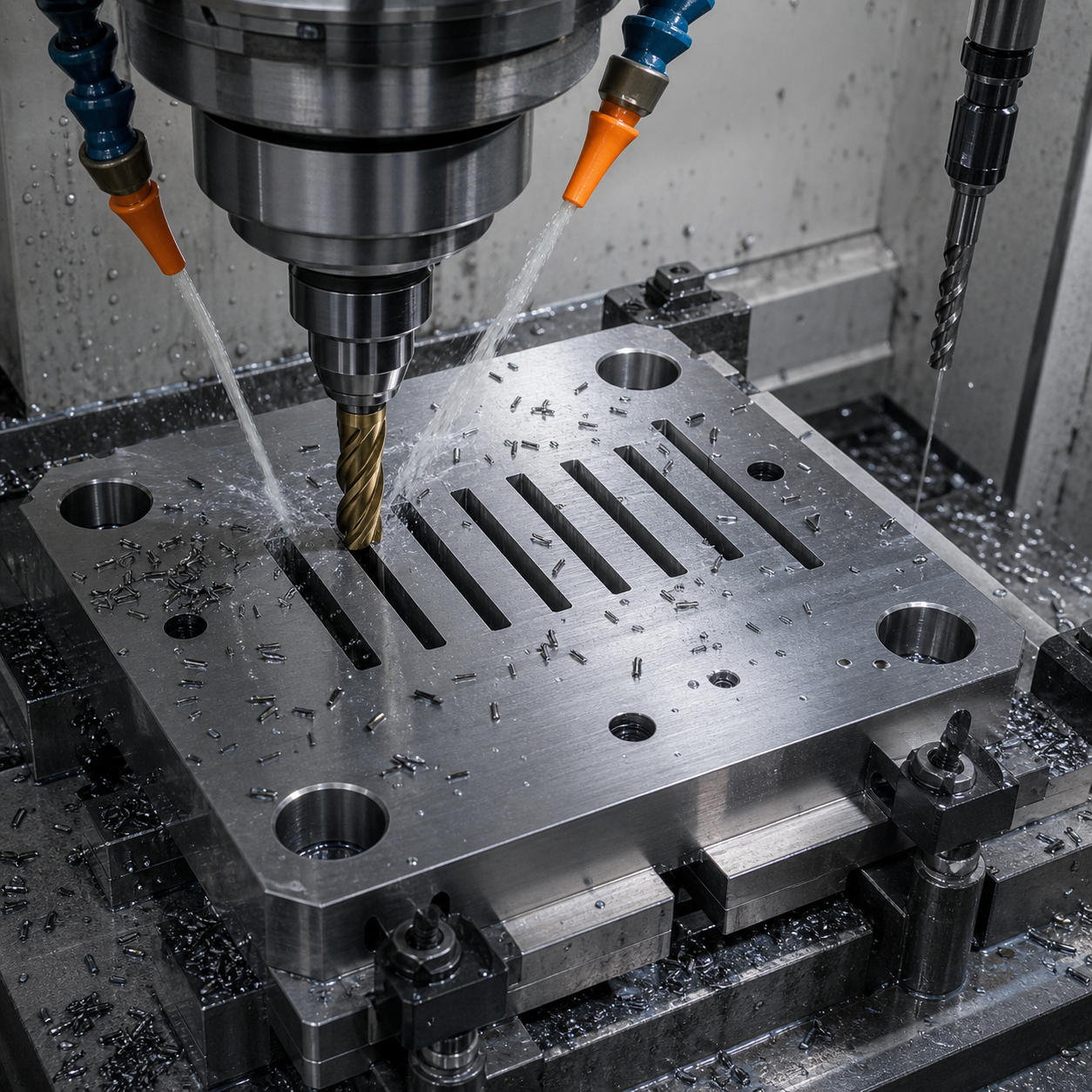
Drawing state and allowance plan
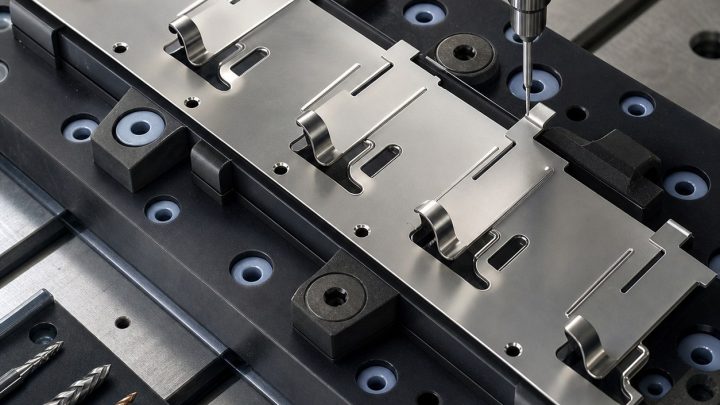
The 32 mm plate uses ground face A, long edge B and dowel C. Eight slots are 5.00 +0.02/0 mm with 0.015 mm position, faces require 0.01 mm parallelism after 58–60 HRC heat treatment, and dowels are Ø12 H7. The drawing marks 0.20 mm per slot wall for wire EDM, 0.30 mm per face for grinding and leaves starter holes outside finished corners.
Feature-to-tool plan
| Feature | Tool selection | Why / rejection |
|---|---|---|
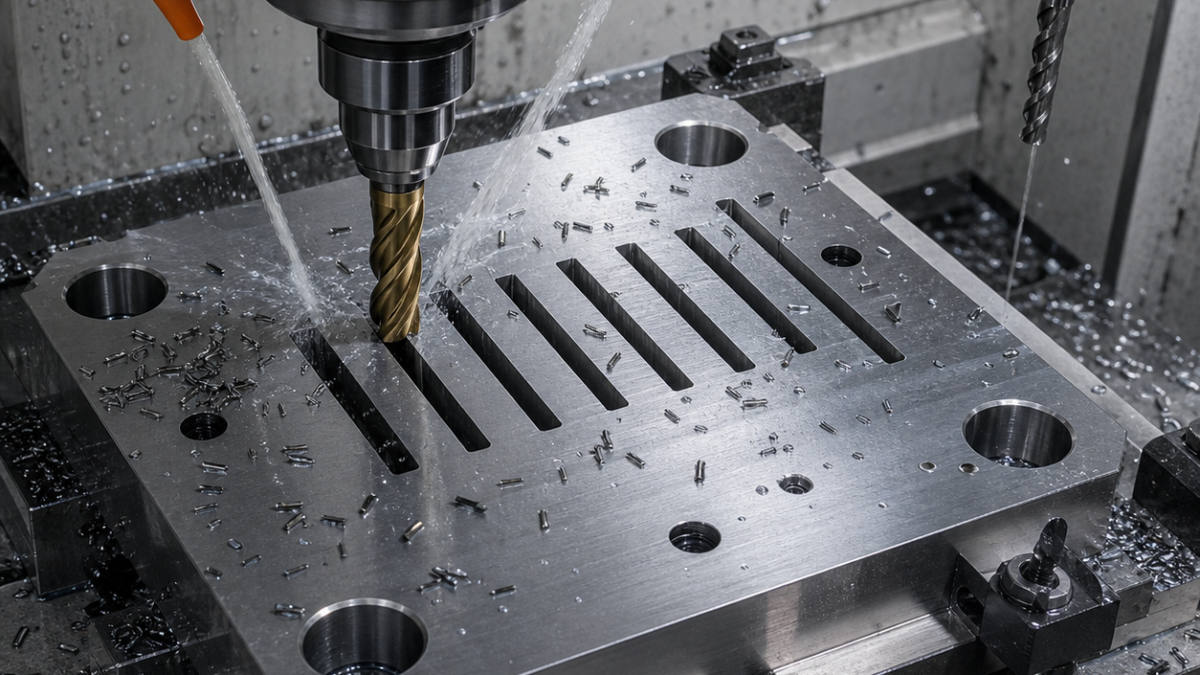
| Pre-hard pocket clearing | Ø12, 5-flute AlTiN carbide, variable pitch, strong 0.1 mm edge hone, hydraulic holder | Stable in D2; a sharp aluminum tool chips on carbides. |
| 5 mm slot preform | Ø4, 4-flute TiAlN carbide, necked 28 mm reach, shrink holder | Leaves EDM stock; a Ø5 full slot cutter has no chip space or correction allowance. |
| EDM starter hole | Ø2.5 through-coolant carbide drill, 140° point | Controlled straightness; HSS wanders in high-chromium D2. |
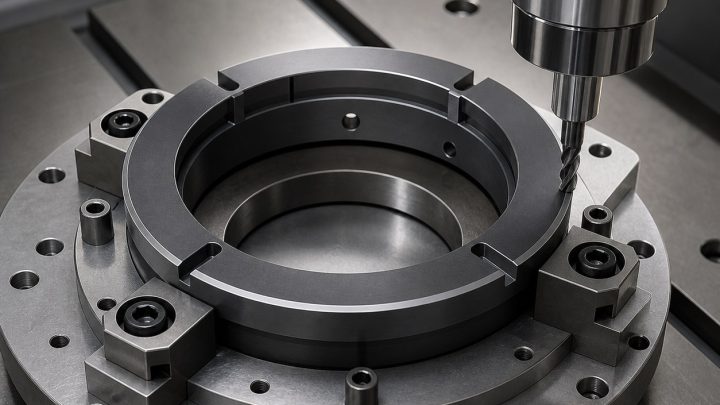
| Dowel pre-bore | Ø11.5 carbide drill then Ø11.8 carbide boring tool | Leaves stock for post-hard jig grinding; reaming before heat treat cannot hold final relation. |
| Counterbore | Indexable carbide helical interpolation tool | Adjustable diameter; fixed counterbore is vulnerable to wear shift. |
Process and tool-life decisions
A and B are established on a stress-relieved blank. High-efficiency roughing stays below 12% radial engagement and uses through-spindle coolant. Slots are opened by trochoidal paths from starter holes, leaving uniform EDM allowance and full corner bridges. After roughing, the plate rests before a second skim verifies movement. Heat treatment uses protected surfaces; faces are ground to A, then wire EDM locates from ground A-B-C and alternates slots across the plate to distribute residual stress.
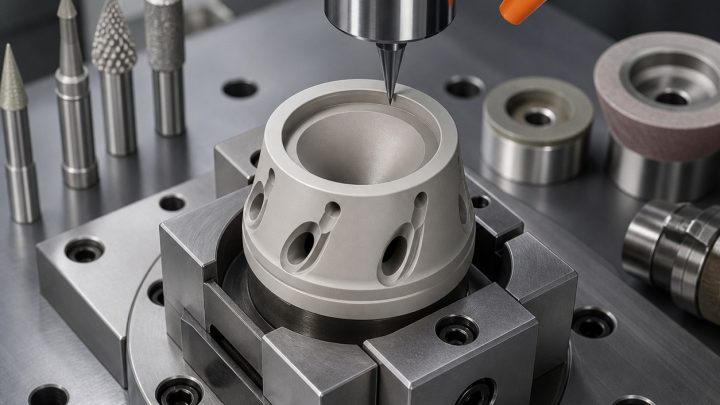
Carbide failure is monitored by corner chipping, load spikes and a rising burr at the slot entrance. The Ø4 tool is not run to size; its job is only a stable preform. Burrs before heat treatment are chamfered with a 6 mm, 4-flute TiAlN carbide chamfer mill at 0.15 mm. After EDM, a fine stone removes only recast feather under magnification—no uncontrolled edge rounding.
Inspection and FAQ
A CMM checks preforms and starter-hole clearance before heat treatment. After grinding and EDM, it rebuilds A-B-C, measures slot position and width, dowel relation and counterbore depth. Flatness is measured free-state, while surface finish and recast-layer acceptance follow the drawing.
Why not mill the 5 mm D2 slots to final size?
Heat-treatment movement and 32 mm depth make wire EDM the more controllable finishing process; carbide creates a uniform, economical preform.
Which coating suits pre-hardened D2?
A tough AlTiN/TiAlN system with reinforced edge and stable coolant delivery; ultra-sharp uncoated geometry is too fragile here.
When are dowel holes finished?
After hardening and face grinding, so their axis is tied to the final datum surfaces.
Compare EDM allowance planning and H7 hole tool selection.