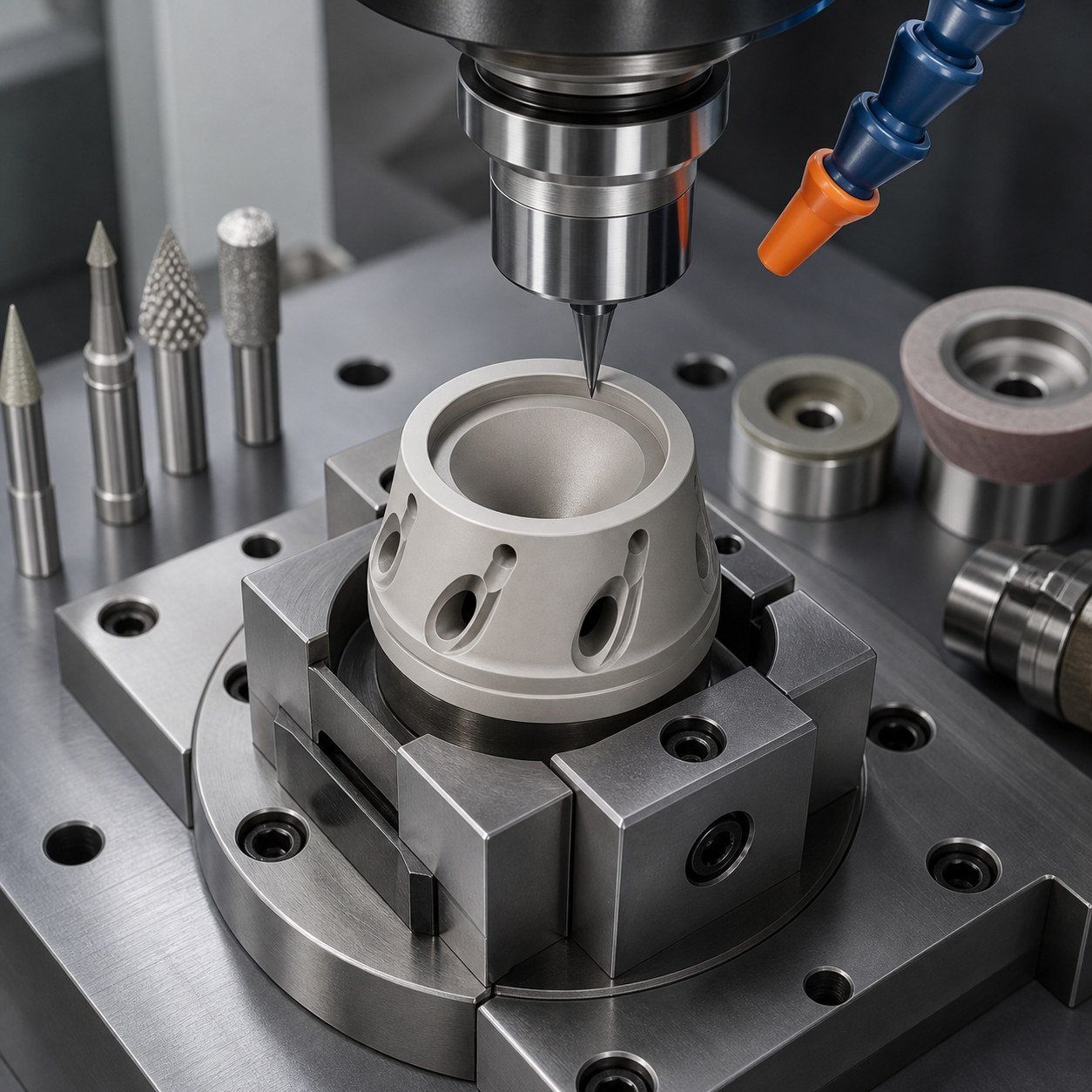
English: Sialon Ceramic Nozzle Seat CNC Tool Selection for Angled Spray Bores
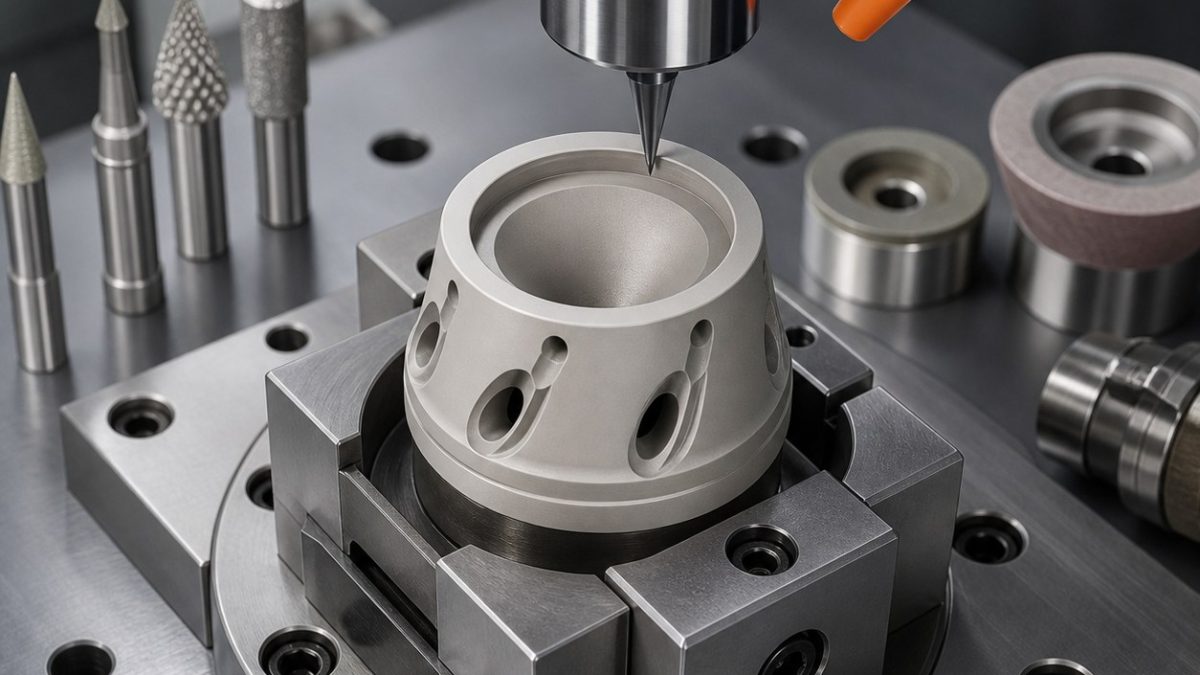
This hypothetical case answers a practical search intent: how to choose CNC tools when a ceramic nozzle-seat drawing combines angled spray bores, a conical sealing seat and a thin exit lip. The part is not approached like a metal manifold. The drawing logic starts with damage prevention: every tool must reduce edge chipping, avoid rubbing heat and keep the bore axes related to the lapped sealing cone.
Drawing interpretation and manufacturing risk
The datum face controls the cone, while the angled bores must break into the cone without flaking the lip. A note calling for a fine sealing surface does not mean aggressive milling followed by polishing. It means leaving predictable stock for diamond finishing and supporting the ceramic during every interrupted exit. Compared with metal cases such as micro hole-array machining, the risk is less burr growth and more brittle breakout.
Feature-to-tool selection table
| Drawing feature | Selected tool | Why alternatives are rejected |
|---|---|---|
| Datum face and OD cleanup | Fine-grit resin-bond diamond wheel, light spark-out | Carbide face milling would chip the rim and mask cracks. |
| Conical sealing seat | Vitrified diamond form wheel, dedicated cone dresser | A ball end mill cannot hold the sealing line without chatter marks. |
| Angled spray bores | Electroplated diamond core drill with short guide bushing | A twist drill loads the exit lip and wanders in ceramic. |
| Exit lip protection | Small diamond chamfer pin, climb-touch deburr pass | Hand stones round the lip unevenly. |
Process plan, fixture and inspection
The route is face grind, soft vacuum-and-nest support, pilot spotting with a diamond point, angled bore grinding, cone finishing and final lip relief. Flood coolant is filtered and gentle; dry cutting is rejected because ceramic dust and local heat hide damage. Inspection uses optical edge review, pin-angle probing, roundness of the cone contact band and a blue-check style contact test. Related ceramic thinking appears in the alumina vacuum chuck grinding case.
FAQ
Can carbide cut Sialon ceramic? Carbide may assist fixture tooling, but diamond abrasive tools are normally selected for the ceramic features.
What is the main failure mode? Exit chipping at the angled bore and sealing cone edge is more critical than ordinary metal burrs.
How is tool life watched? Wheel loading, bore edge whitening and rising spindle load are treated as replacement signals.
中文: Sialon陶瓷喷嘴座斜孔与薄出口边的数控配刀
这个假设案例解决的是一个很具体的搜索需求:图纸上同时有斜向喷孔、锥形密封座和很薄的出口边时,应该怎样选刀。这里不能按普通金属件思路用铣刀硬推,核心是减少崩边、控制磨削热,并保持喷孔轴线与密封锥面的关系。
图纸重点与风险
基准端面决定锥面位置,斜孔在锥面附近贯通,出口薄边最容易崩裂。表面粗糙度要求不是简单“最后抛一下”,而是要求前序留量稳定、夹具支撑充分、金刚石工具状态可控。与氧化锆陶瓷金刚石加工案例类似,风险来自脆性边缘而不是金属毛刺。
特征到刀具选择
| 图纸特征 | 刀具选择 | 不用的方案 |
|---|---|---|
| 基准面和外圆修正 | 细粒度树脂结合剂金刚石砂轮 | 硬质合金面铣刀会诱发边缘微裂。 |
| 锥形密封座 | 修整后的金刚石成形砂轮 | 球刀扫面难保证连续接触带。 |
| 斜向喷孔 | 电镀金刚石套料钻配短导套 | 普通麻花钻会偏摆并拉裂出口。 |
| 薄出口边 | 小直径金刚石倒角针轻触 | 手工油石容易倒圆过量。 |
工艺、装夹与检测
推荐流程为端面磨削、软支撑定位、金刚石点定位、斜孔磨削、锥面精磨、出口轻倒钝。夹具采用真空辅助加仿形托座,冷却液要过滤,避免粉尘重复划伤。检测包括显微镜看崩边、角度销或影像测孔轴、锥面接触带和自由状态复检。更多资料可见 AXKXA技术文章。
常见问题
能不能用硬质合金刀直接加工Sialon?陶瓷关键面通常应选金刚石磨削工具,硬质合金更多用于辅助夹具或软材料部件。
最该控制什么?斜孔出口崩边和密封锥面连续性。
怎样判断工具寿命?看砂轮堵塞、边缘发白、负载上升和表面划痕。
Français: Choix d’outils CNC pour siège de buse Sialon à perçages inclinés
Cette étude hypothétique traite le choix d’outils lorsque le plan impose des perçages inclinés, un siège conique d’étanchéité et une lèvre de sortie fragile. La priorité n’est pas le débit d’enlèvement, mais la maîtrise de l’écaillage et de la position des axes.
Lecture du plan
La face de référence pilote le cône. Les petits perçages débouchent près de la zone d’étanchéité, donc chaque sortie doit être soutenue et contrôlée. Un exemple proche sur les petits trous est disponible ici : guide plate à réseau de micro-trous.
Table fonction-outil
| Fonction du plan | Outil choisi | Alternative écartée |
|---|---|---|
| Face de référence | Meule diamant résine grain fin | Fraisage carbure trop risqué pour l’arête. |
| Siège conique | Meule diamant profilée | Fraise hémisphérique trop instable pour la ligne de contact. |
| Perçages inclinés | Foret diamant électroplaqué avec guidage court | Foret hélicoïdal sujet à la déviation. |
| Lèvre de sortie | Pointe diamant de micro-chanfrein | Ébavurage manuel non répétable. |
Contrôle
Le bridage utilise un appui doux et une aspiration légère. Les trajectoires sont courtes, refroidies et vérifiées après chaque groupe de trous. Le contrôle combine microscope, mesure d’axe, contact du cône et recherche de fissures. Les principes de meulage céramique sont proches du cas mandrin en alumine.
FAQ
Pourquoi du diamant? Parce que la céramique use et éclate sous une coupe carbure classique.
Quel est le défaut critique? L’écaillage à la sortie du trou incliné.
Comment limiter la casse? Par faible effort, guidage court, support complet et inspection fréquente.
Русский: Подбор инструмента для сопла Sialon с наклонными отверстиями
Этот условный пример показывает, как выбирать инструмент, когда на чертеже есть наклонные распылительные отверстия, коническое уплотнительное седло и тонкая выходная кромка. Для керамики главный вопрос не скорость, а защита кромок и стабильная ось отверстия.
Логика чертежа
Базовая плоскость задает положение конуса, а отверстия выходят рядом с рабочей кромкой. Поэтому припуск, опора и алмазный инструмент важнее обычной фрезерной производительности.
Выбор инструмента
| Элемент | Инструмент | Почему не другой |
|---|---|---|
| База | Мелкозернистый алмазный круг | Твердосплавная фреза дает сколы. |
| Конус седла | Профильный алмазный круг | Шаровая фреза оставляет нестабильный след. |
| Наклонные отверстия | Алмазное сверло с короткой направляющей | Спиральное сверло уводит ось. |
| Выходная кромка | Малая алмазная фасочная оправка | Ручная доводка нарушает размер. |
Контроль
Процесс строится через шлифование базы, мягкую опору, обработку отверстий и чистовое формирование конуса. Проверяют сколы под увеличением, оси отверстий, контактную полосу конуса и повторяемость после снятия с приспособления. См. также технические заметки AXKXA.
FAQ
Можно ли использовать карбид? Для основных керамических поверхностей обычно нужен алмаз.
Главный риск? Скол выходной кромки.
Что контролировать по ресурсу? Засаливание круга, рост нагрузки и микросколы.