English: Hardened 52100 Bearing Outer Ring CNC Case: Raceway Roundness and Finish Handoff
Direct answer: a hardened 52100 outer ring reaches stable raceway roundness when pre-heat-treatment stock is balanced, clamping is proven at low pressure, hard turning removes a continuous allowance, and free-state roundness is separated from chuck-state readings. Carbide prepares the annealed blank; CBN finishes the 60–62 HRC raceway. This is a hypothetical case.
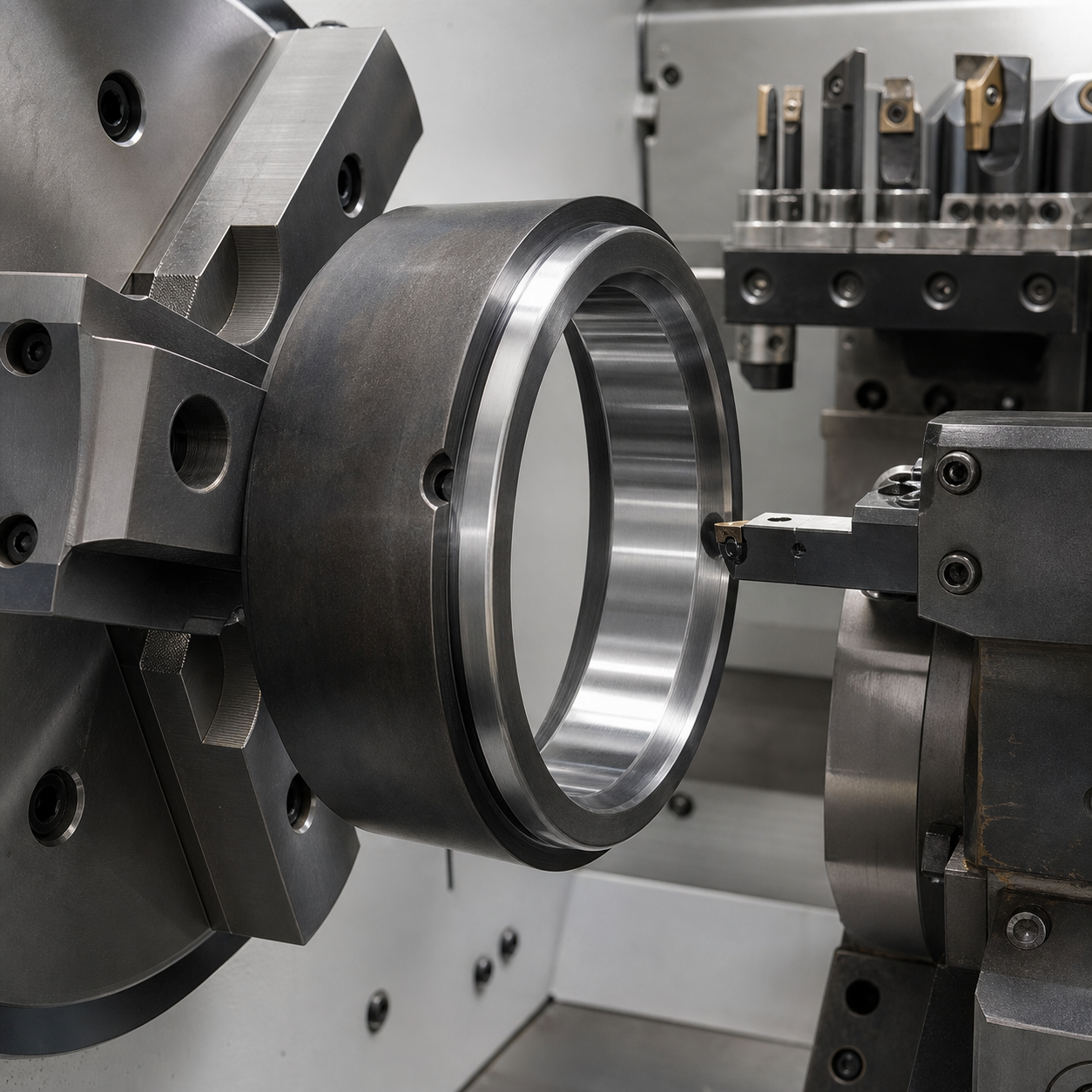
The tolerance stack crosses heat treatment
The ring is Ø126 × 24 mm with an internal crowned raceway, 0.012 mm free-state roundness, 0.015 mm raceway-to-OD runout, Ra 0.2 µm and a shallow lubrication groove. Datum A is the raceway-derived axis, B one face and C the OD clocking mark. The route drawing reserves 0.35 mm diametral raceway stock and 0.20 mm per face before hardening; final stock is verified after quench, not assumed from nominal growth.
Before hardness: create uniform stock
In the annealed state, a positive coated-carbide insert faces and bores; a carbide groover forms the lubrication channel undersize. Soft jaws grip a broad OD band, and turning alternates faces to keep wall thickness balanced. The bore, OD and faces remain concentric enough that heat-treatment movement produces removable, not intermittent, stock. Parts are marked outside functional surfaces and tempered to the specified 60–62 HRC.
After hardness: clamp only what inspection can release
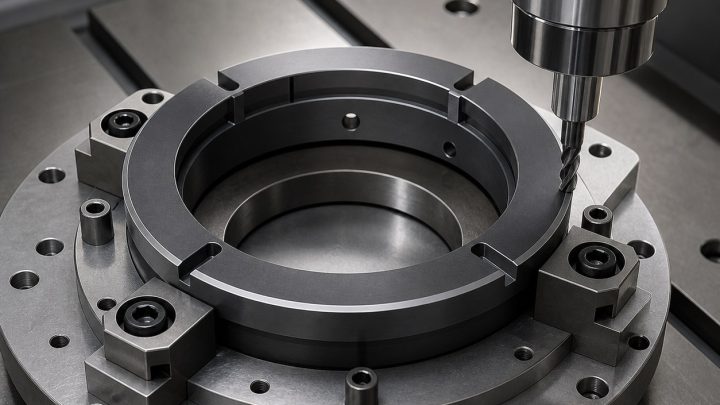
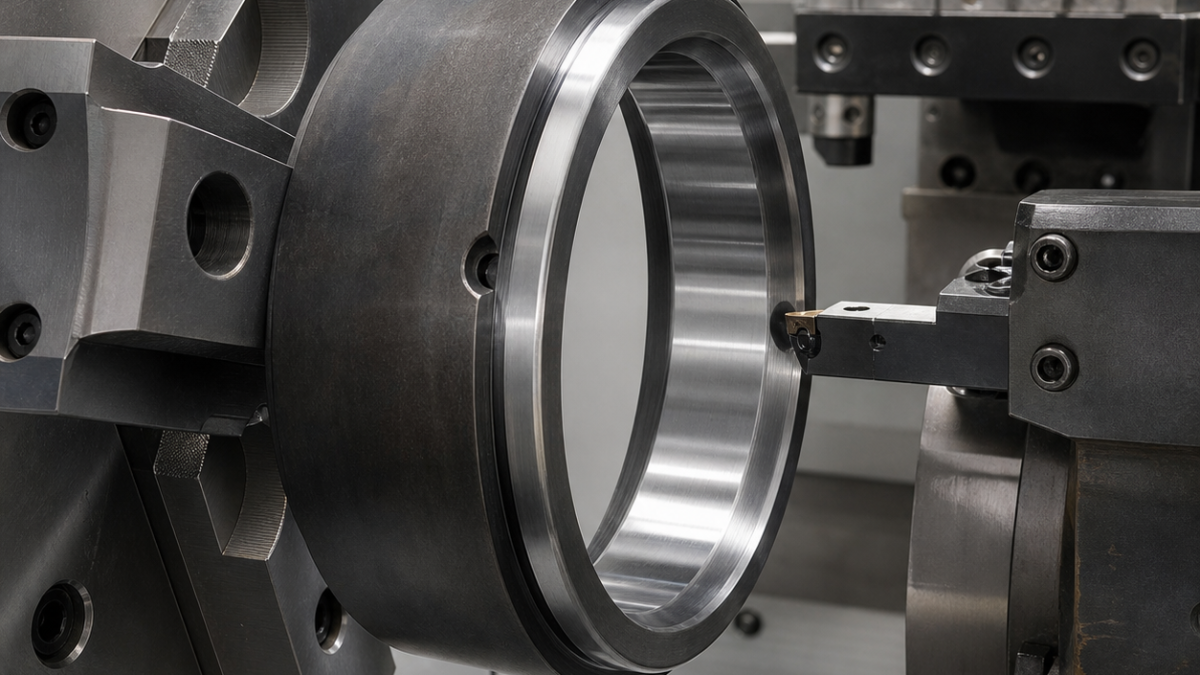
Post-heat-treat roundness and stock are mapped before cutting. Precision-bored six-segment jaws contact the OD over a wide band; hydraulic pressure is qualified by measuring the ring both clamped and released. A wiper CBN insert hard-turns the raceway with constant surface speed and no dwell. A generated-radius path creates crown rather than relying on a form tool that would amplify force. Two semi-finish passes remove the variable skin; the final pass takes a continuous 0.06 mm radial allowance.
Surface integrity decides whether grinding remains
White-layer risk rises with worn edges, low feed and heat. Acoustic signature, cutting force and surface trend trigger insert indexing. The lubrication groove is finished with a sharp CBN-compatible tool and its exits receive programmed edge breaks. If the specification requires residual-stress or subsurface limits beyond validated hard turning, a controlled grinding or superfinishing handoff remains; the article does not claim hard turning universally replaces grinding.
Measure in the same state the drawing defines
A roundness machine measures the released ring at three axial planes and separates harmonic lobing from simple eccentricity. A CMM relates raceway axis to B and OD; an air gauge checks diameter after thermal soak. A profilometer traverses along and across the raceway to record Ra and lay, while an approved etch or metallographic audit validates surface integrity by sampling plan. Final inspection occurs after demagnetization and cleaning.
FAQ
Can 52100 bearing raceways be hard turned instead of ground?
Sometimes, if roundness, finish and surface-integrity validation are met; demanding applications may still require grinding or superfinishing.
Why measure bearing rings after unclamping?
Thin rings can look round in the jaws and spring into lobing when released.
Which tool finishes 60–62 HRC 52100?
CBN is used for the continuous raceway finish here; carbide handles the annealed-stage roughing required by the route.
Related: free-state ring inspection and size-versus-position inspection logic.
中文: 淬硬52100轴承外圈加工:滚道圆度与精整交接
直接回答:淬硬52100外圈要稳定达到滚道圆度,必须在热处理前均匀留量、用低压力装夹并验证释放变形、硬车时连续切除余量,并把夹持状态与自由状态数据分开。退火态由硬质合金预加工,60–62 HRC滚道由CBN精加工。
尺寸链跨越热处理
外圈Ø126 × 24 mm,内滚道带冠形,释放态圆度0.012 mm,滚道对外圆跳动0.015 mm,Ra 0.2 µm,并有浅润滑槽。A为滚道轴,B为端面,C为外圆标记。淬火前滚道留直径0.35 mm、端面每侧0.20 mm;淬火后实测余量,不能按理论膨胀假定。
退火态先创造均匀余量
正前角涂层硬质合金刀片车端面和孔,硬质合金切槽刀把润滑槽预留。软爪宽带夹外圆,两面交替加工,保证孔、外圆和端面有足够同心度,使热变形后仍为连续可切余量。标记避开功能面,回火硬度按图达到60–62 HRC。
淬硬后只施加可验证的夹紧力
加工前绘制三截面圆度和余量图。六段精镗软爪宽带接触外圆,通过夹紧、释放对比确认液压压力。刮光型CBN刀片恒线速硬车,不得停顿;冠形由生成刀路形成,不使用高力成形刀。两次半精去除不均匀硬皮,终刀连续切0.06 mm径向余量。
表面完整性和检验
刃口磨损、低进给和积热会增加白层风险,以声学、切削力和表面趋势分度刀片。若规范要求更严格的残余应力或亚表层条件,仍移交磨削或超精,不宣称硬车万能替代。圆度仪在释放态三截面测量并分离谐波棱圆;三坐标关联滚道、B面和外圆,气动量仪恒温测径,轮廓仪顺、横滚道测Ra和纹理。清洗消磁后终检。
常见问题
52100滚道能用硬车代替磨削吗?
只有在圆度、粗糙度和表面完整性验证均通过时;高要求场合仍可能需要磨削或超精。
为何必须松夹测圆度?
薄环在爪内可能看似圆,释放后却恢复成多棱变形。
60–62 HRC用什么刀?
本路线用CBN连续精滚道,硬质合金负责退火态预加工。
延伸阅读:薄环自由状态检验和尺寸与位置的检验逻辑。
Français: Bague 52100 trempée : circularité de piste et finition
Réponse directe : la circularité stable d’une bague 52100 vient d’une surépaisseur équilibrée avant traitement, d’un serrage faible qualifié, d’une coupe dure continue et d’une mesure à l’état libre. Le carbure prépare l’état recuit; le CBN finit la piste à 60–62 HRC.
Une chaîne de cotes à travers la trempe
La bague Ø126 × 24 mm possède une piste bombée, une circularité libre de 0,012 mm, un battement de 0,015 mm et Ra 0,2 µm. A vient de la piste, B d’une face et C d’un repère extérieur. Avant trempe, 0,35 mm au diamètre de piste et 0,20 mm par face restent; le stock réel est cartographié après trempe.
Carbure avant, CBN après
Une plaquette carbure positive usine l’état recuit et un outil carbure préforme la gorge. Les faces sont alternées pour équilibrer les parois. Après traitement, des mors à six segments largement portants sont validés par mesures serrée et libérée. Une plaquette CBN wiper génère le bombé sans arrêt; deux passes retirent la peau variable et la dernière coupe 0,06 mm radialement.
Intégrité et mesure libre
Usure, faible avance et chaleur favorisent la couche blanche; force, acoustique et tendance de surface commandent l’indexage. Un relais de rectification ou superfinition reste prévu si l’intégrité l’exige. Un appareil de circularité mesure trois plans libres; la MMT relie piste, face et diamètre extérieur, le calibre pneumatique contrôle le diamètre et le profilomètre relève Ra dans deux directions.
FAQ
Le tournage dur remplace-t-il toujours la rectification ?
Non; seulement après validation de circularité, rugosité et intégrité.
Pourquoi mesurer desserré ?
Les mors peuvent masquer une lobation qui réapparaît au relâchement.
Quel outil pour 60–62 HRC ?
CBN pour la finition continue; carbure pour l’ébauche recuite.
Voir le contrôle libre des anneaux et la logique taille-position.
Русский: Кольцо 52100: круглость дорожки после закалки
Краткий ответ: стабильную круглость получают равномерным припуском до термообработки, проверенным малым зажимом, непрерывным твёрдым точением и измерением освобождённого кольца. Твёрдый сплав готовит отожжённую заготовку, CBN заканчивает дорожку 60–62 HRC.
Припуск через термообработку
Кольцо Ø126 × 24 мм имеет выпуклую дорожку, свободную круглость 0,012 мм, биение 0,015 мм и Ra 0,2 мкм. A — ось дорожки, B — торец, C — метка. До закалки оставляют 0,35 мм по диаметру дорожки и 0,20 мм на торцах; после закалки припуск измеряют.
Карбид и CBN
Позитивная твердосплавная пластина обрабатывает отожжённую сталь, канавочный резец оставляет запас. После закалки шестисегментные мягкие кулачки проверяют измерением в зажиме и после освобождения. CBN wiper без остановки генерирует корону; две получистовые снимают переменную корку, чистовая — 0,06 мм по радиусу.
Целостность и контроль
Износ, малая подача и тепло повышают риск белого слоя. По силе, звуку и поверхности индексируют пластину; при строгих требованиях сохраняют шлифование или суперфиниш. Кругломер измеряет три свободных сечения, КИМ связывает дорожку с торцом и наружным диаметром, пневмокалибр проверяет размер, профилометр — Ra в двух направлениях.
Вопросы
Всегда ли твёрдое точение заменяет шлифование?
Нет, только после подтверждения круглости, шероховатости и поверхностной целостности.
Зачем измерять без зажима?
Кулачки могут скрыть огранку, возвращающуюся после освобождения.
Какой инструмент для 60–62 HRC?
CBN для чистовой дорожки, твёрдый сплав для отожжённой стадии.
Сравните со свободным контролем колец и разделением размера и положения.