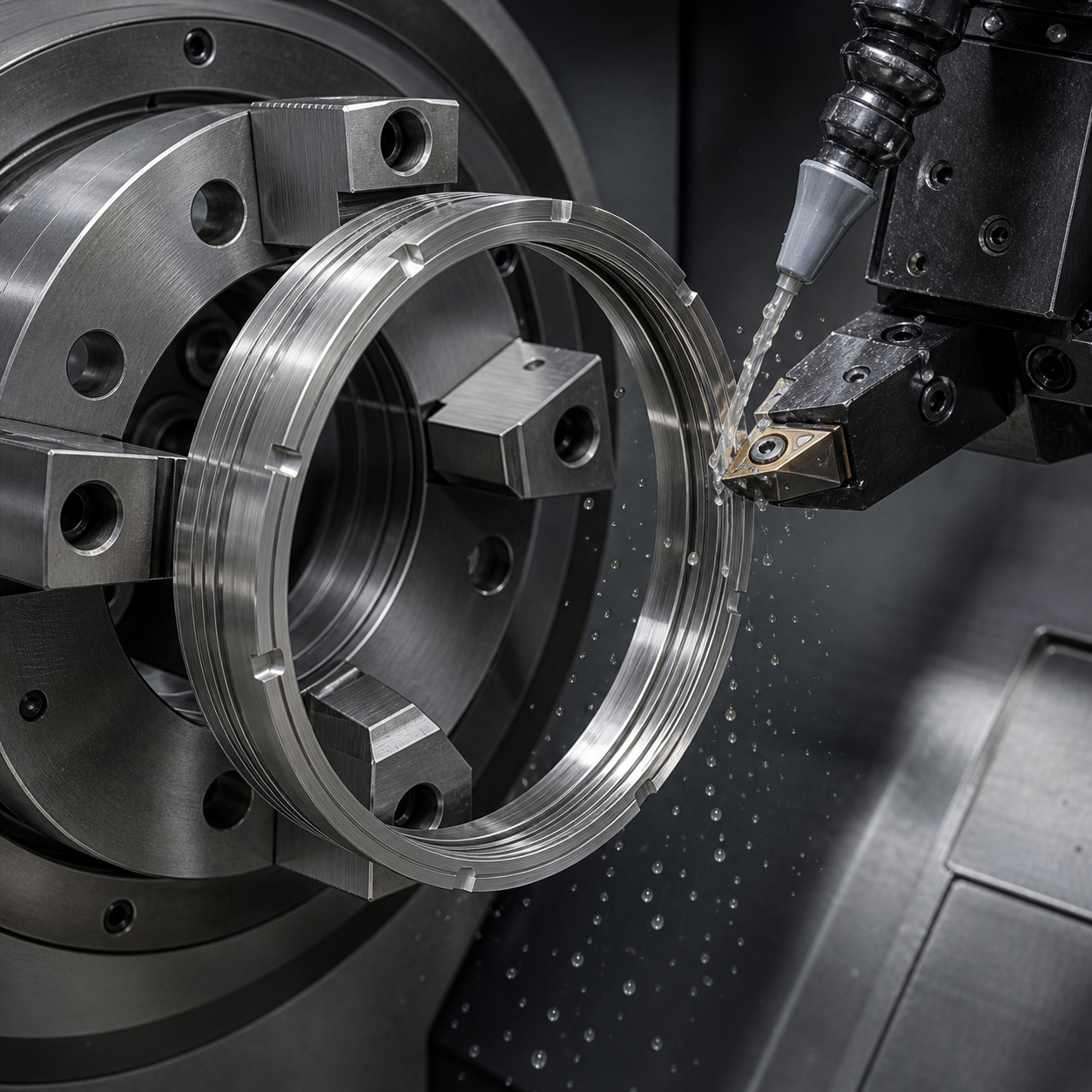
This is a realistic hypothetical process-planning case, not a customer project or confidential drawing.
English: Inconel 718 Seal Ring CNC Turning Case: Thin-Wall Grooves, Distortion and Tool-Life Control
Search intent and drawing interpretation
The long-tail question is how to turn a thin-wall Inconel 718 seal ring with interrupted grooves without losing roundness. The drawing must be read around free-state roundness, groove width and position, sealing-land finish, wall thickness and datum runout before a cutting tool is selected.
- Relate every groove to the same axial datum face
- Identify whether roundness applies clamped or free
- Reserve inspection access to narrow sealing lands
Carbide tool selection
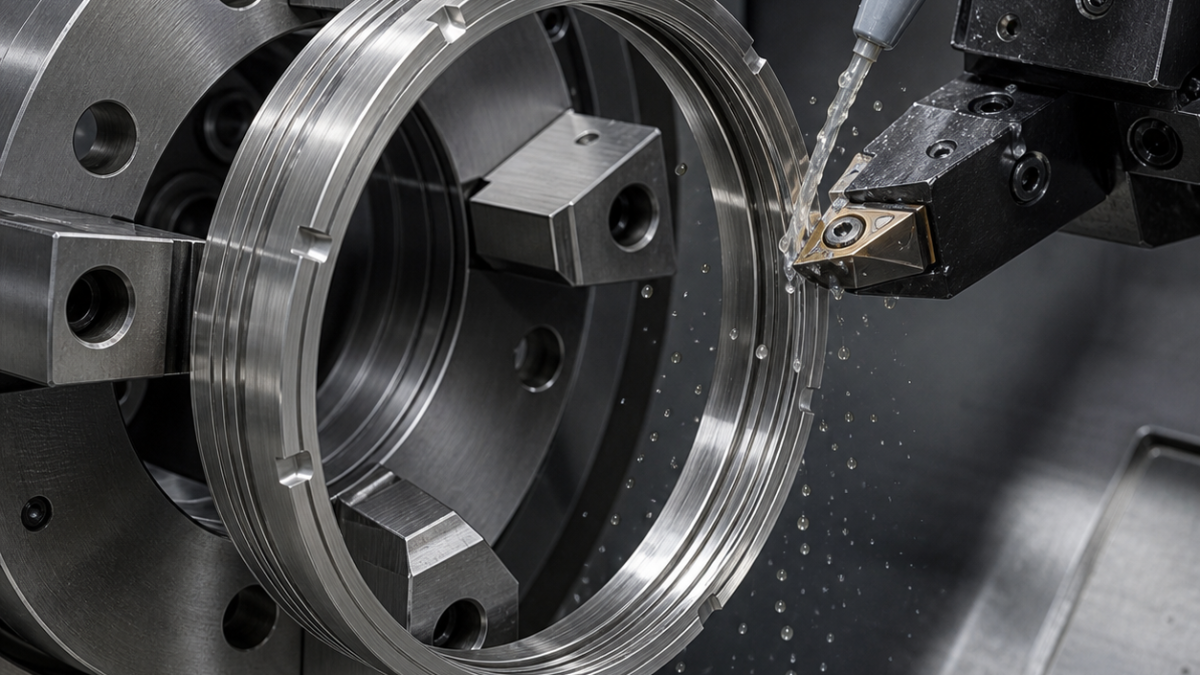
Use a tough PVD-coated fine-grain carbide grade with a sharp positive geometry, but keep enough edge strength for interruptions. Select a rigid narrow grooving blade, a stable positive turning insert for semi-finishing and a fresh dedicated edge for the final sealing lands.
Process planning and fixture choice
Rough the bore and outside diameter while the ring still has stiffness, stress-balance material removal, then grip on wide contoured soft jaws with minimum pressure. Finish the datum face and bore, reverse on a supported pilot, and cut grooves before the last free-state diameter correction.
- Keep jaw contact broad and concentric
- Leave uniform stock on both diameters
- Separate roughing and finishing insert offsets
Roughing, finishing and toolpaths
Use constant-surface-speed limits, short controlled groove pecks and a retract that clears work-hardened material. Avoid dwelling at groove shoulders. Semi-finish both diameters, allow thermal equalization, then make one continuous light finish pass with lead-out beyond the sealing land.
Material risks, chip or burr control and tool life
Inconel concentrates heat at the cutting edge, work-hardens after rubbing and can notch an insert at the depth-of-cut line. Bird-nest chips can scratch sealing lands. Track flank wear, notch wear, spindle load and finish trend; fixed part counts alone are not enough.
Tolerances, surface finish and inspection
Check free-state roundness on a calibrated roundness instrument, groove width and location with a narrow stylus or optical method, runout to the datum bore, wall thickness around the circumference and sealing-land roughness in the correct lay direction.
Inconel 718 seal-ring turning FAQ
How can thin-ring distortion be reduced?
Balance stock removal, use broad low-pressure soft jaws, thermally stabilize and correct size in the free state.
Which carbide insert is best for Inconel grooving?
A tough PVD-coated grade with a sharp but supported edge is a practical starting point; rigidity and coolant delivery remain decisive.
What signals end of tool life?
Notch or flank wear, rising load, chip-form change and sealing-land roughness drift are useful limits.