This is a realistic hypothetical process-planning example, not a claim about a specific customer drawing or production result.
Related: Compare the heat-control approach in our titanium aerospace bracket tooling case and the alignment logic in the 17-4PH clevis case.
English: reading the hinge-fitting drawing
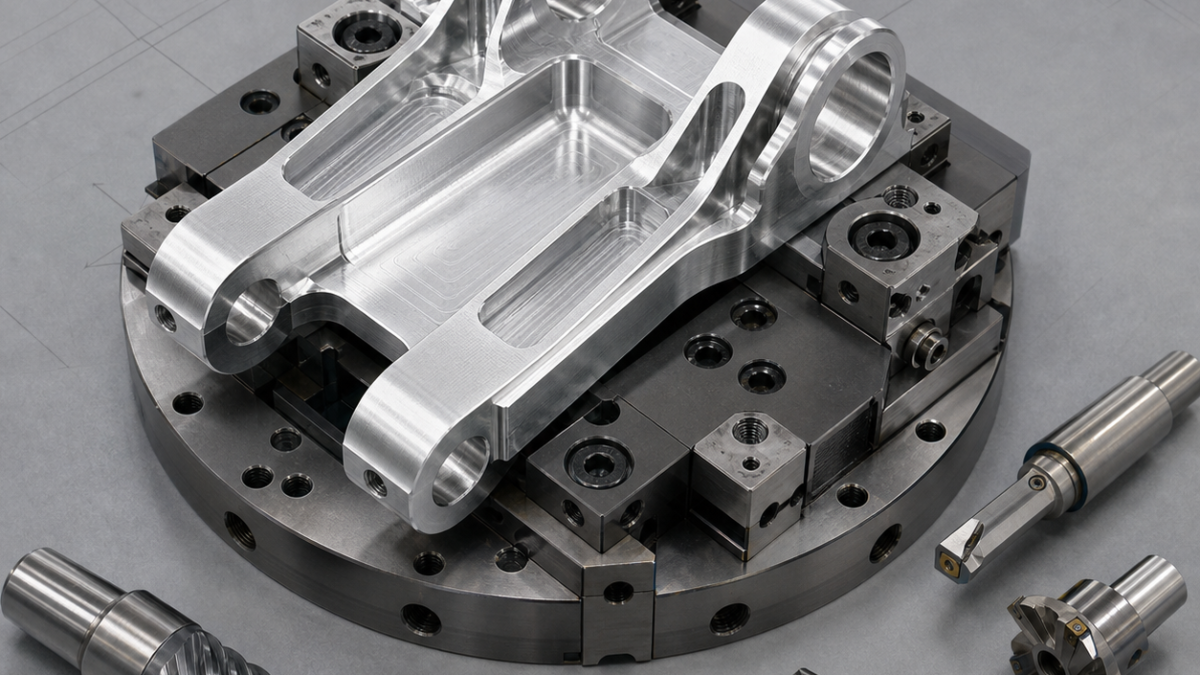
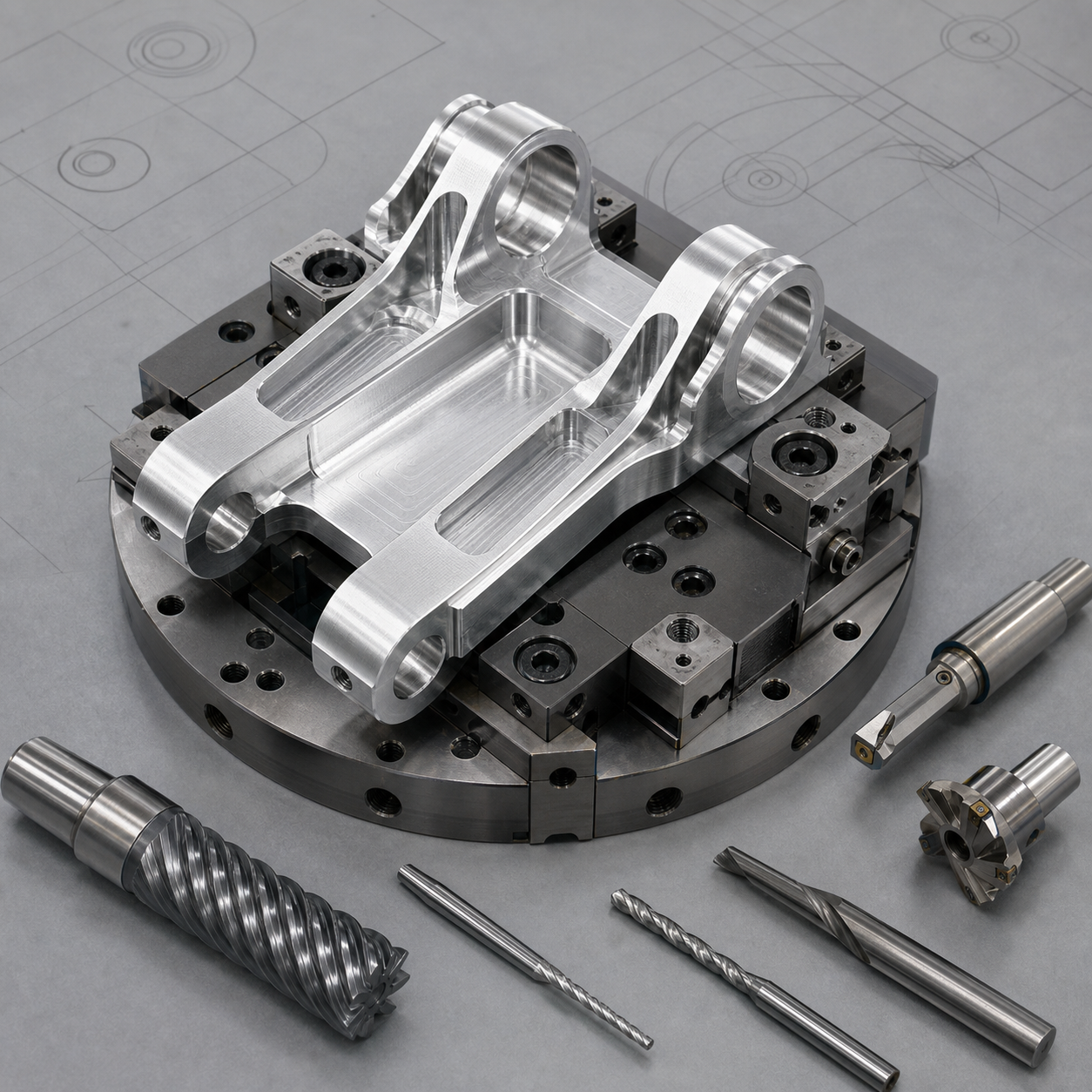
This hypothetical case starts with a 7050-T7451 billet and a drawing that prioritizes the common axis of two lug bores, fork spacing, pocket floor thickness and profile datums. The tooling plan must protect those relationships after heavy stock removal.
Translate features into controls
Treat the primary mounting face and two locating holes as datum A-B-C. Mark the lug bores as one functional feature rather than two independent holes. Deep fork pockets create unequal wall stiffness, so leave balanced stock and delay final bore sizing until the main pockets are stable.
Carbide tool set
Use a short variable-helix rougher for open-pocket adaptive milling, then a reduced-neck long-reach end mill for fork walls. Pre-drill the lugs, interpolate close to size, and finish both bores in one setup with a precision boring tool or line-boring arrangement. A small chamfer mill breaks edges without pushing the slender arms.
Process and fixture sequence
Face and establish datums first; rough both sides symmetrically with temporary ribs or sacrificial tabs. Stress-relieve through a controlled rest period if required by the process specification, reclamp on hardened datum pads, finish pockets, then bore the lugs. Probe the datum plane after every turnover and use a 5-axis trunnion only when it preserves tool rigidity.
Tolerance, finish and tool-life risks
The main risks are fork-arm movement, chatter from excessive stickout and built-up edge on aluminum. Use polished flutes, high chip evacuation and conservative radial engagement. Inspect coaxiality with a common mandrel or CMM routine, and check fork spacing only after unclamping because fixture force can hide movement.
FAQ
Why not finish the lug bores before the pockets?
Pocketing releases more stress and changes arm position, so early-finished bores may lose coaxiality.
Is a reamer enough for both bores?
Only when alignment and allowance are already controlled. For separated lugs, a common-axis boring method is usually safer.
中文:从铰链支座图纸提取加工重点
本假设案例采用7050-T7451铝合金毛坯。图纸的核心不是单个尺寸,而是两耳孔公共轴线、叉口间距、深腔底厚以及轮廓基准之间的关系。大量去料后仍要保持这些关系,工艺顺序比单纯提高切削参数更重要。
把图纸特征转化为控制项目
将安装底面和两个定位孔建立为A-B-C基准体系;把两只耳孔视为一个功能特征,不能分别加工后只检查孔径。深叉腔两侧刚性不同,应对称留量,并在主要腔体稳定后再完成耳孔精加工。
硬质合金刀具组合
开放腔粗加工选短刃变螺旋粗加工立铣刀,叉臂侧壁采用缩颈长刃精加工刀。耳孔先钻孔、圆弧插补预加工,再用精镗刀或同轴镗削方案一次装夹完成。小直径倒角刀用于去除锐边,避免对细长叉臂施加过大侧向力。
装夹与工序路线
先铣基准面,再通过临时工艺筋或牺牲连接对称粗加工两面;必要时按工艺规范安排稳定化处理。随后以硬化定位块重装,精加工深腔和叉壁,最后完成两耳孔。每次翻面后用测头复核基准,五轴转台只在能缩短刀具悬伸时使用。
公差、表面与寿命风险
主要风险是叉臂回弹、长悬伸振动和铝合金积屑瘤。应使用抛光排屑槽、充分排屑和较小径向吃刀。卸夹后再检查叉口间距,并用公共检验芯轴或三坐标共同评价两孔同轴度。
常见问题
为什么不能先精加工耳孔?
深腔去料会释放应力并改变叉臂位置,过早完成的耳孔可能失去同轴度。
两孔直接铰削是否足够?
只有在预孔位置和余量已受控时才可行;分离耳板通常更适合公共轴线镗削。
Français : interpréter le plan de la ferrure articulée
Ce cas hypothétique part d’une ébauche en 7050-T7451. Le plan met surtout en relation l’axe commun des deux alésages, l’écartement de la fourche, l’épaisseur des fonds de poche et les références de profil. La gamme doit préserver ces relations après un enlèvement de matière important.
Transformer les cotes en contrôles
La face de montage et deux trous de positionnement forment le système A-B-C. Les deux alésages doivent être traités comme une seule fonction. Les poches profondes créant des rigidités dissymétriques, on conserve une surépaisseur équilibrée jusqu’à la stabilisation de la pièce.
Choix des outils carbure
Une fraise courte à hélice variable assure l’ébauche adaptative; une fraise longue à col dégagé finit les flancs. Les oreilles sont percées puis interpolées avant une finition sur axe commun avec une tête à aléser. Une petite fraise à chanfreiner limite l’effort sur les bras minces.
Ordre des opérations et bridage
Créer d’abord les références, puis ébaucher les deux faces symétriquement avec nervures temporaires. Reprendre sur appuis trempés, finir poches et parois, puis aléser les oreilles. Le palpage après retournement évite de propager une erreur; le cinq axes n’est utile que s’il réduit le porte-à-faux.
Risques de tolérance et de durée de vie
Les risques dominants sont la détente des bras, les vibrations et l’arête rapportée. Des goujures polies, une bonne évacuation et un faible engagement radial sont essentiels. Contrôler l’écartement après débridage et la coaxialité avec un mandrin commun ou une MMT.
FAQ
Pourquoi aléser après les poches ?
L’ébauche libère des contraintes et peut déplacer les oreilles.
Un alésoir suffit-il ?
Seulement si les avant-trous sont déjà alignés; un alésage sur axe commun est plus robuste.
Русский: чтение чертежа шарнирного кронштейна
В этом условном примере заготовка выполнена из 7050-T7451. На чертеже критичны общая ось двух проушин, ширина вилки, толщина дна глубоких карманов и связь с базами. Маршрут должен сохранить эти параметры после большого съема металла.
От требований к контролю
Монтажную плоскость и два установочных отверстия принимают за систему баз A-B-C. Отверстия проушин рассматривают как единую функцию. До стабилизации детали на стенках и в карманах оставляют симметричный припуск.
Комплект твердосплавного инструмента
Короткая концевая фреза с переменной спиралью выполняет адаптивное черновое фрезерование, удлиненная фреза с шейкой — чистовую обработку стенок. Проушины сверлят, растачивают интерполяцией и окончательно обрабатывают по общей оси. Малой фасочной фрезой снимают кромки без лишней нагрузки.
Последовательность и оснастка
Сначала формируют базы, затем симметрично черновят обе стороны с временными перемычками. После повторного базирования на закаленных опорах чистят карманы и только затем растачивают проушины. После каждого переворота базы проверяют щупом; пятиосевая схема оправдана при уменьшении вылета.
Риски точности и стойкости
Опасны раскрытие вилки, вибрации длинного инструмента и налипание алюминия. Нужны полированные канавки, надежный отвод стружки и малое радиальное врезание. Соосность проверяют общей оправкой или КИМ после снятия зажима.
FAQ
Почему отверстия заканчивают после карманов?
Удаление материала высвобождает напряжения и меняет положение проушин.
Достаточно ли развертки?
Только при уже обеспеченной соосности; обработка по общей оси надежнее.