This is a realistic hypothetical process-planning example, not a claim about a specific customer drawing or production result.
Related: Read the related CNC tooling case.
English: 42CrMo Eccentric Camshaft Segment CNC Case: Offset Journals, Oil Hole and Hardening Allowance
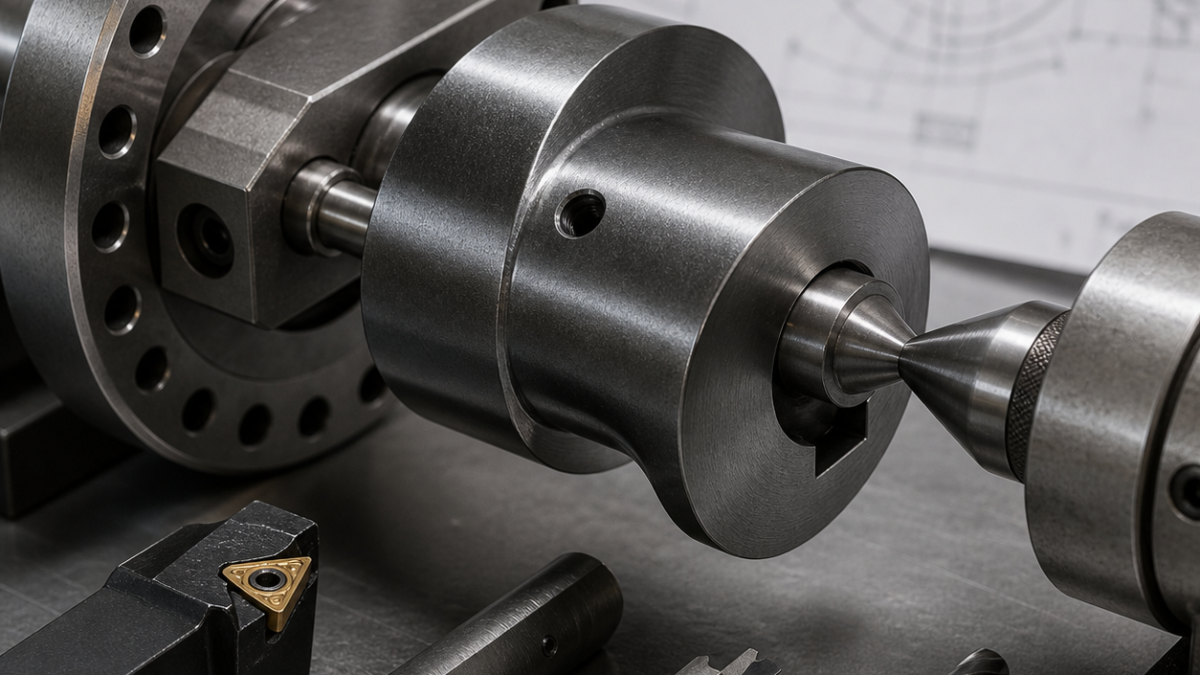
This hypothetical 42CrMo segment has a main journal, offset cam journal, axial pilot, keyway and intersecting oil hole. The drawing links eccentricity, phase angle and post-hardening runout, so datum transfer matters more than machining each diameter independently.
Feature and datum interpretation
Use the main journal axis as datum A, an axial face as B and the keyway center plane as clocking datum C. Convert the basic eccentricity and angular phase into fixture coordinates, then identify which diameters are final before induction hardening and which retain grind or hard-turn stock.
Carbide tool selection
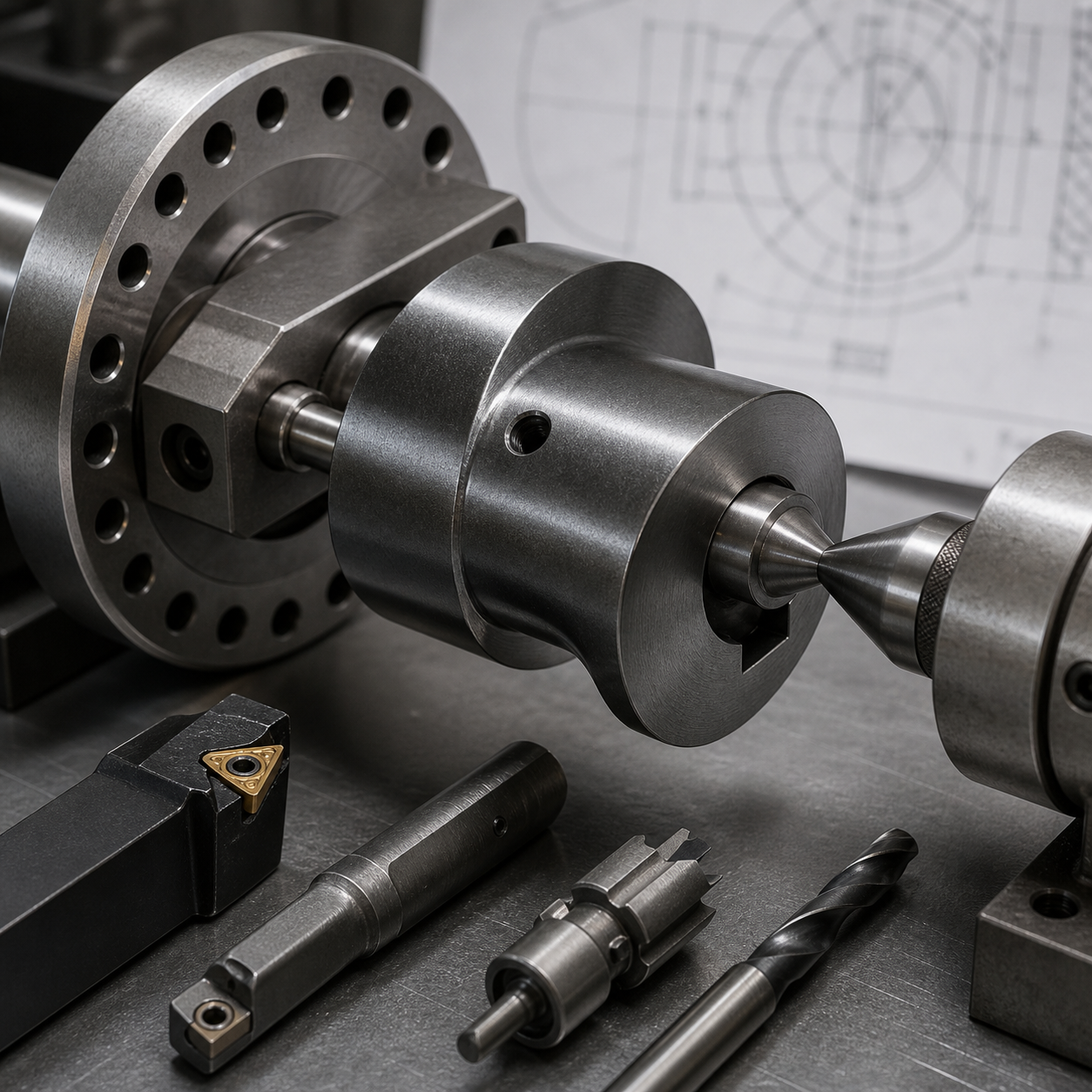
Rough with a tough carbide turning insert, finish soft journals with a sharp wiper geometry, and use a short boring bar for the pilot. A rigid carbide end mill cuts the keyway; a stub drill and back-deburring tool complete the intersecting oil passage. Keep a separate protected edge for post-hardening cleanup.
Fixture and process sequence
Establish the main centers and face first. Transfer to a balanced eccentric fixture, verify offset with probing, and rough and finish the cam journal without changing the clocking reference. Mill the keyway and drill the oil path before heat treatment, then induction harden and recover only the specified journals and faces.
Tolerance, surface and tool-life risks
Fixture imbalance, interrupted cuts and hardening distortion can change phase or runout. Limit speed to the verified balance condition, use constant engagement and track insert wear. Inspect eccentricity and phase from the main journal axis both before and after heat treatment, and borescope the oil-hole intersection for burrs.
FAQ
Why recover datums before finishing?
Because the functional geometry must be related to the actual part, not an assumed nominal center.
Why inspect after unclamping?
Clamping can temporarily hide distortion or runout.
中文: 42CrMo 偏心凸轮轴段 CNC 案例:偏置轴颈、油孔与淬火余量
本假设 42CrMo 凸轮轴段包含主轴颈、偏心凸轮轴颈、轴向定位孔、键槽和相交油孔。图纸把偏心量、相位角和热后跳动联系在一起,基准传递比孤立保证每个直径更重要。
特征与基准解释
以主轴颈轴线为基准 A,以轴向端面为 B,以键槽中心平面作为角向基准 C。把理论偏心量和相位转换为夹具坐标,并区分感应淬火前成品尺寸与保留磨削或硬车余量的表面。
硬质合金刀具选择
粗车采用韧性硬质合金刀片,软态轴颈精加工使用锋利修光刃,定位孔用短镗杆。键槽由高刚性硬质合金立铣刀完成;短钻和反向去毛刺刀处理相交油孔,并为热后修复保留独立刀具刃口。
夹具与工序顺序
先建立主中心孔和端面,再转入经过平衡验证的偏心夹具,探测确认偏置后保持同一角向基准完成凸轮轴颈。热处理前完成键槽、油孔和内部去毛刺,感应淬火后只恢复图纸指定的轴颈与端面。
公差、表面与刀具寿命风险
夹具不平衡、断续切削和淬火变形会改变相位与跳动。转速必须受平衡验证限制,保持稳定切削负载并跟踪刀片磨损;热前热后都从主轴线检查偏心和相位,并用内窥方式确认油孔交叉口。
常见问题
为什么精加工前要恢复基准?
功能几何必须对应实际零件,而不是假设的理论中心。
为什么卸夹后还要检测?
夹紧力可能暂时掩盖变形或跳动。
Français: Cas CNC d’un segment de came excentrée en 42CrMo : portées décalées, canal d’huile et surépaisseur de trempe
Ce segment hypothétique en 42CrMo associe portée principale, came excentrée, pilote, rainure de clavette et canal d’huile. Excentricité, phase et faux-rond après trempe forment une seule chaîne fonctionnelle.
Fonctions et références
L’axe principal devient A, la face B et le plan de clavette C. Transformer excentricité et phase en coordonnées de montage et distinguer les cotes finales des surépaisseurs après trempe.
Choix des outils carbure
Utiliser une plaquette carbure tenace, une géométrie de finition vive, une petite barre d’alésage, une fraise rigide pour clavette, un foret court et un outil d’ébavurage arrière.
Montage et gamme
Créer centres et face, reprendre dans un montage excentré équilibré, palper le décalage et usiner la came sans perdre l’indexation. Réaliser rainure et canal avant trempe puis reprendre seulement les portées prescrites.
Risques de qualité et d’usure
Le déséquilibre et la trempe modifient phase et faux-rond. Limiter la vitesse, suivre l’usure et mesurer depuis l’axe principal avant et après traitement.
FAQ
Pourquoi reconstruire les références ?
La géométrie fonctionnelle doit suivre la pièce réelle.
Pourquoi contrôler après débridage ?
Le serrage peut masquer une déformation.
Русский: Кулачок 42CrMo: смещенные шейки, масляный канал и припуск под закалку
Условный сегмент 42CrMo имеет основную и эксцентричную шейки, посадочное отверстие, шпонку и масляный канал. Эксцентриситет, фаза и биение после закалки контролируются совместно.
Функции и базы
Основная ось задает A, торец — B, плоскость шпонки — C. Эксцентриситет переводят в координаты приспособления и отделяют окончательные размеры от припуска после закалки.
Твердосплавный инструмент
Нужны прочная твердосплавная пластина, чистовая геометрия, короткая расточная оправка, жесткая шпоночная фреза, сверло и обратный инструмент для заусенца.
Установ и маршрут
Сначала создают центры и торец, затем проверяют смещение в сбалансированном эксцентричном приспособлении. Шпонку и канал делают до закалки, после нее восстанавливают заданные поверхности.
Риски точности и стойкости
Дисбаланс и закалка меняют фазу. Скорость ограничивают по балансировке, износ отслеживают, а эксцентриситет проверяют до и после термообработки.
FAQ
Зачем восстанавливать базы?
Функциональная геометрия должна соответствовать реальной детали.
Зачем измерять после освобождения?
Зажим может скрывать деформацию.