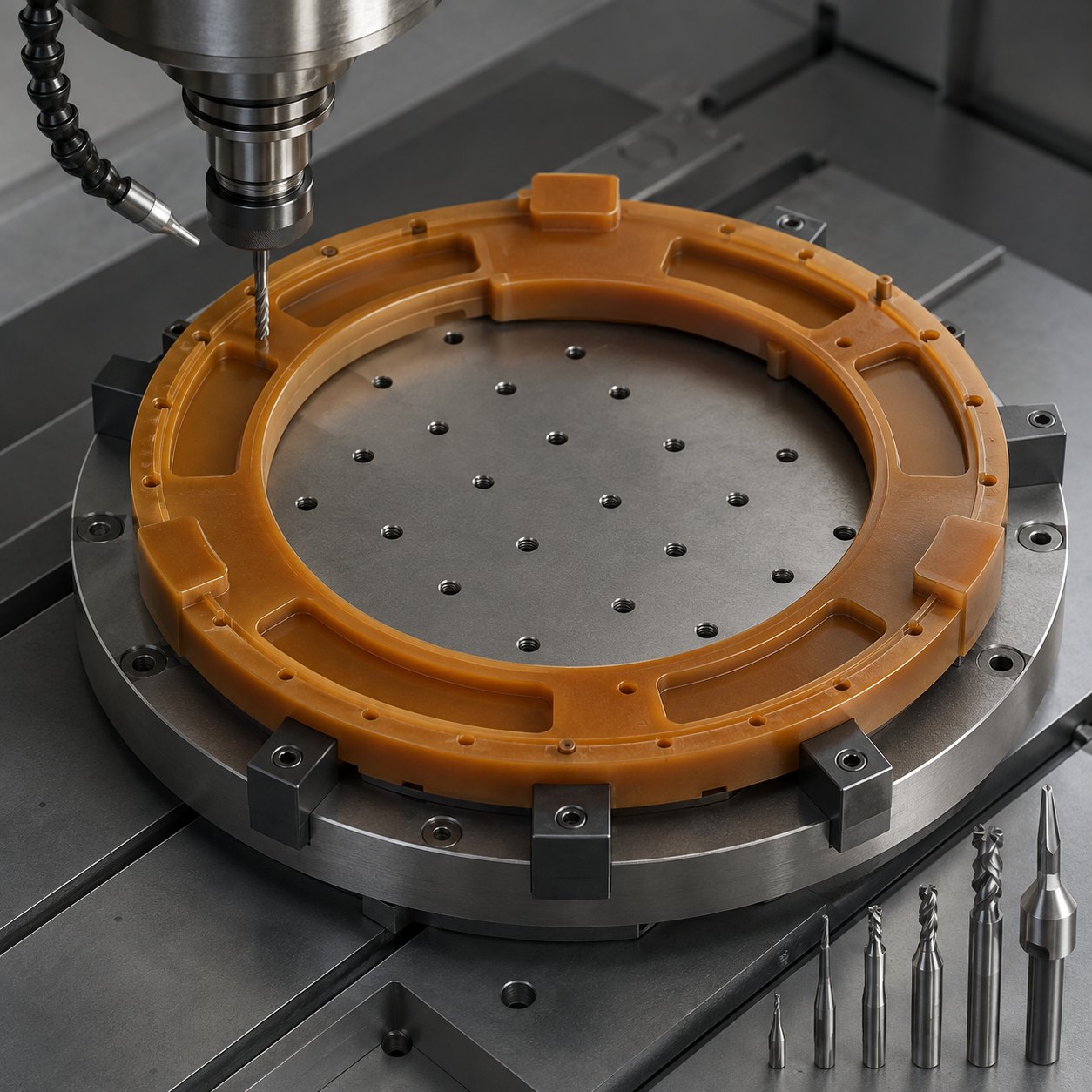
English: Torlon 4203 Wafer Carrier Ring CNC Tool Selection for Vacuum Pockets and Purge Holes
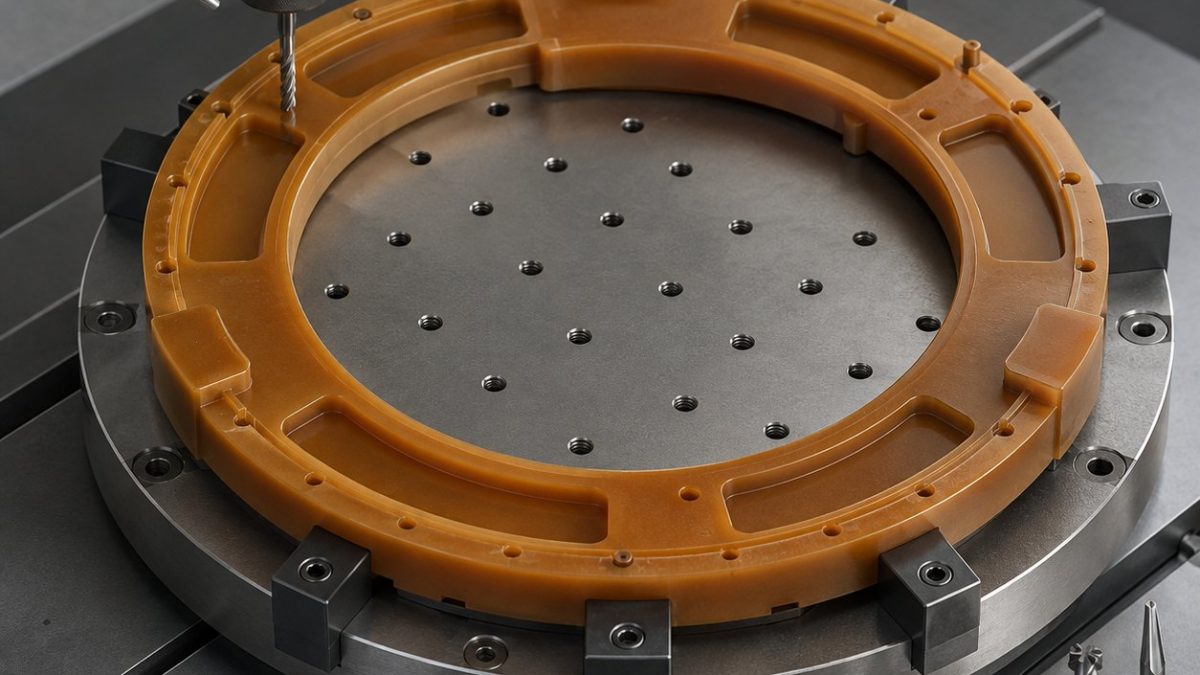
This hypothetical Torlon 4203 wafer carrier ring targets users searching for polymer CNC tool selection for delicate support pads, shallow vacuum relief pockets and tiny purge holes. The tooling strategy favours polished, sharp carbide and controlled support because heat and clamping marks can become functional defects.
Feature-driven tooling sequence
The drawing defines a free-state ring profile, raised wafer pads, anti-rotation flats and purge holes that must stay open after deburring. The sequence roughs the OD/ID with balanced stock, finishes pads last, and keeps the part on a vacuum nest until all holes and flats are complete. Related support logic appears in Vespel SP-1 rotor tooling and vacuum fixturing for thin sheet milling.
Feature-to-tool selection
| Drawing feature | Selected cutter | Risk controlled |
|---|---|---|
| OD and ID circular profiles | Ø6 mm 2-flute polished carbide end mill, uncoated, high rake | Sharp edge shears Torlon; coated roughers are rejected because they rub and heat the polymer. |
| Shallow vacuum pockets | Ø3 mm single-flute polished carbide, short stickout | Large chip space removes stringy chips; four-flute tools pack chips. |
| Raised wafer support pads | Ø2 mm ball or corner-radius carbide finisher, measured runout below pad tolerance | Leaves controlled blends; abrasive hand finishing is rejected. |
| Tiny purge holes | Carbide micro drill with backup support and air blast | Prevents exit lip rollover; drill-through without backing is rejected. |
| Anti-rotation flats | Sharp 2-flute end mill plus light climb finishing pass | Keeps flats straight without squeezing the ring. |
Inspection and burr control
Use low clamping pressure, air blast rather than flood coolant, and pause for thermal stabilization before final pad height measurement. Inspect pad coplanarity, ID/OD roundness, purge-hole openness, pocket floor fuzz and free-state flatness.
中文: Torlon 4203晶圆承载环真空槽、支撑凸台和微孔配刀
Torlon 4203 晶圆承载环的配刀重点是浅真空槽、支撑凸台、微小吹扫孔和防转平面。材料受热后容易变形,夹痕也可能变成功能缺陷,所以刀具必须锋利、排屑顺畅,并配合真空软支撑。
特征配刀表
| 图纸特征 | 刀具 | 控制风险 |
|---|---|---|
| 内外圆轮廓 | Ø6 mm 两刃未涂层抛光硬质合金立铣刀 | 高前角切削,减少发热。 |
| 浅真空槽 | Ø3 mm 单刃抛光立铣刀,短伸出 | 排屑空间大;不选四刃刀,防止缠屑。 |
| 晶圆支撑凸台 | Ø2 mm 球刀或圆角精刀,低跳动 | 保证凸台过渡和高度。 |
| 微小吹扫孔 | 硬质合金微钻,背面支撑加气吹 | 避免出口翻边堵孔。 |
| 防转平面 | 锋利两刃刀顺铣精修 | 保持直线度,减少挤压变形。 |
检验
检验支撑凸台共面度、内外圆自由状态圆度、微孔通畅、槽底毛边和整体平面度。最终尺寸应在零件温度稳定后测量。
Français: Outils CNC pour anneau Torlon 4203 avec poches de vide
L’anneau porte-wafer en Torlon 4203 exige des outils très coupants pour éviter l’échauffement, les bavures fibreuses et les marques de serrage.
Sélection par fonction
| Fonction | Outil | Risque réduit |
|---|---|---|
| Profils ID/OD | Fraise carbure polie Ø6 mm, 2 dents | Coupe nette sans échauffement. |
| Poches de vide | Fraise polie Ø3 mm, 1 dent | Évacuation des copeaux filants. |
| Plots support | Fraise boule ou torique Ø2 mm | Hauteur de plot stable. |
| Micro-trous | Micro-foret carbure avec support arrière | Sortie propre. |
| Méplats | Fraise 2 dents avec passe en avalant | Moins de compression. |
Contrôle
Le contrôle porte sur la coplanarité des plots, la rondeur libre, les trous ouverts et les bavures dans les poches.
Русский: Инструмент для кольца Torlon 4203
Кольцо-носитель из Torlon 4203 требует острых полированных фрез, потому что нагрев, стружка и следы зажима сразу влияют на посадочные площадки.
Таблица выбора
| Элемент | Инструмент | Причина |
|---|---|---|
| Внутренний и наружный контур | Ø6 мм полированная 2-зубая фреза без покрытия | Чистый срез. |
| Вакуумные карманы | Ø3 мм однозубая фреза | Лучший вывод стружки. |
| Опорные площадки | Ø2 мм шаровая или радиусная фреза | Контроль высоты. |
| Малые отверстия | Карбидное микросверло с подкладкой | Нет завальцовки выхода. |
| Плоские зоны | Острая 2-зубая фреза | Меньше сжатие кольца. |
FAQ
Why avoid coated roughing tools in Torlon?
Many coatings add edge radius; Torlon needs a sharp polished edge more than heat-resistant coating.
Should the support pads be machined early?
No. Leave them for the last stable finishing step so later clamping and heat do not mark them.
What is the main inspection point?
Pad coplanarity and purge-hole openness decide whether the carrier works.