English: AISI 8620 Gerotor Housing CNC Tooling Case: Epitrochoid Bore and Carburizing Stock
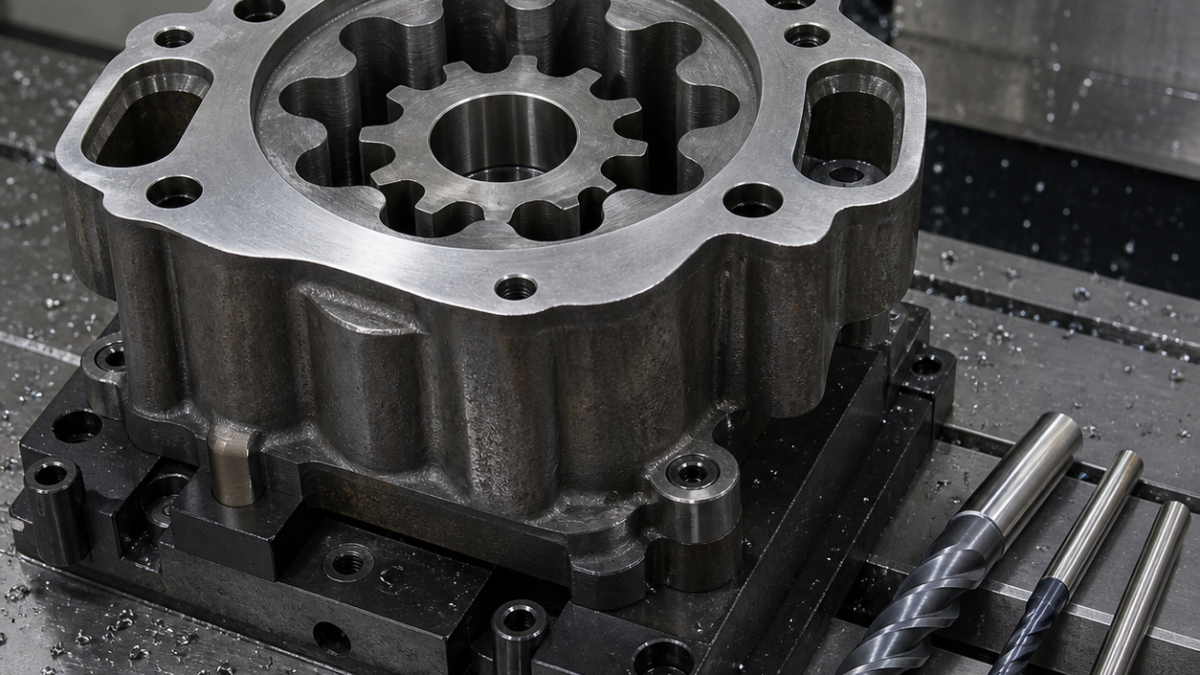
An AISI 8620 gerotor housing cannot be tooled as a generic pocket. The internal epitrochoid needs a rigid rougher, a smaller bull-nose semifinisher and a precision necked finisher; crescent ports need a separate chip-clearing path; and the drawing must distinguish pre-carburizing stock from surfaces that remain soft. This hypothetical case builds the tool plan around that sequence.
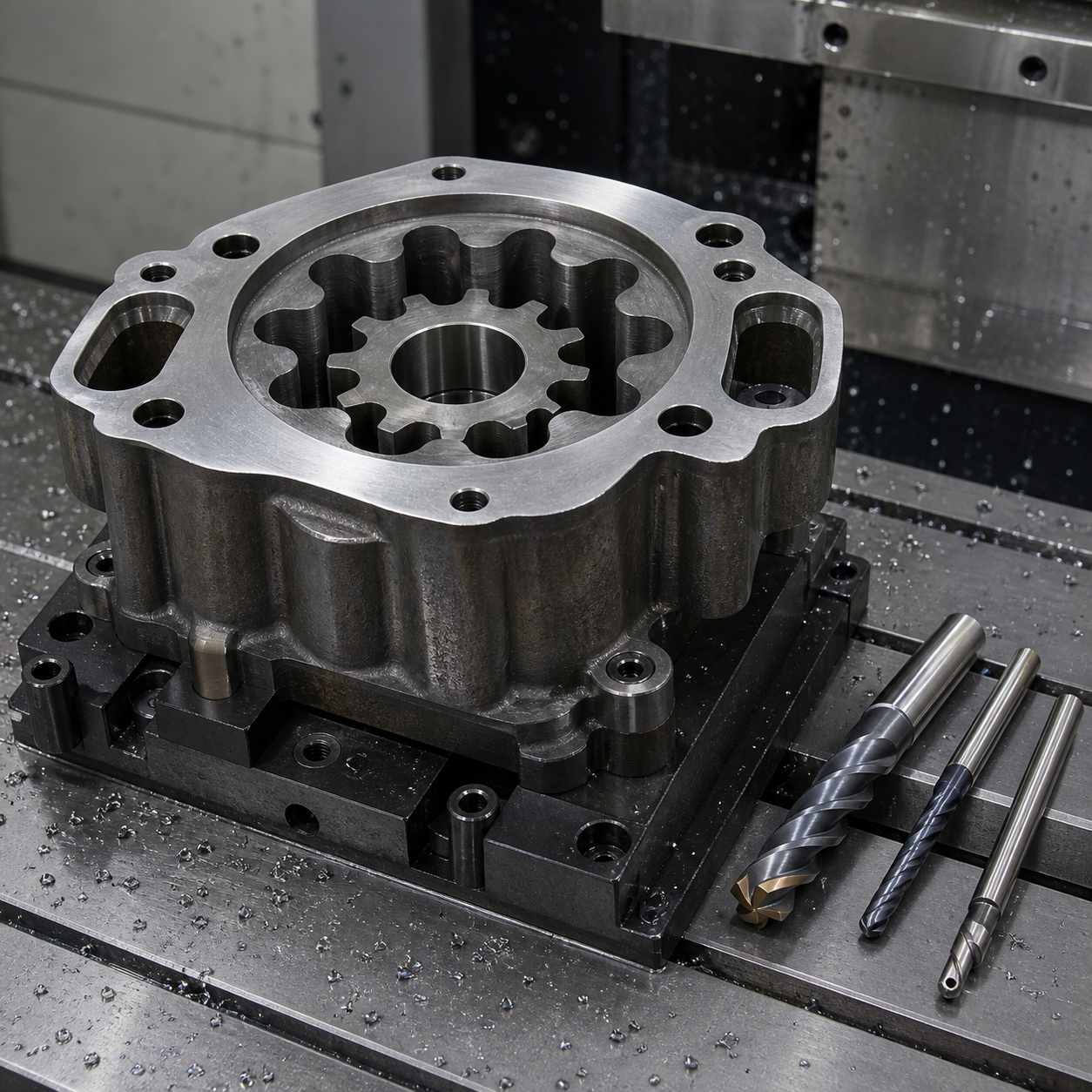
Drawing interpretation and heat-treatment intent
Mounting face A and dowel bores B-C establish the pump datum. The epitrochoid is profile-toleranced 0.025 mm to A-B-C, the rotor side clearance is developed after heat treatment, crescent ports hold 0.05 mm position, and A is flat within 0.02 mm at Ra 0.8 µm. The drawing leaves 0.18 mm per wall for post-carburizing hard finishing and masks the external mounting face from carbon. Blind oil pockets meet the profile with R0.8 minimum, so an undersized finishing tool must reach residual cusps without rubbing the full wall.
Feature-to-tool selection table
| Drawing feature | Selected tool and holder | Rationale / alternative rejected |
|---|---|---|
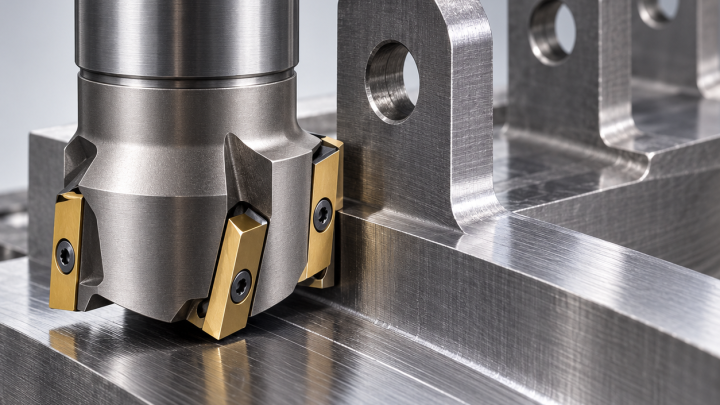
| Datum face A | Ø50, six-insert positive face mill, PVD-coated P25 carbide, 0.8 mm wiper, rigid arbor | Stable in normalized 8620 with interrupted skin. PCD is rejected because ferrous cutting causes rapid chemical wear. |
| Epitrochoid bulk roughing | Ø16, 5-flute variable-pitch AlTiN carbide, 0.1 mm edge hone, 32 mm reach, hydraulic holder | High metal removal with a tough edge. A four-flute long cutter lacks radial stiffness at the deepest lobes. |
| Profile semifinish | Ø8, 5-flute TiAlN bull nose R0.5, relieved neck, 38 mm reach, shrink holder | Equalizes stock through concave lobes while protecting the corner. A ball nose creates excessive scallop and axial force. |
| Pre-carburizing profile finish | Ø6, 6-flute high-precision AlCrN carbide, R0.2, necked shank, shrink holder with runout below 0.005 mm | Reaches residual geometry and leaves uniform 0.18 mm. A Ø4 tool would be more flexible without adding access. |
| Crescent ports | Ø5, 4-flute coated carbide, chip-splitter geometry, through-coolant hydraulic chuck | Trochoidal paths control slot load. Full-width plunging with a standard end mill traps chips. |
| Dowel bores B-C | Carbide pilot drill, Ø9.5 through-coolant drill and fine-boring head to pre-heat size | Boring secures position and controlled hard-finish stock; a reamer follows drill drift. |
| Port edge chamfers | Ø10, 4-flute AlTiN carbide chamfer mill, 90°, short projection | Controlled break before carburizing; hand blending would vary the carbon-case edge. |
Roughing, fixture and carburizing handoff
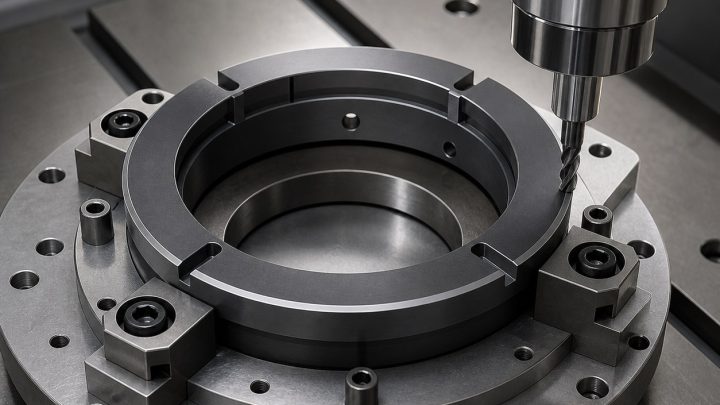
A is faced first, and B-C pilots are established from the same setup. A rigid tombstone nest then locates on A with two expanding pins and supports the housing beneath the lobe ring. The Ø16 tool uses high-efficiency milling at less than 10% radial engagement, leaving 0.60 mm. The Ø8 bull nose follows a constant-cusp morph between the mathematical curves, leaving 0.28 mm. The Ø6 finisher makes two axial bands per lobe and leaves the specified 0.18 mm hard-finishing stock rather than chasing final rotor clearance in the soft condition.
Crescent ports are machined after the cavity so their breakthrough burr is accessible. The Ø5 cutter starts in a drilled relief, uses trochoidal arcs and alternates the two ports to distribute heat. Chips are evacuated with through-coolant and air only when permitted by the enclosure. Tool-life alarms track spindle-load slope, corner chipping and lobe-to-lobe stock variation. After carburizing, datum A is lightly ground, B-C are hard-finished, and the epitrochoid is completed by the qualified hard-finishing or grinding process from the restored datum frame.
Inspection and search-focused FAQ
Before heat treatment, a CMM scans each lobe at three axial levels and reports actual stock against the nominal finished profile, not merely the soft-stage contour. Port position, minimum web, B-C relation and A flatness are recorded for heat-treatment compensation. After carburizing, hardness and case depth follow the drawing; the restored A-B-C frame is used for final profile, rotor clearance, port blending and surface-finish verification.
Which end mill should finish an epitrochoid bore before carburizing?
Use the largest necked precision tool that reaches every concavity; here Ø6 with six flutes and controlled runout leaves uniform hard-finishing stock.
Why not machine the gerotor profile to final size before heat treatment?
Carburizing and quenching can distort the thin lobe ring. Defined stock allows the final profile to be restored from the hardened datum system.
How are crescent-port burrs prevented from damaging the cavity?
Machine ports after cavity roughing, use a chip-splitting trochoidal path, flush breakthrough chips outward and apply a programmed chamfer before heat treatment.
Related reading: carburizing allowance and datum restoration and hardening-stock inspection planning.