English: PMMA Optical Flow Cell CNC Tooling Case: Polished Windows and Microchannels
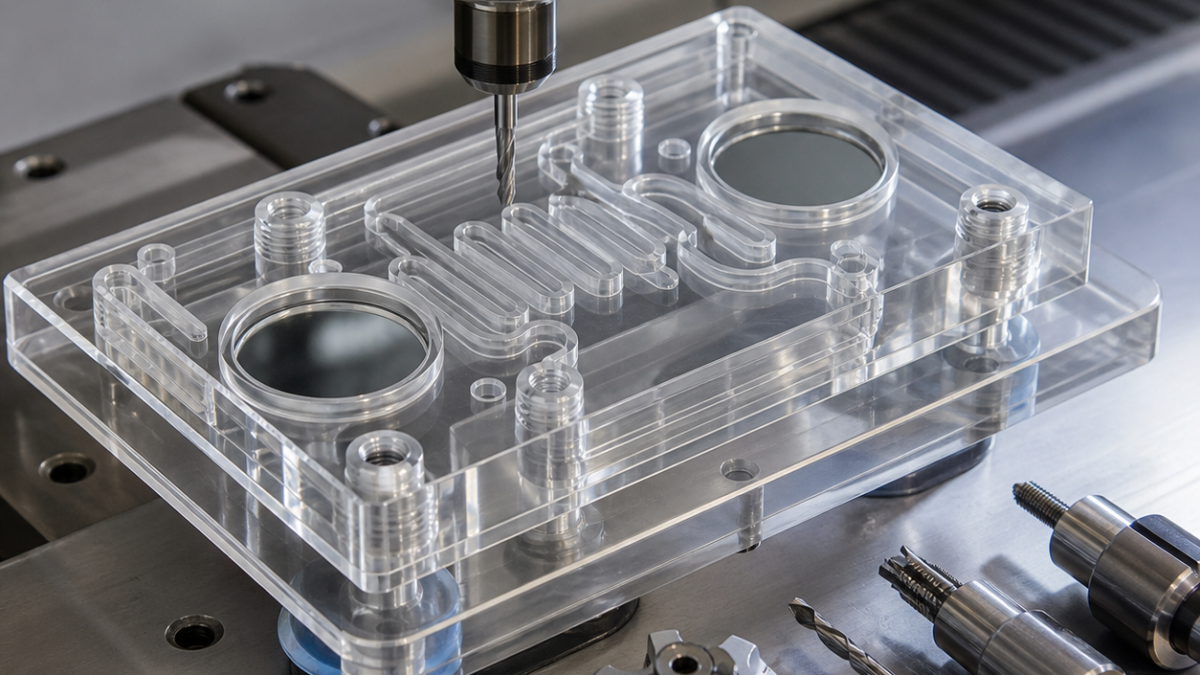
For a transparent PMMA flow cell, optical windows must be finished before the microchannels remove support, while ports and threads must be machined without coolant chemistry that can cause crazing. The tool set therefore combines a balanced PCD fly cutter for the viewing faces, polished single-flute carbide for channels, and a small carbide thread mill that produces threads without tap torque.
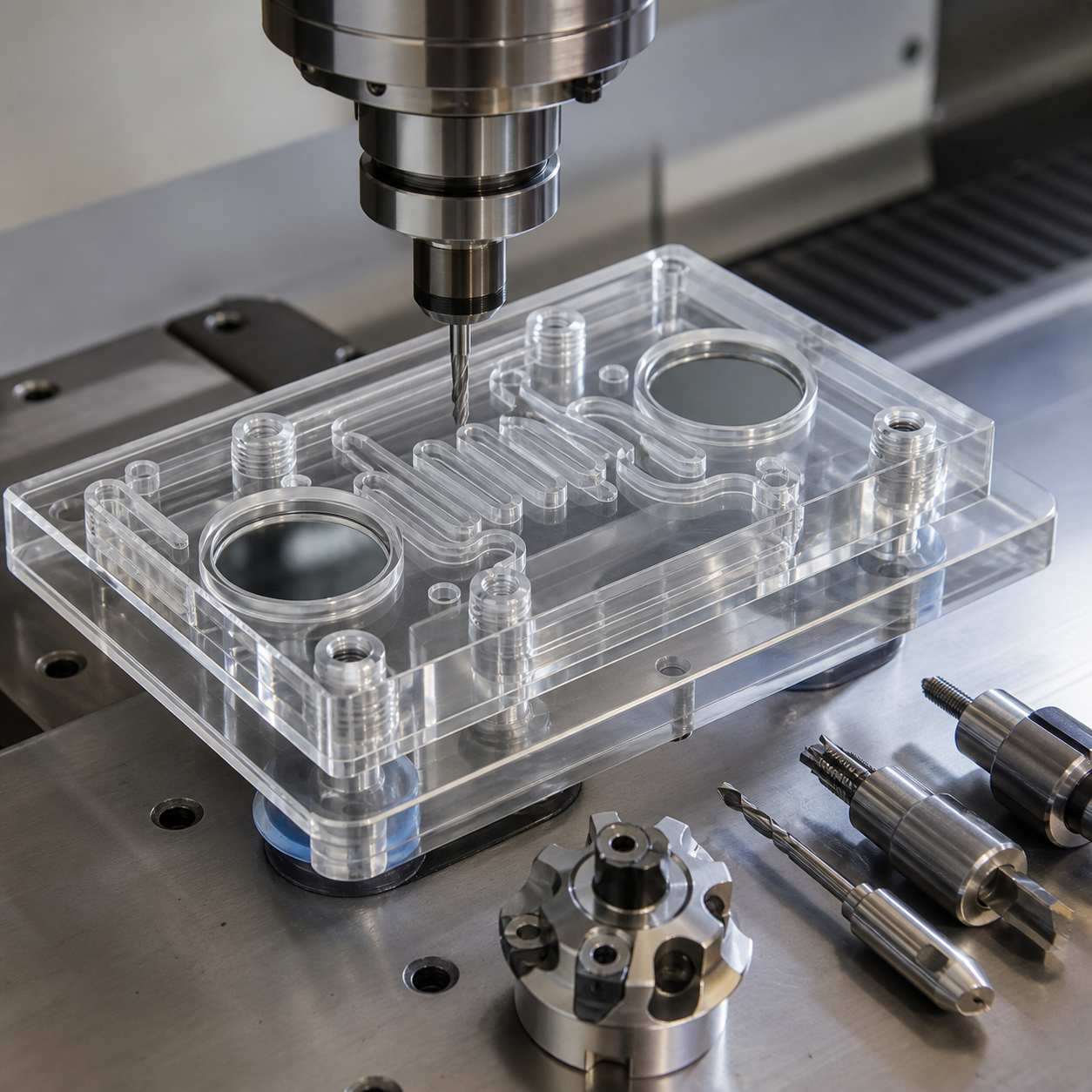
Optical surface first: drawing intent
Viewing face A is the optical datum; dowel holes B-C locate a cover. Two 32 mm windows require flatness 0.015 mm and a diamond-machined finish target of Ra 0.05 µm. The serpentine channel is 1.20 ±0.03 mm wide by 0.80 ±0.02 mm deep, the O-ring groove is 1.50 mm wide, and four M4 ports meet the channel without visible whitening or loose burrs. A 0.20 mm edge break protects assembly while preserving the clear aperture.
Tool selection by surface energy and chip escape
| Feature | Selected cutter and holder | Reason / rejected choice |
|---|---|---|
| Optical windows | Ø40 single-point PCD fly cutter, 0.5 mm nose, balanced ultra-precision arbor | One continuous sweep avoids stitch lines; a small end mill would leave overlapping tracks. |
| Block squaring | Ø10 single-flute polished uncoated carbide O-flute, 30° helix, hydraulic holder | Large polished gullet ejects warm chips; a coated four-flute steel tool can melt and recut them. |
| 1.2 mm microchannel | Ø1.0 two-flute polished carbide, 15° helix, 3 mm cutting length, precision micro chuck | Leaves side compensation and limits upward pull; a 1.2 mm form tool cannot correct width. |
| O-ring groove | Ø1.2 single-flute polished carbide, flat end, 2.5 mm flute | Controls floor and width independently; a ball tool produces a sealing cusp. |
| Port pilots | Ø3.3 stub polished-carbide drill, 90°–100° point, double margin, low-runout collet | Short point reduces breakthrough wedge; a standard 118° drill can lift a white exit cone. |
| M4 threads | Ø2.5 single-row uncoated carbide thread mill, sharp edge, hydraulic micro holder | Low torque and adjustable pitch diameter; a tap can wedge chips and craze the boss. |
| Edge break | Ø6 single-flute polished carbide chamfer mill, 90°, preset height | Produces 0.20 mm before final cleaning; hand scraping clouds the edge. |
Fixture, thermal pause and contamination control
The annealed blank rests on a clean sacrificial acrylic plate over a low vacuum zone, with three hard stops outside the viewing aperture. Window A and its opposite face are fly-cut in separate light passes with a thermal pause between them. B-C are then drilled, and the block is located to mill the channel from its outlet toward the inlet so chips always have an open escape. Radial engagement stays low and every pass ends outside the optical area.
Chilled clean air and vacuum extraction remove chips; only a PMMA-compatible coolant qualified by the facility may touch the part. Alcohol, aggressive solvent and overheated recutting are excluded. A milky edge, curled fused chip or rising spindle load marks excessive heat or a dull edge. Threads are milled after channels but before the final optical cleaning, and a sacrificial plug supports each port breakout.
Inspection and real search questions
Interferometric or qualified optical measurement checks window flatness and transmitted distortion. A vision system measures channel width, corner condition and burr; a depth instrument references A. Thread pitch diameter is verified with a polymer master at limited torque, dowels by CMM, and the assembled cell by pressure or leak testing compatible with the hypothetical drawing. Inspection occurs after thermal stabilization and protective film removal.
What cutter produces a clear PMMA optical window?
A balanced single-point PCD fly cutter can create a continuous optical sweep when the machine, blank and thermal process are qualified.
How can a 1.2 mm acrylic microchannel be held to width?
Use an undersized Ø1.0 polished two-flute carbide tool and finish each wall with compensation instead of relying on a full-width form cutter.
Why thread mill PMMA ports instead of tapping?
Thread milling reduces wedging torque, clears chips and allows pitch-diameter correction without stressing the transparent boss.
Compare polished-tool chip control in POM and thermal control in precision polymer machining.