English: AISI 1215 Spool Sleeve CNC Tooling Case: Deep Bore, Metering Windows and Honing Stock
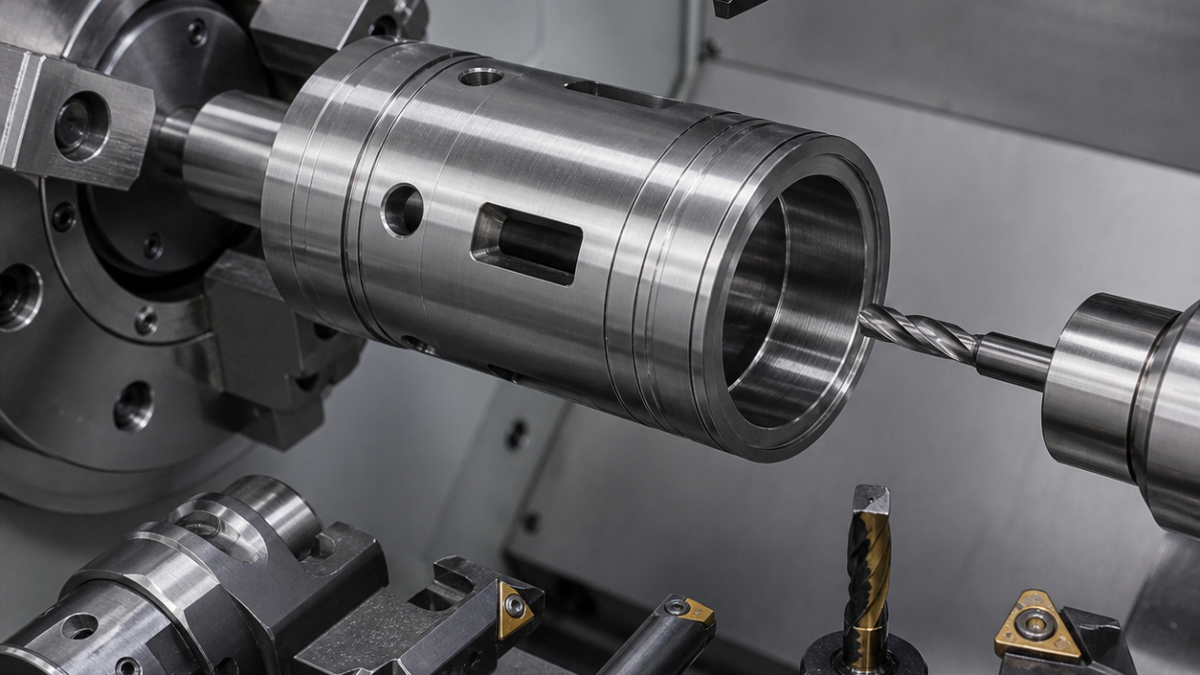
The efficient tooling route for an AISI 1215 pneumatic spool sleeve begins inside the part. Drill and fine-bore the long passage while the wall is still continuous, mill the metering windows only after a honing allowance has been measured, and remove their internal burrs with a controlled back-cutting tool. That order protects bore straightness and gives honing uniform stock instead of forcing the hone to correct milling distortion.
What the drawing makes functionally important
End face A and the Ø20 bore axis B locate six metering windows; one small cross port establishes clocking datum C. The 96 mm-long bore is finished to Ø20 H6, straightness 0.008 mm and Ra 0.20 µm after honing. Window position is 0.020 mm to A-B-C, their internal edges allow only a 0.05–0.10 mm break, and two 1.5 mm-wide outside seal grooves run within 0.015 mm of B. The machining route leaves 0.035 mm radial honing stock after window cutting.
Tool chain from closed tube to open window sleeve
| Drawing feature | Selected tool and holder | Why it is assigned here |
|---|---|---|
| Faces and outside datum | CNMG 120404 P15 CVD-coated carbide, light 0.05 mm hone, rigid lever-lock holder | Free-cutting steel permits a stable coated edge; the smaller nose limits wall pressure. |
| Bore pilot | Ø18.5 through-coolant solid-carbide drill, 140° point, four margins, hydraulic chuck | Creates a straight guided hole; a large indexable drill would leave more entry runout. |
| Pre-hone bore | Positive fine-grain carbide boring insert R0.2 on a damped 5×D bar | Corrects axis and distributes 0.035 mm stock; a reamer cannot correct a bowed pilot. |
| Metering windows | Ø4 four-flute variable-pitch AlTiN carbide, 0.1 mm corner radius, 12 mm flute, shrink holder | Trochoidal entry and short reach control the corners without pushing the sleeve. |
| Internal window edges | Ø3 reverse-cut two-flute carbide back-chamfer mill, necked 22 mm, hydraulic micro chuck | Programs the bore-side break; abrasive hand brushing would round metering edges unevenly. |
| Seal grooves | 1.2 mm PVD-carbide grooving insert with two side offsets and through-tool coolant | Both flanks are compensable; a full-width blade can chatter as windows release wall stiffness. |
| Cross port | Ø2.8 stub carbide drill plus Ø2 reverse chamfer tool | Controls both external and bore-side breakout before honing. |
Fixture and stock-control sequence
Operation one turns A, the outside reference and grooves, then drills and fine-bores B in the same chucking. Bore stock is air-gauged at both ends and mid-length. Operation two uses a close-fit expanding arbor with relieved pockets under every future window; expansion is limited by a torque setting so the sleeve is located, not stretched. Opposite windows are milled in pairs and the Ø4 cutter leaves a 0.12 mm skin at breakout until the final low-force lap.
The back-chamfer tool follows each window before the arbor moves. A second bore map records elastic recovery; honing removes the specified uniform stock with the sleeve free of clamp pressure. Stringy sulfur-bearing chips are evacuated continuously from the window pockets. A rising burr, shiny sidewall or repeated load pulse indicates edge buildup or arbor contact and triggers inspection before another window is released.
Inspection and search-focused FAQ
An air gauge maps bore size before and after windows, then after honing. A CMM constructs A-B-C and measures window position, seal-groove runout and cross-port angle. A borescope confirms every internal edge break; a profilometer records the honed lay and Ra. The final spool is checked at controlled temperature with a functional clearance master, without using that fit to replace geometry data.
How much honing stock should a spool sleeve retain?
The drawing and process study decide it; this hypothetical case uses 0.035 mm radial after windows so the hone corrects finish, not major milling distortion.
What end mill suits AISI 1215 metering windows?
A short Ø4 variable-pitch four-flute AlTiN carbide tool balances steel cutting, corner access and wall stiffness.
How are burrs removed inside the spool bore?
A necked reverse-cut carbide tool programs each window and port edge before honing, followed by borescope verification.
Related methods: radial-port breakout control and boring versus reaming for accurate holes.