English: Drawing Review and Process Target
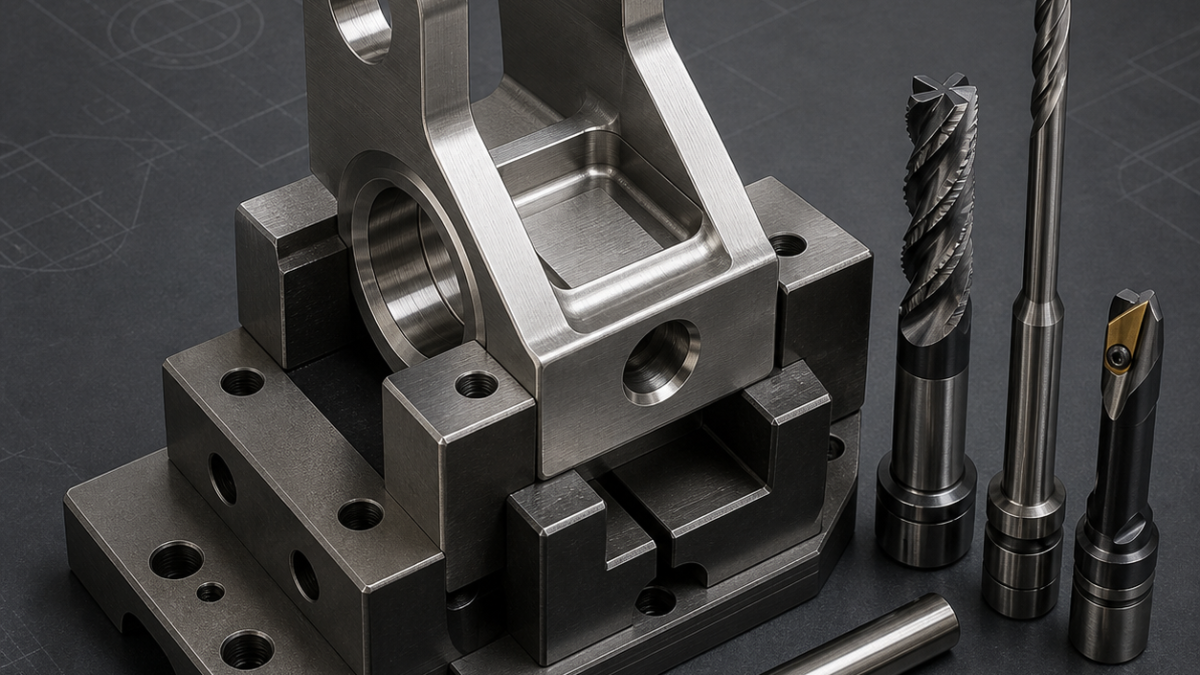
This CNC case study examines a 17-4PH stainless steel clevis bracket with two parallel fork arms, a cross hole through both ears, a reamed pivot bore, threaded mounting holes and a flat mounting base. The example drawing calls for 0.03 mm coaxiality between the two fork-ear bores, 0.05 mm perpendicularity from the cross-hole axis to the mounting base and a controlled fork gap after heat treatment. The values are used for process planning; the real customer drawing always controls final acceptance.
The main risk is that the two fork ears behave like flexible cantilevers after the center slot is opened. If the shop roughs the slot too early or finishes one ear without supporting the other, the cross hole can measure acceptable in the machine and move after unclamping. The process therefore needs a clear datum chain, staged material removal and support during the final bore operation.
Fixture and Datum Strategy
Machine the mounting base and two locating holes before separating the fork arms. These features become the repeatable datum set for later operations. Rough the outside profile while the blank still has bridge stock between the ears, then open the fork slot in stages. A removable spacer or soft expanding support inside the fork gap helps control deflection during finishing.
For the cross hole, use one setup whenever possible. Drill undersize, interpolate or bore the first ear, continue through the spacer and finish the second ear from the same coordinate system. If the machine cannot reach both sides cleanly, a qualified flip fixture and probing routine must prove that the second setup repeats the datum axis.
Tooling Plan
| Feature | Suggested tool | Reason |
|---|---|---|
| Base and profile roughing | Variable-helix carbide end mill with tough coating | Reduces chatter in precipitation-hardened stainless steel |
| Fork slot roughing | High-performance carbide end mill, constant engagement path | Balances force and protects the thin ears |
| Fork wall finishing | Sharp carbide end mill with small corner radius | Controls wall finish without pushing the ears away |
| Cross hole | Carbide drill, boring tool or reamer depending on tolerance | Maintains diameter, coaxiality and surface condition |
| Deburring | Back-chamfer tool or programmed ball/chamfer mill | Removes hidden burrs between the fork ears |
Starting Cutting Parameters
For 17-4PH in H1025-H1150 condition, a 10 mm carbide end mill may start around 90-140 m/min, 0.035-0.070 mm per tooth and 8-15 percent radial engagement for trochoidal roughing. Finishing the fork walls can begin near 80-120 m/min with 0.025-0.050 mm per tooth and a light radial pass. Cross-hole drilling and reaming should follow the tool supplier’s grade data, with coolant aimed directly at chip evacuation.
Operation Sequence and Inspection
- Verify material condition, heat-treatment state and stock allowance.
- Machine the mounting base, locating holes and rough outside profile.
- Rough the fork slot while leaving bridge stock or support in place.
- Semi-finish fork walls equally on both sides to balance stress.
- Install a controlled spacer and finish the fork gap.
- Machine the cross hole from one datum system and deburr both exits.
- Inspect fork gap, bore size, coaxiality, perpendicularity and base flatness after unclamping.
The SEO theme is 17-4PH clevis bracket CNC machining, cross-hole alignment, fork finishing and carbide tool selection. These terms describe the real process problem, so they are used naturally instead of repeated as keyword stuffing.
中文:17-4PH 叉形支架加工方案
本案例针对 17-4PH 不锈钢叉形支架,零件包含安装底面、两片叉耳、贯穿交叉孔、铰制孔和螺纹孔。加工重点是叉口开槽后的刚性下降、两侧孔同轴度、叉口间距和去毛刺质量。建议先加工安装底面和定位孔,在零件仍有整体刚性时完成外形粗加工,再分阶段开叉口槽。
配刀可选用变螺旋涂层硬质合金立铣刀进行粗加工,用锋利小圆角立铣刀精修叉口侧壁。交叉孔根据公差选择硬质合金钻、精镗或铰削。精加工叉口时应使用受控垫块或软支撑,避免刀具推开叉耳。最终检测应在松夹后完成,确认叉口间距、孔径、同轴度、垂直度和底面平面度。
Español: soporte tipo horquilla 17-4PH
Este caso CNC analiza un soporte tipo horquilla de acero inoxidable 17-4PH. La ranura central reduce la rigidez de las orejas, por lo que el proceso debe mantener apoyo, retirar material en etapas y mecanizar el agujero transversal desde un sistema de referencia estable. Las herramientas de carburo con geometria estable ayudan a controlar vibracion y vida util.
Français : chape en 17-4PH
Ce cas traite une chape en acier inoxydable 17-4PH avec deux oreilles, un trou transversal et une base de montage. Le risque principal est la flexion des oreilles apres ouverture de la fente. La gamme conserve de la rigidite aussi longtemps que possible, utilise un appui dans l entre-fourche et controle la coaxialite apres desserrage.
Русский: кронштейн-вилка 17-4PH
В этом примере рассматривается ЧПУ обработка кронштейна-вилки из стали 17-4PH. После прорезания паза две проушины становятся гибкими, поэтому нужны поэтапное снятие припуска, опора внутри вилки и стабильная база для поперечного отверстия. Контроль выполняют после снятия зажима.
FAQ
Why use a spacer inside the fork?
It reduces elastic movement while the cutter finishes the ears and while the cross hole is completed.
Why inspect after unclamping?
The fork can spring back after fixture pressure is removed, so free-state inspection shows the geometry the customer receives.
Related reading: Tool Holder Runout and CNC Chamfering and Deburring.