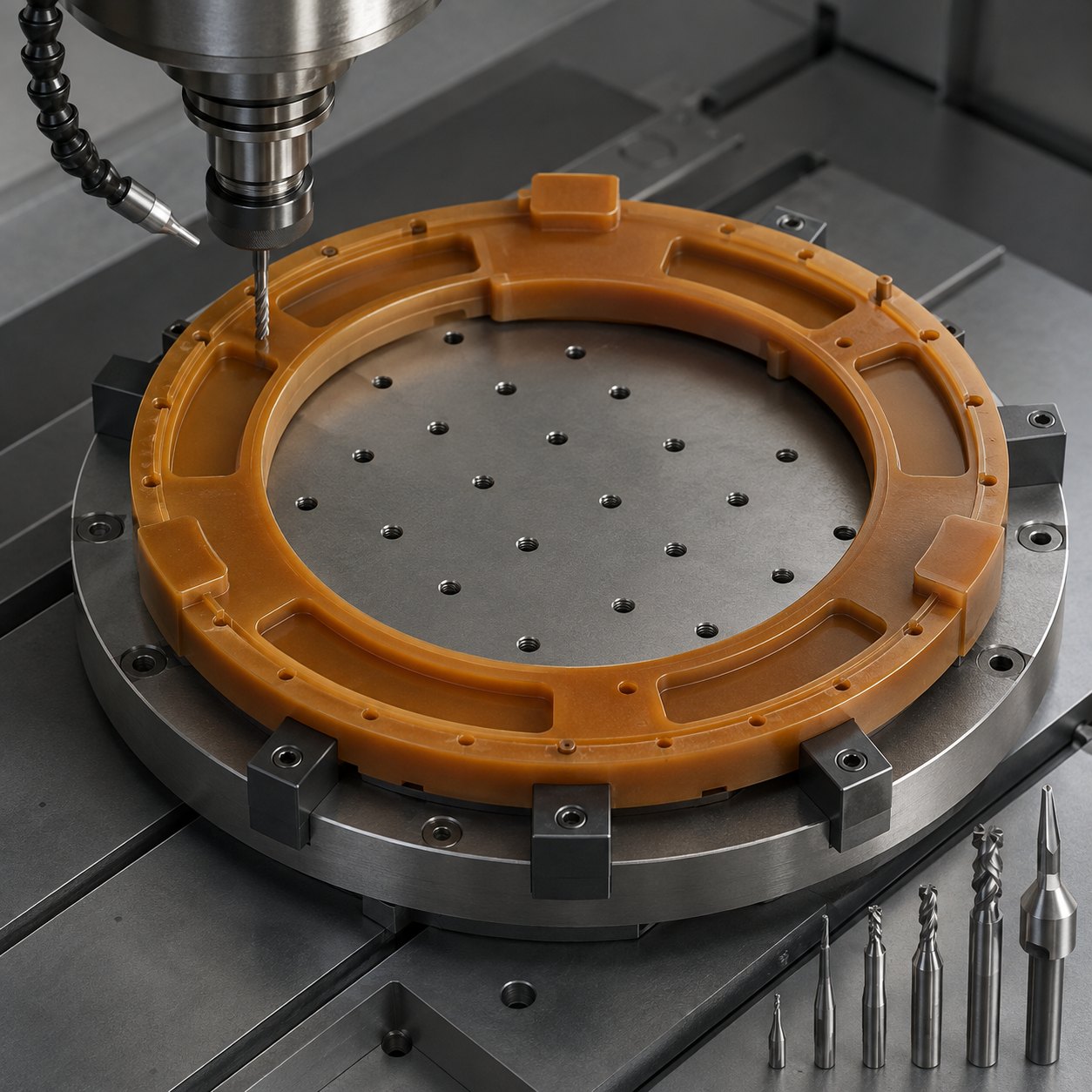
English: Torlon 4203 Wafer Carrier Ring CNC Tool Selection for Vacuum Pockets and Purge Holes
This hypothetical Torlon 4203 wafer carrier ring targets users searching for polymer CNC tool selection for delicate support pads, shallow vacuum relief pockets and tiny purge holes. The tooling strategy favours polished, sharp carbide and controlled support because heat and clamping marks can become functional defects.
Feature-driven tooling sequence
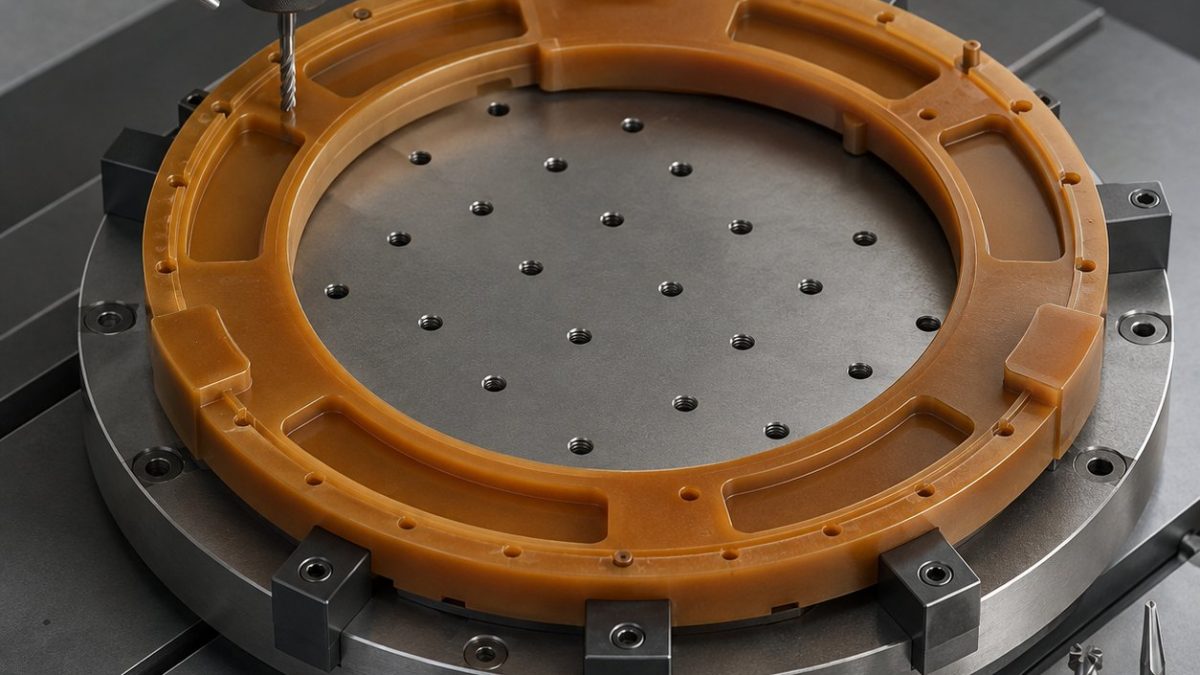
The drawing defines a free-state ring profile, raised wafer pads, anti-rotation flats and purge holes that must stay open after deburring. The sequence roughs the OD/ID with balanced stock, finishes pads last, and keeps the part on a vacuum nest until all holes and flats are complete. Related support logic appears in Vespel SP-1 rotor tooling and vacuum fixturing for thin sheet milling.
Feature-to-tool selection
| Drawing feature | Selected cutter | Risk controlled |
|---|---|---|
| OD and ID circular profiles | Ø6 mm 2-flute polished carbide end mill, uncoated, high rake | Sharp edge shears Torlon; coated roughers are rejected because they rub and heat the polymer. |
| Shallow vacuum pockets | Ø3 mm single-flute polished carbide, short stickout | Large chip space removes stringy chips; four-flute tools pack chips. |
| Raised wafer support pads | Ø2 mm ball or corner-radius carbide finisher, measured runout below pad tolerance | Leaves controlled blends; abrasive hand finishing is rejected. |
| Tiny purge holes | Carbide micro drill with backup support and air blast | Prevents exit lip rollover; drill-through without backing is rejected. |
| Anti-rotation flats | Sharp 2-flute end mill plus light climb finishing pass | Keeps flats straight without squeezing the ring. |
Inspection and burr control
Use low clamping pressure, air blast rather than flood coolant, and pause for thermal stabilization before final pad height measurement. Inspect pad coplanarity, ID/OD roundness, purge-hole openness, pocket floor fuzz and free-state flatness.