English: Stellite 6 Valve Seat CNC Tooling Case: Interrupted Cut and Sealing Cone Finish
A Stellite 6 hardfaced valve seat requires two different cutting strategies: a tough tool to cross irregular overlay interruptions and a stable finishing tool for the continuous sealing cone. This hypothetical tooling case explains when coated carbide is safer than ceramic, how to support the ring, and how to reach Ra 0.4 µm without smearing the cobalt alloy or rounding the contact edge.
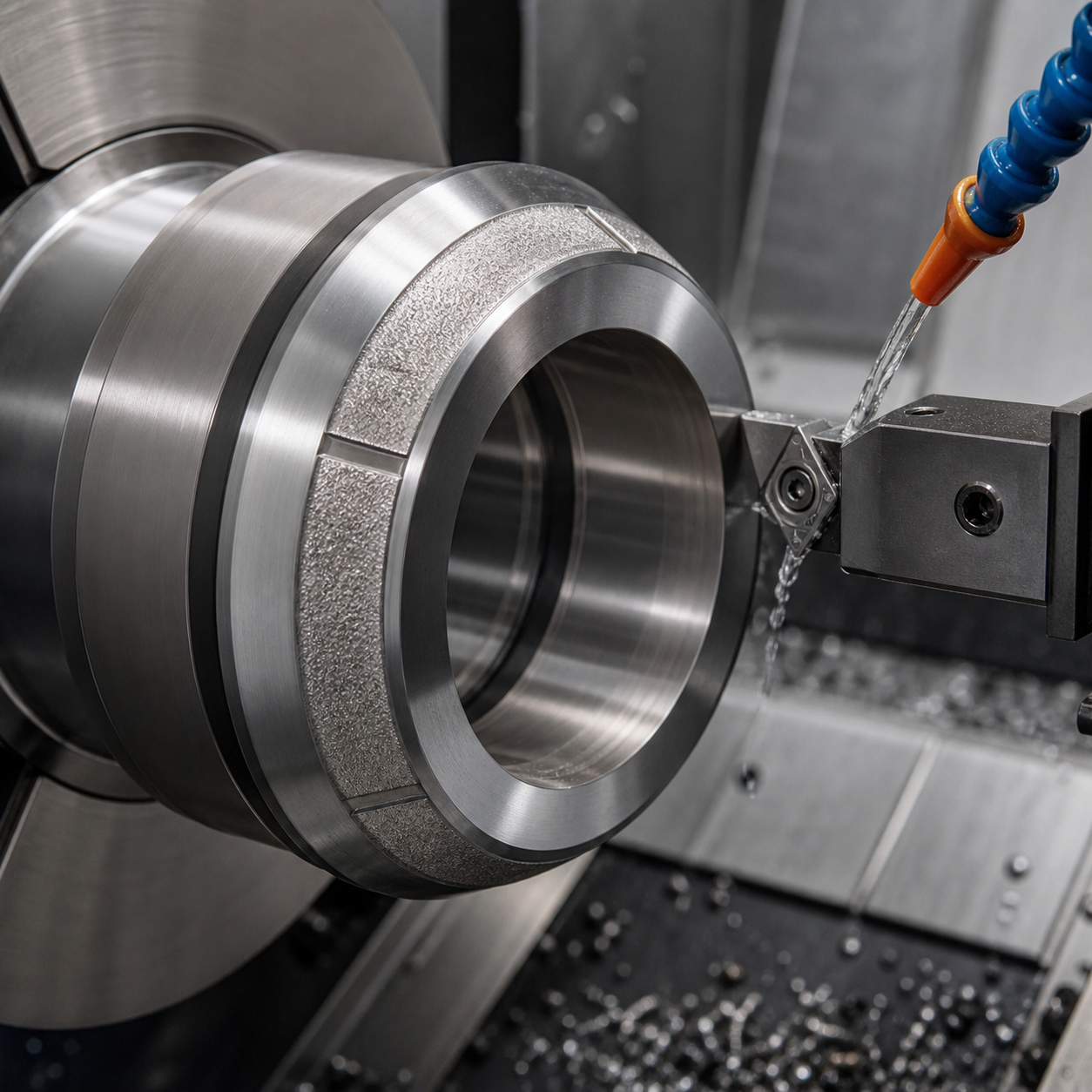
Drawing logic and overlay condition
Datum A is the rear mounting face and B is the pilot bore. The 30° sealing cone runs within 0.015 mm to B, has a 1.8 mm contact width, Ra 0.4 µm and 0.02 mm circularity. Stellite overlay is 2.5 mm nominal with four local start-stop transitions. The drawing permits no undercut into the stainless substrate and limits edge break to 0.05 mm at the sealing boundary.
Feature-to-tool selection
| Feature | Selected tool | Decision |
|---|---|---|
| Overlay skin and interruptions | Round PVD-coated fine-grain carbide, positive rigid holder, 0.4 mm nose | Tough against impact; whisker ceramic is rejected until the cut becomes continuous. |
| Continuous cone semifinish | SiAlON ceramic RNGN insert, negative rigid clamp | Heat-resistant at steady engagement; not used across overlay gaps. |
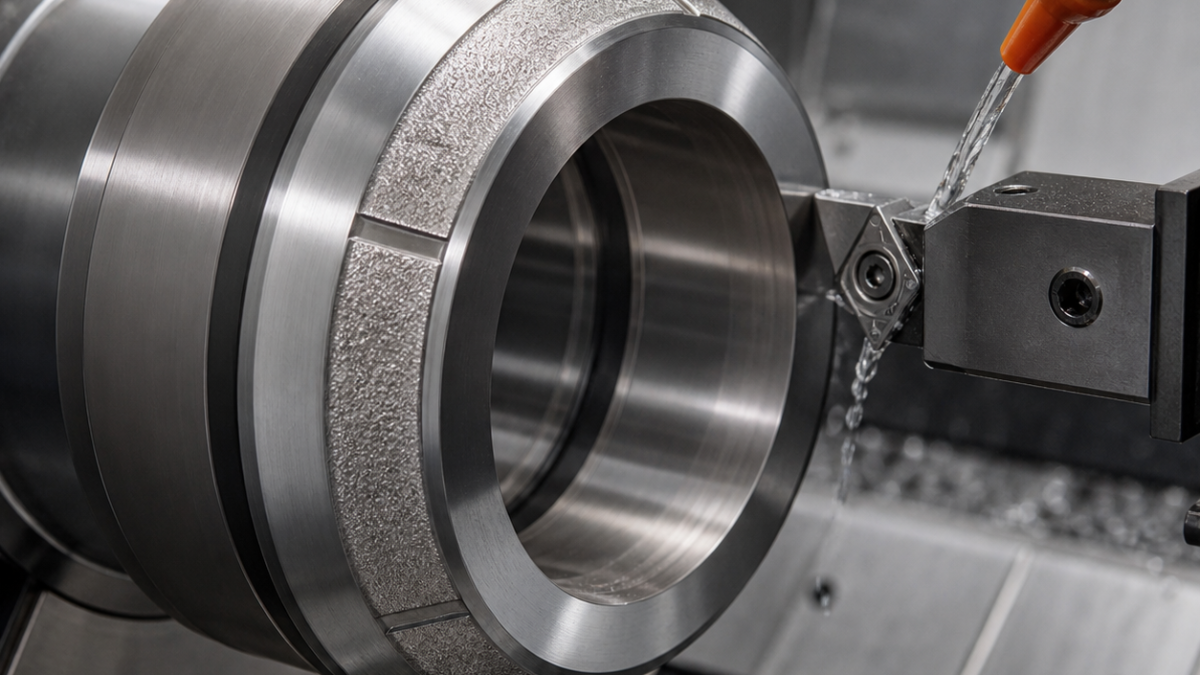
| Final sealing cone | Fresh CBN-tipped 55° insert, 0.2 mm nose, precision modular boring bar | Low wear and accurate contact line; a worn ceramic edge cannot hold Ra 0.4. |
| Pilot bore | Coated carbide boring insert with positive chipbreaker | Controls B and chip form. |
| Relief groove | 2 mm PVD-carbide grooving insert with through-tool coolant | Specific width; form tool overload is avoided. |
Fixture, roughing and finishing sequence
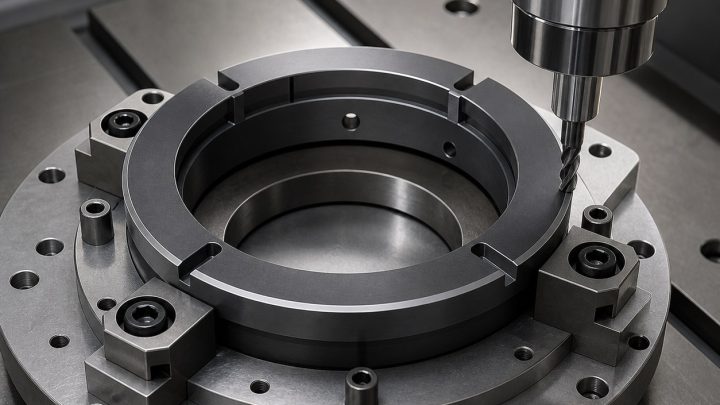
Soft jaws grip the substrate land, not the hardface, and an axial stop supports A. A low-force trial establishes roundness before cutting. The carbide round insert removes overlay skin using constant depth so impact is distributed around the edge. Once a continuous annulus is proven, SiAlON semifinishes the cone with no dwell. B is bored in the same chucking to connect cone runout to the pilot.
The CBN finish pass uses fixed surface speed, a single directional cut and a measured wear offset; there is no spring pass. High-pressure coolant is applied only to carbide/CBN operations under a qualified thermal strategy, while ceramic cutting remains controlled and uninterrupted. Short segmented chips are cleared from the relief groove. Notch wear at the overlay boundary, load spikes and a widening contact band trigger tool change.
Inspection and FAQ
A roundness instrument references B and measures cone runout and circularity. A CMM verifies 30° angle and contact width; a profilometer records Ra along the cone generator. Blue-check contact is used only as a supplementary visual, not a substitute for geometry. Microscopy confirms no substrate exposure, pullout or uncontrolled edge rounding.
Is ceramic always best for Stellite 6?
No. Ceramic performs well in stable continuous engagement but is vulnerable at hardfacing interruptions; tough coated carbide opens the cut first.
Why use CBN for the final valve-seat cone?
Its wear stability supports the narrow contact width and Ra 0.4 µm with one controlled pass.
Should a spring pass be used?
Not automatically. A spring pass can rub and work-harden the cobalt alloy; measured offset and a fresh edge are more predictable here.
Useful comparisons: CBN finish control and ring support and grooving.
中文: Stellite 6阀座配刀:断续切削与密封锥面精加工
Stellite 6堆焊阀座需要两套配刀逻辑:韧性刀具跨越不规则堆焊接头,稳定精加工刀具负责连续密封锥面。本假设案例说明何时硬质合金比陶瓷更安全,以及怎样稳定获得Ra 0.4 µm而不磨圆接触边。
特征—刀具表
| 特征 | 刀具 | 理由 |
|---|---|---|
| 堆焊皮与断续点 | PVD涂层细晶圆刀片,正角刚性刀杆,R0.4 | 抗冲击;须等连续切削后才用陶瓷。 |
| 锥面半精 | SiAlON陶瓷RNGN负角刀片 | 连续接触耐热,禁止跨堆焊缺口。 |
| 密封锥精车 | CBN刀尖55°刀片,R0.2,模块化精密刀杆 | 稳定控制1.8 mm接触带与Ra 0.4。 |
| 定位内孔 | 正角断屑槽涂层硬质合金镗刀 | 建立B轴并控制切屑。 |
| 退刀槽 | 2 mm PVD硬质合金内冷槽刀 | 宽度独立控制,避免大成形刀过载。 |
工艺与风险
软爪夹不锈钢基体台阶,避开硬面,轴向止挡支撑A。圆刀片以恒定切深去堆焊皮,让冲击分布在圆周刃口;确认形成连续圆环后才换SiAlON半精。B孔与锥面在同一装夹完成。最终CBN按固定线速度单向一刀完成,以实测磨损补偿,不安排无依据的空走弹簧刀。
堆焊边界沟槽磨损、负载尖峰、接触带变宽均触发换刀。圆度仪以B为轴测锥面跳动和圆度,三坐标测30°角与接触宽,轮廓仪沿母线测Ra,显微镜确认无基体露出和崩落。
常见问题
Stellite 6一定用陶瓷刀吗?
不是。连续稳定切削适合陶瓷,断续堆焊皮先用韧性涂层硬质合金。
为何精锥面用CBN?
磨损稳定,能用一次受控走刀保持窄接触带和Ra 0.4。
要不要弹簧刀?
不默认使用;摩擦可能加工硬化,本案例依靠新刃口和测量补偿。
Français: Siège Stellite 6 : outils pour coupe interrompue et cône d’étanchéité
Le dépôt interrompu exige un outil tenace; le cône continu accepte ensuite céramique et CBN.
Table fonction-outil
| Fonction | Outil | Choix |
|---|---|---|
| Peau interrompue | Carbure fin PVD rond, positif, R0,4 | Tenace; la céramique est exclue aux ruptures. |
| Semi-finition | SiAlON RNGN négatif | Stable en engagement continu. |
| Cône final | CBN 55°, R0,2, barre modulaire | Tient bande 1,8 mm et Ra 0,4. |
| Alésage B | Carbure revêtu positif | Contrôle l’axe et le copeau. |
| Gorge | Carbure PVD 2 mm arrosé | Largeur indépendante. |
Gamme
Les mors doux serrent le substrat. Le carbure rond enlève la peau à profondeur constante. Quand l’anneau devient continu, SiAlON semi-finit; B et le cône restent dans le même serrage. Le CBN effectue une seule passe corrigée, sans passe à vide. Usure en entaille, charge et bande croissante commandent le changement.
Contrôle et FAQ
La circularité part de B; la MMT mesure angle et bande, le profilomètre Ra, le microscope l’intégrité du dépôt.
Toujours de la céramique?
Non, le carbure ouvre la coupe interrompue.
Pourquoi CBN?
Pour une usure stable et Ra 0,4.
Passe à vide?
Non par défaut: elle peut écrouir.
Voir la finition CBN et le support des bagues.
Русский: Седло Stellite 6: инструмент для прерывистого резания
Прерывистый наплавленный слой требует прочного инструмента; непрерывный конус затем допускает керамику и CBN.
Элемент и инструмент
| Элемент | Инструмент | Причина |
|---|---|---|
| Прерывистая корка | Круглый мелкозернистый PVD-карбид, R0,4 | Прочность; керамика скалывается. |
| Полуфиниш | SiAlON RNGN | Для непрерывного контакта. |
| Финальный конус | CBN 55°, R0,2 | Полоса 1,8 мм и Ra 0,4. |
| Отверстие B | Позитивный покрытый карбид | Ось и стружка. |
| Канавка | PVD-карбид 2 мм с подачей | Точная ширина. |
Маршрут
Мягкие кулачки держат основу. Круглая пластина снимает корку при постоянной глубине; после непрерывного кольца SiAlON полуфиниширует. B и конус остаются в одном зажиме. CBN делает один проход с компенсацией, без холостого пружинного прохода.
Контроль и вопросы
Кругломер измеряет от B, КИМ — угол и полосу, профилометр — Ra.
Всегда керамика?
Нет, прерывистый слой открывает карбид.
Почему CBN?
Стабильный износ и Ra 0,4.
Нужен пружинный проход?
Не по умолчанию: он может наклепать сплав.
См. CBN и опору колец.