English: Graphite EDM Electrode CNC Case: Thin Ribs, Corner Detail and Dust Control
Direct answer: a fine-grain graphite EDM electrode with tall ribs is safest to machine by defining electrode polarity and burn allowance before CAM, supporting the blank across a broad datum, roughing open regions before narrow slots, and using sharp diamond-coated carbide with continuous dust extraction. This is a newly conceived hypothetical process, not a customer claim.
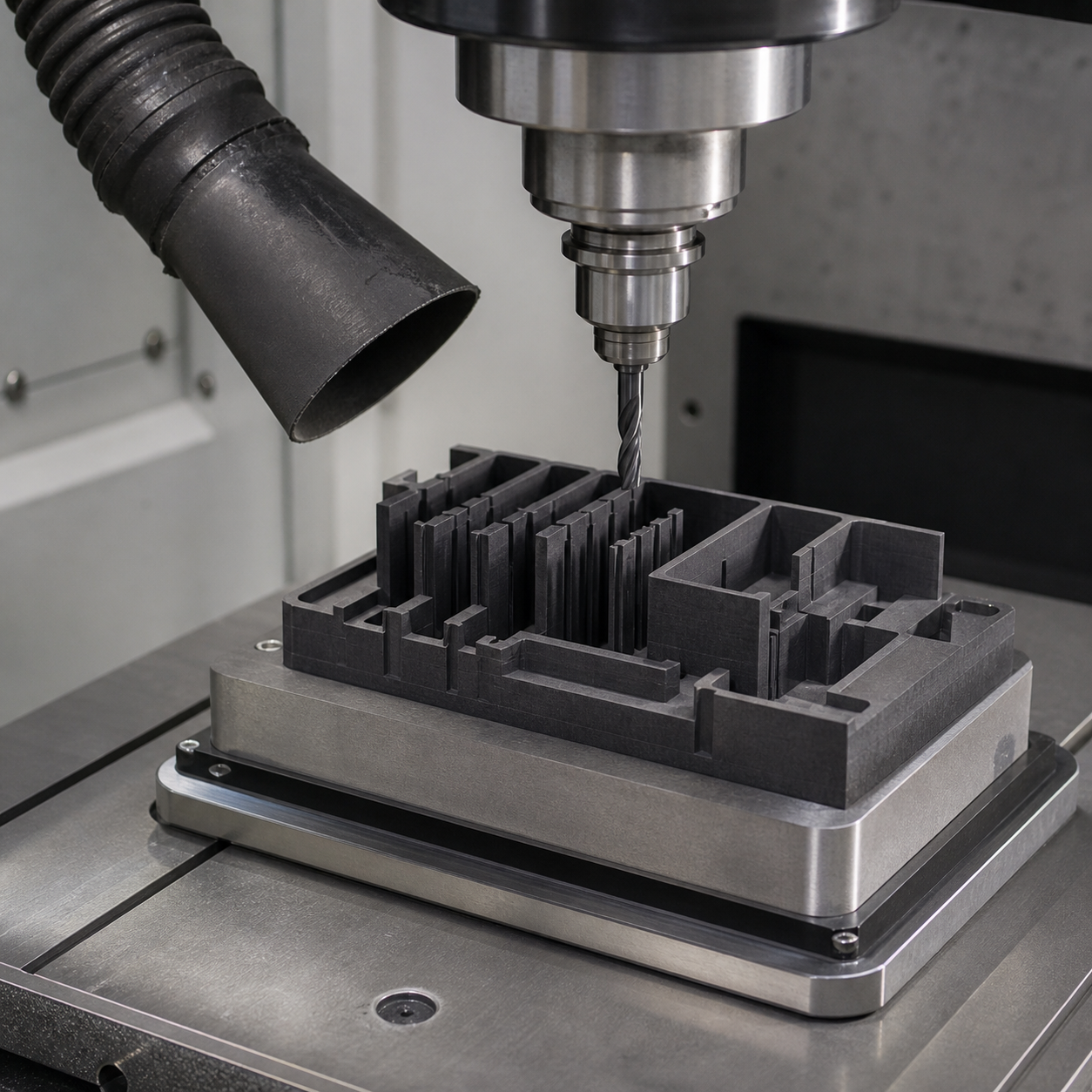
The drawing is an inverse geometry contract
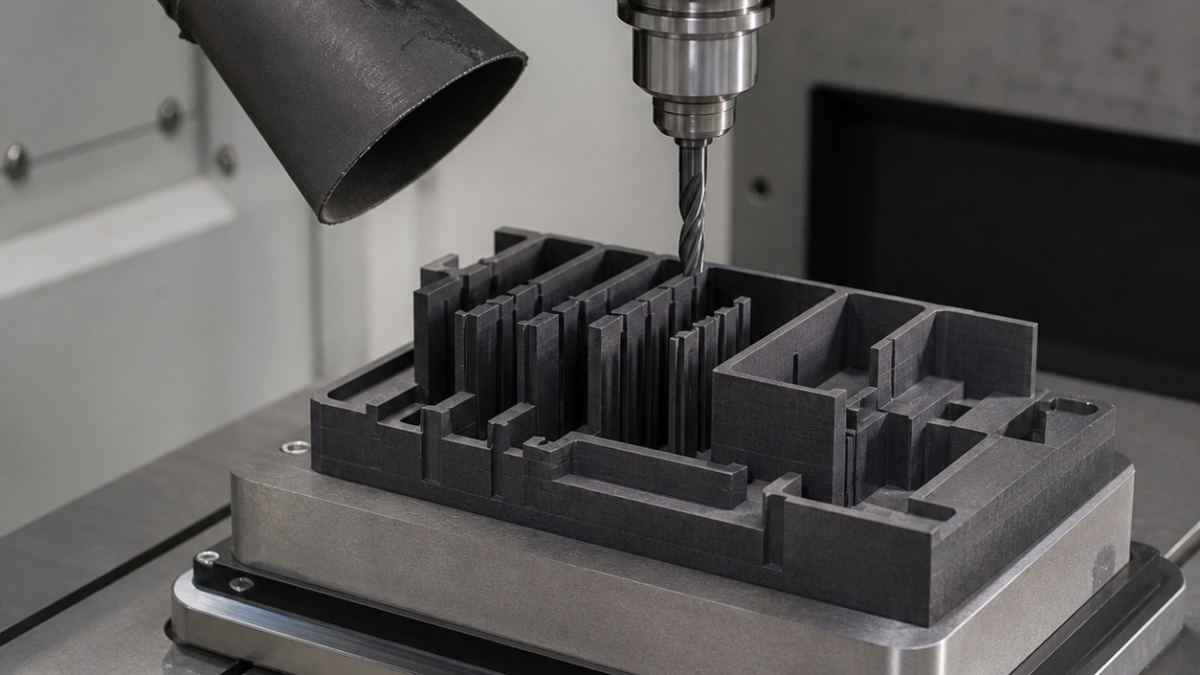
The 82 × 64 mm electrode has 28 mm ribs only 1.2 mm wide, 0.4 mm internal radii, a 0.18 mm rough-burn undersize and 0.06 mm finish-burn undersize. Datum A is the holder face; B and C are orthogonal reference flats. The print must distinguish electrode dimensions from final cavity dimensions and state whether orbit is included. Rib thickness and root radius outrank cosmetic outside faces because one chipped rib changes the spark gap.
Tooling follows fragility, not metal-removal rate
A 6 mm diamond-coated carbide end mill clears open stock, a 2 mm necked carbide tool semi-finishes channels, and a 0.8 mm two-flute diamond-coated cutter resolves the roots. Short flute length and balanced holders reduce runout. Dry machining with a graphite-rated vacuum captures powder at source; coolant is excluded from this route because wet sludge would contaminate the holder and metrology. A fresh tool is reserved for the finish electrode.
Stock removal is sequenced from open to confined
The blank is bonded to a reusable pallet with a thin, uniform adhesive film and positive side stops; vacuum alone is not trusted across a porous surface. A planar skim establishes A, then adaptive roughing leaves 0.25 mm on walls and 0.15 mm on floors. Wide cavities are completed first so extraction remains effective. Slots alternate by location rather than being cut consecutively beside one rib. Semi-finishing reduces the allowance to 0.04 mm, and one climb-only pencil pass finishes each root. Leads enter in open space; plunges beside ribs are prohibited.
Chipping, dust and tool-life decisions
Graphite makes discontinuous powder, so chip recutting appears as polished streaks and rounded corners rather than a conventional built-up edge. Vacuum flow is checked at the nozzle, spindle load is trended, and a 10× camera compares the smallest root after each group. Tool replacement is triggered by radius growth or edge breakout, not an invented part count. Manual abrasive blending is barred because it changes the discharge gap.
Inspection closes the EDM allowance loop
An optical CMM establishes A-B-C and measures rib width, root radius, height and the programmed undersize. A flatness check verifies the holder face before and after release. Critical corners are compared with a calibrated profile image, while continuity and dust-free mounting surfaces are visually confirmed. The inspection report identifies rough and finish electrodes separately so the EDM operator cannot swap offsets.
FAQ
What carbide coating works for graphite electrodes?
Diamond-coated micrograin carbide is preferred here because abrasive graphite rapidly rounds ordinary edges.
How can thin graphite ribs be kept from chipping?
Use low-runout short tools, balanced stock removal, open-space entries, small finishing allowance and no hand blending.
Should graphite be machined wet or dry?
Both require a qualified system; this case uses dry cutting with graphite-rated source extraction and isolated dust handling.
Related reading: EDM allowance planning and tool-overhang control.
中文: 石墨EDM电极加工:薄筋、清角与粉尘控制
搜索问题先回答:细颗粒石墨薄筋电极必须先在图纸与CAM中明确粗放电、精放电缩放量和摇动量,再以大基准面支撑,从开放区域逐步进入窄槽,并用锋利金刚石涂层硬质合金刀具配合源头抽尘。本案例为假设工艺,不涉及真实客户。
先核对“反形”尺寸
电极为82 × 64 mm,筋高28 mm、筋厚1.2 mm、根部R0.4;粗放电单边缩小0.18 mm,精放电缩小0.06 mm。A为夹持面,B、C为正交找正面。图纸需说明尺寸属于电极还是最终型腔,并注明CAM是否已包含摇动量;薄筋厚度和根圆角比非功能外表更优先。
刀具、装夹和走刀
6 mm金刚石涂层硬质合金刀开粗开放区,2 mm避空颈刀半精窄槽,0.8 mm两刃刀清根。刀柄低跳动、刃长只覆盖必要深度。工件用均匀薄胶层粘接在重复定位托盘,并设侧向止挡;多孔石墨不能只靠真空。自适应开粗侧留0.25 mm、底留0.15 mm,半精后只留0.04 mm。相邻槽交错加工,清根只顺铣一次,进刀点放在开放区。
粉尘、崩边与刀寿命
本路线采用干切和石墨专用源头抽尘,开机前实测吸口流量。石墨重切会表现为亮带、圆角变大和微崩口,因此用主轴负载趋势与10倍影像决定换刀,不设虚构寿命件数。精电极使用保留的新刀,禁止砂纸修筋。
检验与放电交接
光学三坐标建立A-B-C,测筋厚、高度、根R和缩放量;释放前后复查夹持面平面度。关键角用校准轮廓图比对,粗、精电极报告分开编号,并确认安装面无粉尘。
常见问题
石墨电极用什么硬质合金涂层?
本案例选金刚石涂层细晶硬质合金,以降低磨粒磨损造成的刃口圆化。
薄筋怎样防崩?
控制跳动和悬伸、交错去料、保留很小且均匀的精加工余量,并从开放区进刀。
石墨必须干切吗?
不是绝对;本路线采用经过确认的干式抽尘系统,湿加工则需另行解决泥浆与计量污染。
Français: Électrode EDM en graphite : nervures fines, angles et poussière
Réponse directe : l’usinage d’une électrode en graphite à nervures fines exige de figer les réductions d’ébauche et de finition avant la FAO, de soutenir largement l’ébauche, d’ouvrir les volumes avant les rainures et d’utiliser du carbure diamanté avec aspiration à la source. Le scénario est hypothétique.
Un plan de géométrie inverse
L’électrode de 82 × 64 mm comporte des nervures hautes de 28 mm et larges de 1,2 mm, des rayons R0,4, une réduction de 0,18 mm pour l’ébauche EDM et 0,06 mm pour la finition. A est la face porte-électrode; B et C sont les plats d’orientation. Le plan précise si l’orbite est déjà intégrée.
Carbure et ordre des parcours
Une fraise carbure diamantée de 6 mm dégage les zones ouvertes, une fraise détalonnée de 2 mm semi-finit les canaux et une deux dents de 0,8 mm reprend les racines. L’ébauche collée sur palette reçoit des butées latérales. On laisse 0,25 mm sur les flancs, puis 0,04 mm après semi-finition. Les rainures non adjacentes alternent; les entrées restent hors des nervures et la finition se fait en avalant.
Aspiration, usure et mesure
L’aspiration qualifiée graphite est contrôlée avant rotation. Une bande brillante, un rayon accru ou un éclat observé à 10× impose le changement d’outil. La MMT optique reconstruit A-B-C et mesure largeur, hauteur, rayon et réduction EDM; la planéité du porte-électrode est vérifiée avant et après débridage. Les rapports d’ébauche et de finition ne sont jamais mélangés.
FAQ
Quel revêtement pour le graphite ?
Le diamant sur carbure micrograin limite ici l’arrondissement abrasif.
Comment protéger une nervure de 1,2 mm ?
Faible faux-rond, outil court, enlèvement alterné et très petite surépaisseur régulière.
Usinage sec ou humide ?
Cette gamme est sèche avec aspiration dédiée; une gamme humide doit gérer la boue et la contamination.
Voir aussi la gestion des surépaisseurs EDM et le contrôle du porte-à-faux.
Русский: Графитовый EDM-электрод: тонкие рёбра и пыль
Краткий ответ: для тонкорёберного электрода заранее фиксируют припуски под черновой и чистовой разряд, широко опирают заготовку, сначала открывают свободные объёмы и применяют алмазное покрытие на твёрдом сплаве с локальной вытяжкой. Это гипотетический пример.
Обратная геометрия чертежа
Размер электрода 82 × 64 мм, высота рёбер 28 мм, толщина 1,2 мм, радиус R0,4. Уменьшение составляет 0,18 мм для чернового и 0,06 мм для чистового EDM. A — плоскость держателя, B и C — ориентирующие грани. Отдельно указывают, включено ли орбитальное движение.
Инструмент и последовательность
Открытый объём снимает алмазно-покрытая твердосплавная фреза 6 мм, каналы — шейковая 2 мм, корни — двухзубая 0,8 мм. Заготовку приклеивают равномерным слоем к палете и ограничивают сбоку. После адаптивной обработки остаётся 0,25 мм, после получистовой — 0,04 мм. Соседние пазы не режут подряд; вход выполняют вне рёбер.
Пыль, ресурс и контроль
Расход графитовой вытяжки проверяют до пуска. Блестящая полоса, рост радиуса или скол под увеличением служат сигналом замены. Оптическая КИМ строит A-B-C и измеряет толщину, высоту, радиус и EDM-уменьшение; отчёты для чернового и чистового электродов разделяют.
Вопросы
Какое покрытие выбрать?
Алмазное покрытие на мелкозернистом твёрдом сплаве снижает абразивное округление.
Как защитить тонкие рёбра?
Минимизировать биение и вылет, чередовать зоны и оставлять равномерный малый припуск.
Нужно ли сухое резание?
Здесь оно применено с подходящей вытяжкой; мокрый процесс требует отдельного контроля шлама.
Сравните с припусками EDM и вылетом фрезы.