Related tooling references: C360 Brass Microfluidic Valve Seat CNC Tool Selection for Conical Seat and Tiny Cross Holes and Maraging 300 Aerospace Latch Hook CNC Tool Selection for Thin Hook Profile and Reamed Pivot Bore.
English: Aluminum Nitride Carrier Tooling for Isolation Pockets and Fragile Ribs
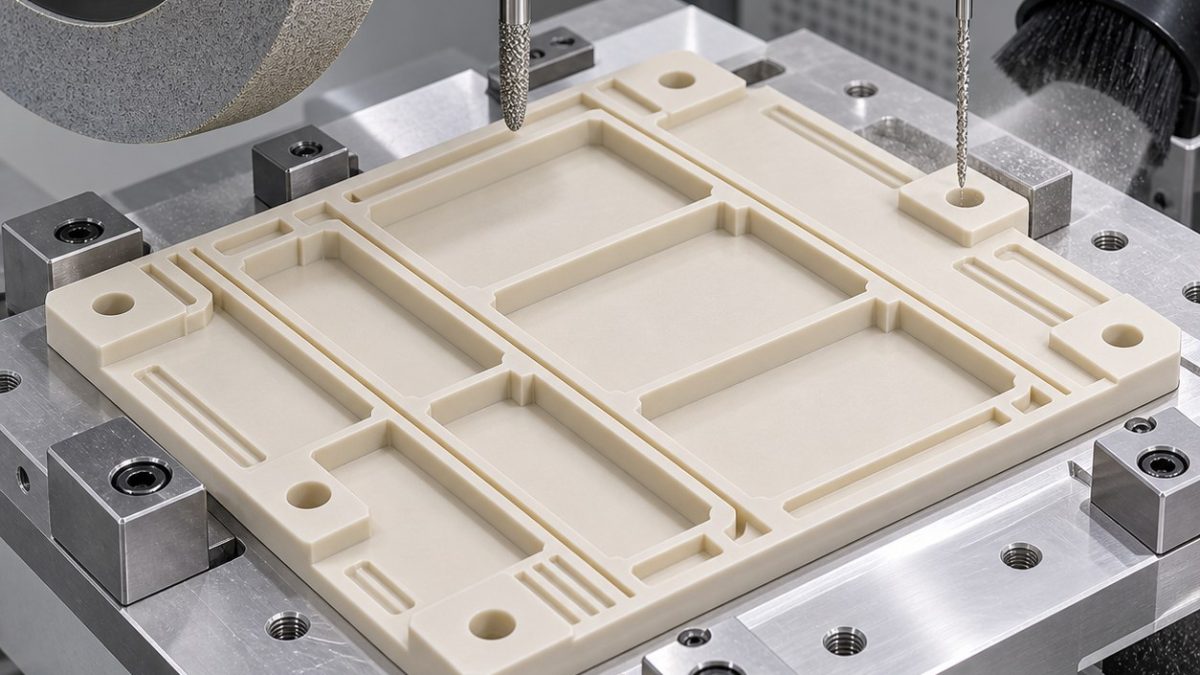
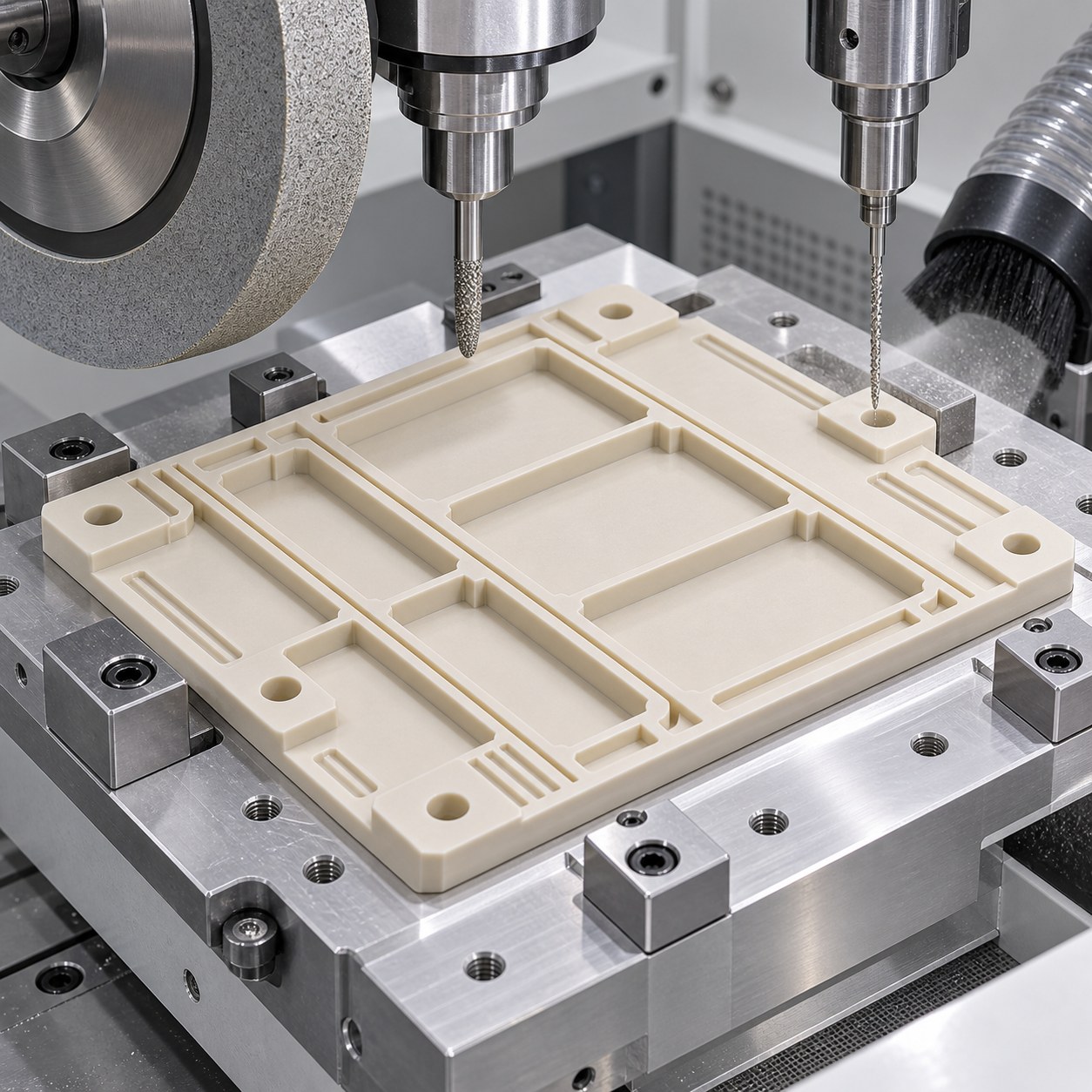
The AlN carrier case is about choosing diamond tools for a ceramic drawing that has isolation pockets and ribs too thin for metal-cutting assumptions. Search intent here is practical: prevent edge chips while preserving pad height.
Ceramic carrier drawing read before diamond grinding
| Ceramic feature | Diamond tool choice | Reason on the drawing |
|---|---|---|
| Isolation pockets | 8 mm fine-grit diamond router, low runout spindle | Carbide abrasion would generate chips and subsurface damage. |
| Fragile ribs | 4 mm resin-bond diamond wheel with shallow passes | Keeps force below rib bending limit. |
| Screw islands | Diamond cup wheel, light finish skim | Preserves pad height without hand lapping. |
| Clearance holes | Ultrasonic diamond core drill with wax backing | Reduces exit breakout. |
| Edge chamfers | Small diamond chamfer pin | Creates controlled edge break without loose grit scratching. |
Low-force grinding sequence
Grind the larger isolation pockets first with a wax-backed support, then finish screw islands before clearance holes. Ribs are touched only after surrounding material is relieved so grinding force does not bend or crack them.
Crack, dust and edge-chip control
Aluminum nitride dust is abrasive and electrically relevant. Dust extraction, clean coolant and low runout are treated as tooling controls. A tool is retired when pocket edges become frosted or the rib corner shows a bright chip.
Flatness and isolation inspection
Flatness is mapped across screw islands, rib edges are reviewed optically, clearance holes are pin-checked and isolation pocket depth is compared to the drawing stack. A part is rejected for functional edge chips even if overall size is correct.
Ceramic tooling FAQ
Why use diamond tools on AlN?
AlN is abrasive and brittle; diamond grinding controls edge chips better than carbide milling.
When are screw islands finished?
Before hole breakout, while the carrier still has broad support.
What defect is most serious?
A functional chip at an isolation rib or screw island edge.
中文: 氮化铝电源模块载板绝缘腔与脆性薄筋配刀
AlN载板案例关注陶瓷图纸的金刚石配刀:绝缘腔和薄筋不能按金属切削假设处理。搜索意图很实际:防止崩边,同时保持螺钉岛高度。
金刚石磨削前先读陶瓷载板图纸
| 陶瓷特征 | 金刚石刀具选择 | 图纸依据 |
|---|---|---|
| 绝缘腔 | 8 mm细粒度金刚石磨削刀,低跳动主轴 | 硬质合金摩擦会带来崩边和亚表面损伤。 |
| 脆性薄筋 | 4 mm树脂结合剂金刚石轮,小切深 | 把力控制在薄筋弯曲极限以下。 |
| 螺钉岛 | 金刚石杯形砂轮轻精修 | 保持垫高,不靠手工研磨。 |
| 通孔 | 超声金刚石套料钻,蜡背支撑 | 减少出口崩边。 |
| 边缘倒角 | 小径金刚石倒角针 | 形成可控倒角,不让游离砂粒划伤。 |
低力磨削顺序
先在蜡背支撑下磨较大的绝缘腔,再精修螺钉岛,之后加工通孔。薄筋等周围材料释放后再轻触磨削,避免磨削力弯裂薄筋。
裂纹、粉尘和崩边控制
氮化铝粉尘既磨蚀又影响电气洁净度。吸尘、洁净冷却液和低跳动都属于配刀控制。当腔边发雾或筋角出现亮崩点时换刀。
平面度与绝缘区检测
检测螺钉岛平面度、光学检查筋边、针规检查通孔,并把绝缘腔深度与图纸堆叠比较。即使外形尺寸合格,有功能崩边也拒收。
陶瓷配刀问答
AlN为什么用金刚石刀具?
AlN磨蚀且脆,金刚石磨削比硬质合金铣削更能控制崩边。
螺钉岛什么时候精修?
在孔出口突破前、载板仍有大面积支撑时精修。
最严重的缺陷是什么?
绝缘薄筋或螺钉岛边缘的功能性崩边。
Español: Herramientas para portador AlN con bolsillos aislantes
El portador AlN requiere diamante porque bolsillos y nervios frágiles no siguen lógica metálica.
Plano cerámico antes de diamante
| Elemento cerámico | Herramienta diamantada | Motivo |
|---|---|---|
| Bolsillos aislantes | Router diamantado 8 mm | Carburo daña la sub-superficie. |
| Nervios | Rueda diamante 4 mm | Baja fuerza. |
| Islas de tornillo | Copa diamantada | Mantiene altura. |
| Agujeros | Corona diamante ultrasónica | Menos astilla. |
| Chaflanes | Punta diamante | Borde controlado. |
Secuencia de baja fuerza
Bolsillos grandes con cera, islas de tornillo, agujeros y luego nervios con baja fuerza.
Grieta, polvo y borde
Polvo, refrigerante limpio y salto bajo son parte de la herramienta. Borde escarchado significa cambio.
Planitud y aislamiento
Planitud de islas, revisión óptica, pasadores y profundidad de bolsillo definen aceptación.
FAQ
¿Por qué diamante?
AlN es abrasivo y frágil.
¿Cuándo acabar islas?
Antes de romper agujeros.
¿Defecto crítico?
Astilla funcional en nervio.
Français: Outils pour support AlN à poches isolantes
Le support AlN impose le diamant car poches et nervures fragiles ne suivent pas la logique métal.
Plan céramique avant diamant
| Élément céramique | Outil diamant | Raison |
|---|---|---|
| Poches isolantes | Fraise diamant 8 mm | Le carbure abîme la sous-surface. |
| Nervures | Meule diamant 4 mm | Faible effort. |
| Plots vis | Meule boisseau diamant | Tient la hauteur. |
| Trous | Carottier diamant ultrasonique | Moins d’éclat. |
| Chanfreins | Pointe diamant | Bord contrôlé. |
Séquence faible effort
Poches sur cire, plots de vis, trous puis nervures à faible effort.
Fissure, poussière et éclat
Poussière, liquide propre et faux-rond bas font partie du choix outil.
Planéité et isolation
Planéité des plots, optique, piges et profondeur valident l’acceptation.
FAQ
Pourquoi diamant ?
AlN est abrasif et fragile.
Quand finir les plots ?
Avant sortie des trous.
Défaut critique ?
Éclat fonctionnel.
Русский: Инструмент для держателя AlN
Держатель AlN требует алмаза: карманы и хрупкие ребра не обрабатываются как металл.
Керамика до алмаза
| Элемент | Алмазный инструмент | Причина |
|---|---|---|
| Изоляционные карманы | Алмаз 8 мм | Карбид повреждает слой. |
| Ребра | Алмазный круг 4 мм | Малая сила. |
| Островки винтов | Алмазная чашка | Высота площадок. |
| Отверстия | УЗ алмазная коронка | Меньше сколов. |
| Фаски | Алмазная игла | Контроль кромки. |
Малая сила
Большие карманы на воске, островки винтов, отверстия и затем ребра с малой силой.
Трещины, пыль и сколы
Пыль, чистая СОЖ и малое биение являются частью выбора инструмента.
Плоскость и изоляция
Плоскость островков, оптика, штифты и глубина карманов решают приемку.
Вопросы
Почему алмаз?
AlN абразивен и хрупок.
Когда площадки?
До выхода отверстий.
Главный дефект?
Скол у ребра.