Related tooling references: C360 Brass Microfluidic Valve Seat CNC Tool Selection for Conical Seat and Tiny Cross Holes and Maraging 300 Aerospace Latch Hook CNC Tool Selection for Thin Hook Profile and Reamed Pivot Bore.
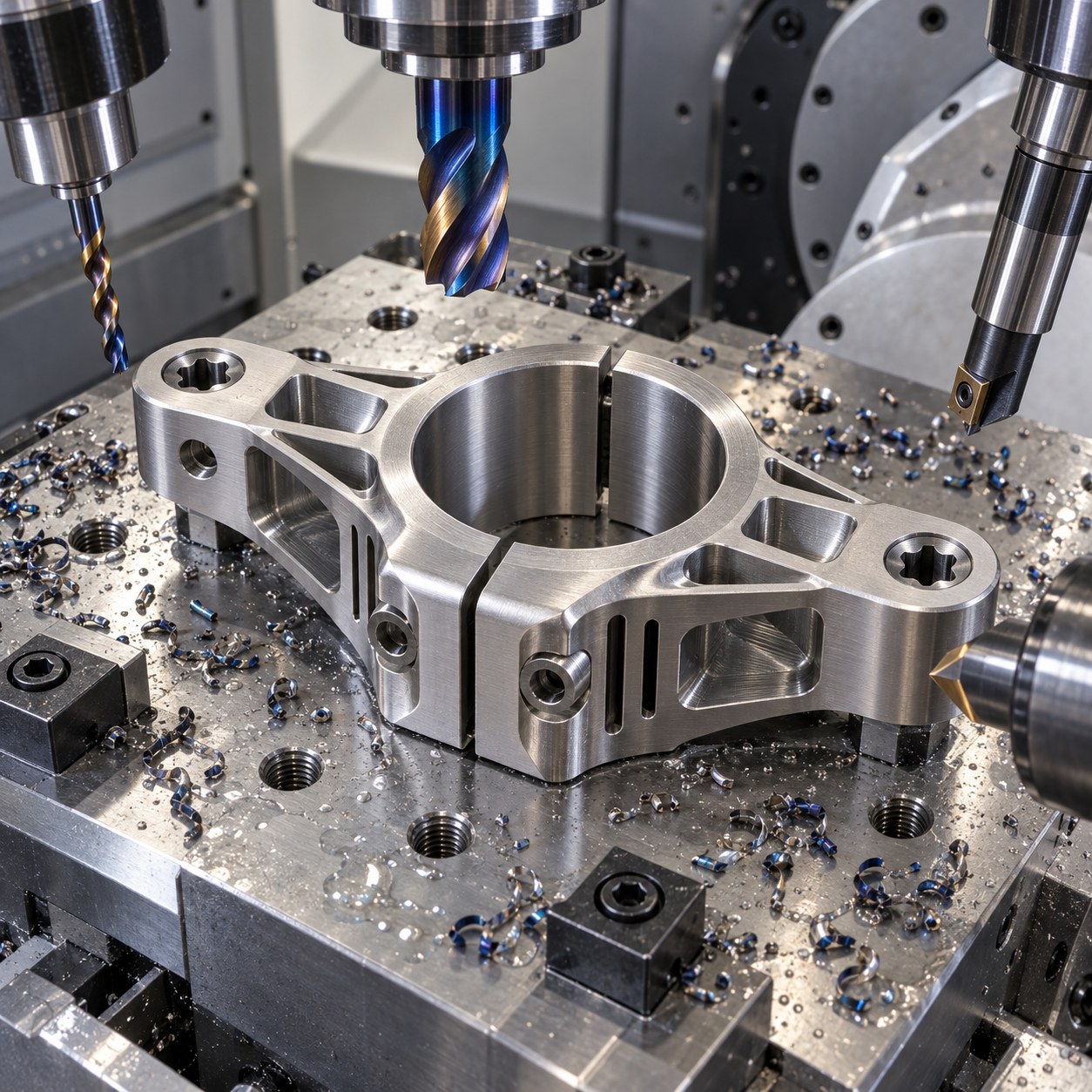
English: Ti-6Al-4V Wrist Clamp Tooling for Split Bore and Flexure Slots
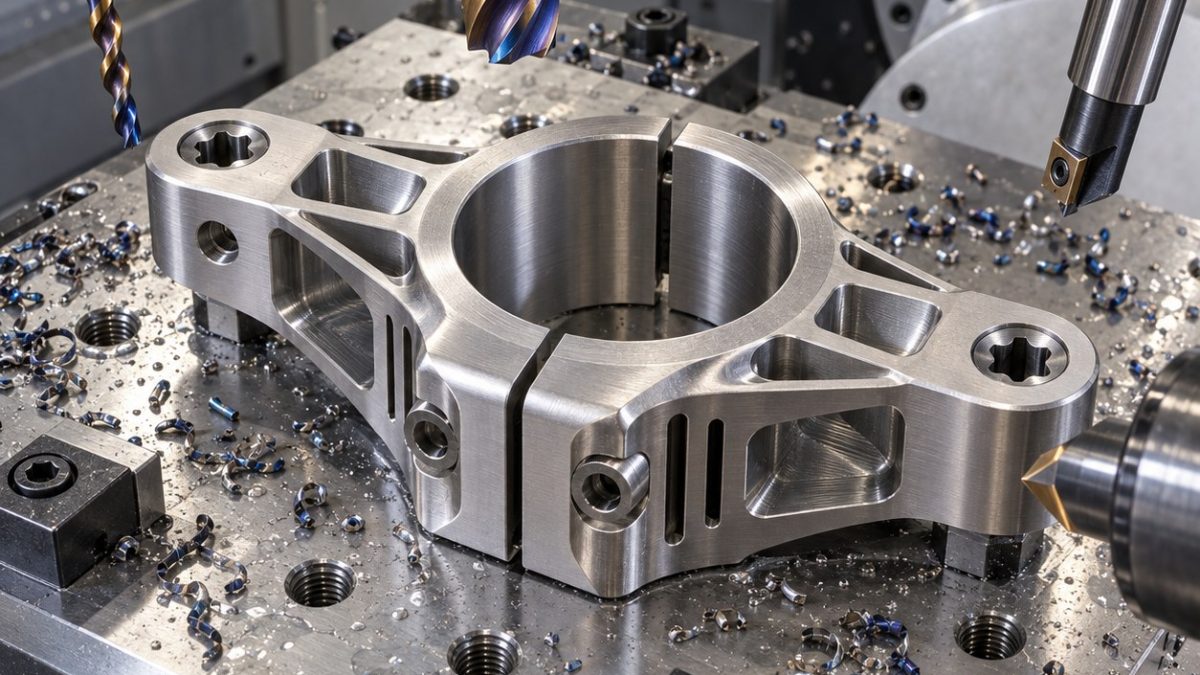
This case answers how to tool a titanium split clamp when the bore, flexure slots and screw counterbores all influence final clamping. The drawing is governed by elastic movement, not simple pocket removal.
Split-clamp features converted into titanium tooling
| Drawing feature | Carbide tool and holder | Why the alternative is rejected |
|---|---|---|
| Split bore | 12 mm variable-helix carbide semi-finisher plus fine boring head in hydraulic holder | Interpolation alone is rejected because the split gap lets the bore breathe. |
| Flexure slots | 2.5 mm 4-flute AlTiN carbide, necked, high-pressure coolant | Wire EDM is too slow and leaves a corner condition that still needs milling. |
| Clamp ears | 6 mm trochoidal rougher with corner radius | Keeps heat out of the ear root. |
| Torx counterbores | Carbide pilot drill, piloted counterbore and small chamfer mill | Separates screw seating from pilot drift. |
| Strain-relief radii | 3 mm ball end mill, short flute | Avoids a sharp crack starter at the slot end. |
Sequence that protects bore roundness
Machine the outside with the split still bridged, semi-finish the bore, cut relief radii, then open the flexure slots symmetrically. Final boring happens after a relaxation dwell so the measured bore reflects the working clamp.
Titanium heat, burr and slot-life control
Titanium heat is controlled by real chip thickness, sharp AlTiN edges and coolant aimed into the narrow slots. Tool life is stopped by burr color and slot-wall rubbing, not only by flank wear.
Inspection of clamp function
Inspection checks free bore size, clamped bore size with a torque simulator, slot width, ear parallelism and counterbore seating. The article passes when the bore repeats after three clamp cycles.
Tooling FAQ
Why not finish the split bore before slotting?
Slotting changes clamp stiffness, so final boring must wait until the split feature is functional.
What ruins titanium slot finish first?
Rubbing at the exit and coolant starvation, not always visible flank wear.
How is clamp repeatability checked?
By measuring the bore free and under repeated simulated screw torque.