This is a realistic hypothetical process-planning example, not a claim about a specific customer drawing or production result.
Related: Read the related CNC tooling case.
English: 2205 Duplex Stainless Filter Basket CNC Case: Long Slots, Weld-Datum Recovery and Burr Control
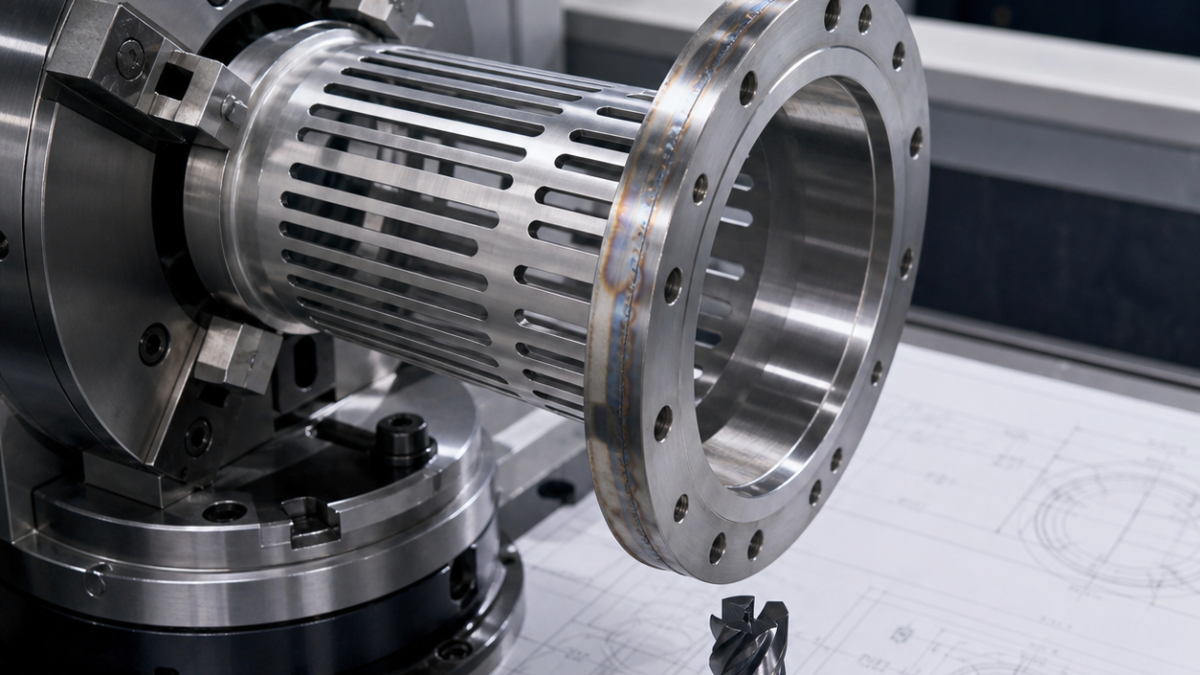
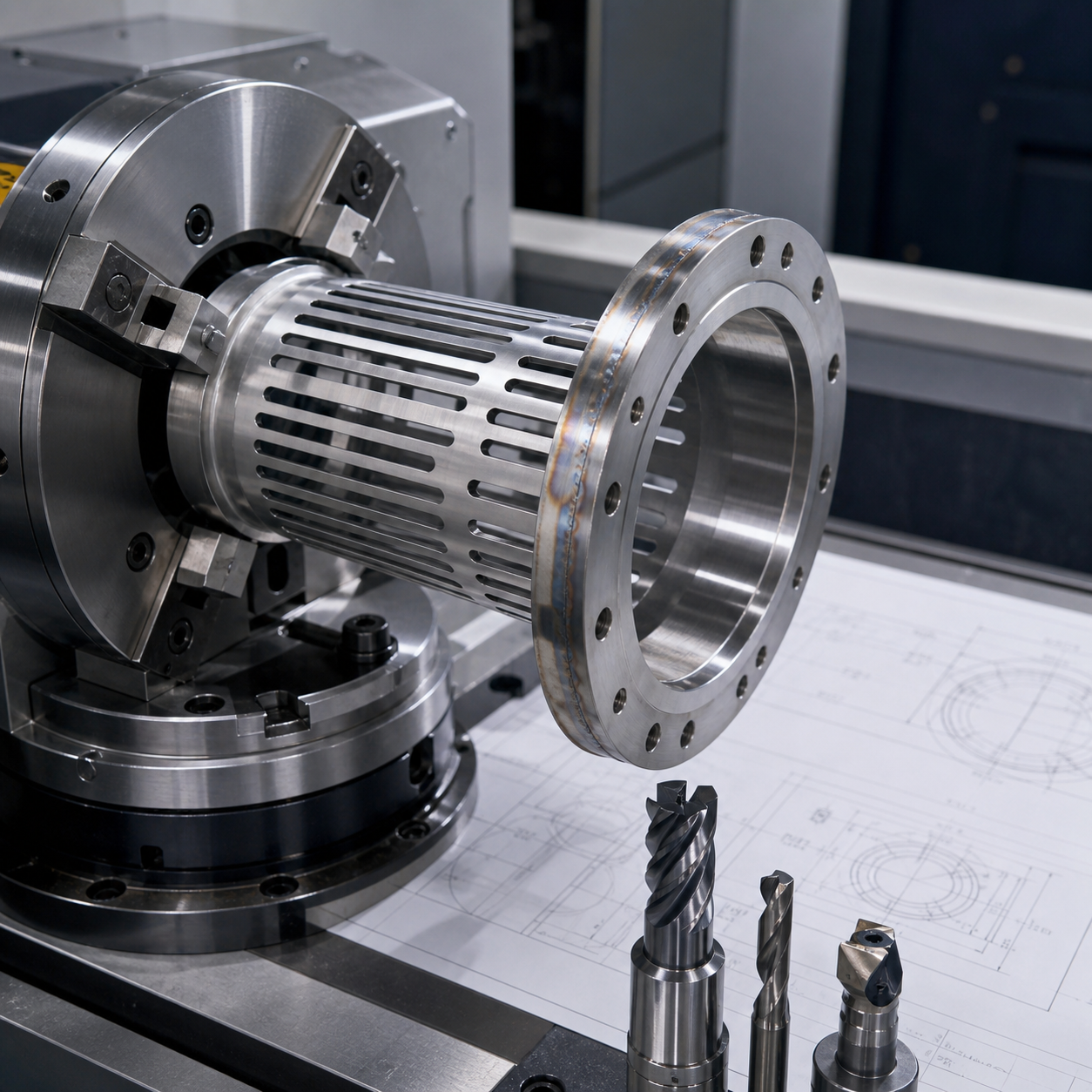
This hypothetical welded filter basket combines a sealing flange, thin slotted wall, internal pilot and bolt circle. The drawing must be converted into a sequence that recovers functional datums after welding without collapsing the ribs or smearing burrs into the flow path.
Feature and datum interpretation
Treat the gasket face as axial datum A and the finished pilot as radial datum B. Clock the slot pattern and bolt circle from a defined weld seam or datum hole. Inspect raw weld runout before assigning cleanup stock, because forcing a nominal centerline can leave one side of the flange unfinished.
Carbide tool selection
Use a positive-rake carbide face mill for the flange, a sharp variable-helix end mill for slot roughing, a reduced-neck finisher for slot walls, stub carbide drills for the bolt circle and a controlled back-chamfer tool for internal edges. Duplex stainless needs real chip thickness and directed coolant to avoid work hardening.
Fixture and process sequence
First skim sacrificial pads and establish a repeatable rotary axis. Support the basket internally with segmented soft jaws or a low-force mandrel, finish the pilot and gasket face, then mill slots in a staggered sequence so adjacent ribs are never released together. Finish bolt holes and edge breaks from the recovered datum set.
Tolerance, surface and tool-life risks
Heat, rubbing and weld residual stress can move the rim or bend narrow ribs. Avoid dwelling at slot ends, monitor spindle load for edge wear and inspect flange flatness after unclamping. Burr inspection must include the hidden inner slot edges before cleaning and passivation.
FAQ
Why recover datums before finishing?
Because the functional geometry must be related to the actual part, not an assumed nominal center.
Why inspect after unclamping?
Clamping can temporarily hide distortion or runout.