This is a realistic hypothetical process-planning example, not a claim about a specific customer drawing or production result.
Related: Review the Inconel seal-ring distortion case and our variable-helix end-mill guide.
English: reading the curved-clamp drawing
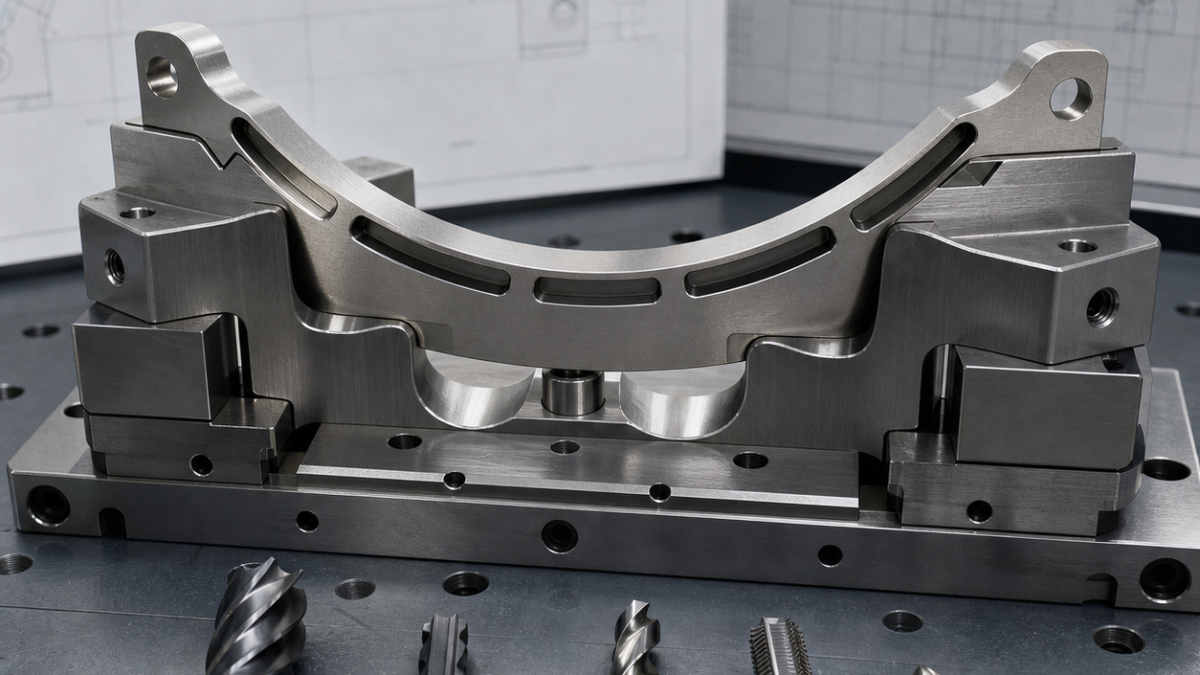
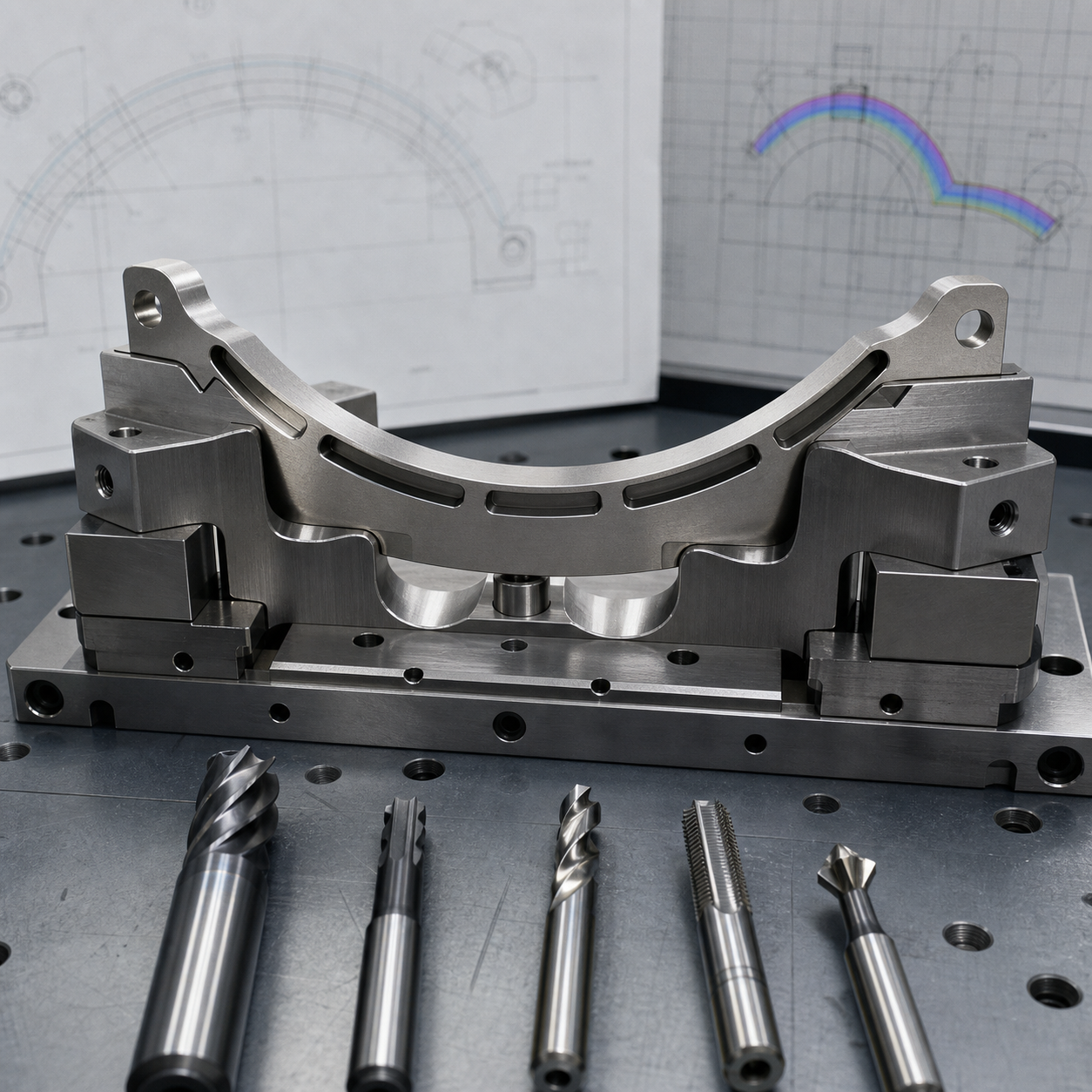
This hypothetical A286 segment has an accurate inner arc, thin connecting wall, narrow relief slots and bolt ears. The drawing should be read as a stiffness problem: arc profile and hole position are meaningful only in the specified free or restrained condition.
Functional interpretation
Identify whether profile tolerance applies free-state or assembled. Use the bolt-ear holes and a central clocking feature to transfer datums, but leave temporary stock across slots so the arc remains supported during roughing.
Tool package
A sharp variable-helix carbide end mill roughs the arc with low radial engagement. A reduced-neck finisher controls wall taper, while a small high-rigidity slot mill opens reliefs in several depths. Carbide drills, a thread mill and a compact chamfer tool complete the ears.
Fixture and sequence
Machine locating pads first, then clamp the blank against a full-contour soft jaw. Rough the inner and outer arcs alternately, leaving equal skin. Finish the profile before opening the final slot depth; add removable bridge tabs when the drawing permits. Release clamps progressively and measure the free-state arc.
Springback, burr and tool-life risks
A286 work-hardens quickly if the cutter rubs. Maintain chip load, avoid dwelling, use constant-engagement paths and high-pressure coolant. Slot exits need supported toolpaths or a sacrificial backup to prevent burr rollover. Track edge wear because a dull cutter increases both heat and springback.
FAQ
Why finish slots late?
Closed material keeps the segment stiff while the accurate arc is generated.
Can clamp force correct the profile?
It can hide error during machining, but the free-state part may spring back outside tolerance.
中文:解读A286弧形卡箍段图纸
本假设零件具有精确内圆弧、薄连接壁、窄减重槽和两端螺栓耳。图纸应先按刚性问题理解:圆弧轮廓和孔位置究竟是在自由状态还是约束状态评价,会直接决定装夹与检测方法。
功能解释
先确认轮廓度适用于自由状态还是装配状态。可用两端孔与中央定向特征转移基准,但窄槽区域应暂时保留材料,使圆弧在粗加工时获得连续支承。
刀具组合
锋利的变螺旋硬质合金立铣刀以小径向吃刀粗铣圆弧;缩颈精加工刀控制薄壁锥度;小直径高刚性槽铣刀分层打开窄槽。耳部使用硬质合金钻头、螺纹铣刀和短型倒角刀。
夹具与加工顺序
先加工定位垫,再将毛坯贴合全轮廓软爪。内外圆弧交替粗加工并保持等量余料,轮廓精加工后才把槽开到最终深度;图纸允许时保留可去除工艺桥。逐步松夹后测量自由状态圆弧。
回弹、毛刺与寿命风险
A286在刀具擦削时很快加工硬化。必须保持切屑厚度,避免停顿,采用恒定负载刀路和高压冷却。槽出口可设置牺牲背板防止毛刺翻卷;钝刀会同时增加热量和回弹,应跟踪刃口磨损。
常见问题
为何最后才完成窄槽?
未开透的材料能在形成精确圆弧时保持整体刚性。
能否用夹紧力校正轮廓?
夹紧只会暂时隐藏误差,卸夹后的自由状态仍可能超差。
Français : interpréter le plan du collier courbe
Ce segment hypothétique en A286 comporte un arc intérieur précis, une paroi mince, des lumières étroites et deux oreilles. Il faut d’abord savoir si le profil est spécifié à l’état libre ou bridé, car cela gouverne l’usinage et le contrôle.
Interprétation fonctionnelle
Transférer les références par les oreilles et un repère central, tout en laissant de la matière provisoire dans les lumières pour soutenir l’arc pendant l’ébauche.
Ensemble d’outils
Une fraise carbure à hélice variable ébauche avec faible engagement radial; une fraise à col dégagé finit la paroi. Une fraise à rainurer rigide ouvre les lumières par profondeurs successives, complétée par foret, fraise à fileter et chanfrein.
Montage et séquence
Plaquer l’ébauche contre un mors doux épousant tout le contour. Ébaucher alternativement arcs intérieur et extérieur, finir le profil avant d’ouvrir les lumières, puis relâcher progressivement le serrage et mesurer l’état libre.
Risques de détente, bavure et usure
L’A286 s’écrouit en cas de frottement. Maintenir l’épaisseur de copeau, éviter les pauses et utiliser une trajectoire à engagement constant. Soutenir les sorties de rainure et suivre l’usure, car une arête émoussée augmente chaleur et détente.
FAQ
Pourquoi ouvrir les lumières en dernier ?
La matière fermée conserve la rigidité pendant la finition de l’arc.
Le bridage peut-il corriger le profil ?
Il peut masquer l’erreur, mais celle-ci réapparaît au débridage.
Русский: анализ чертежа дугового хомута
Условный сегмент из A286 имеет точную внутреннюю дугу, тонкую стенку, узкие разгрузочные пазы и крепежные уши. Важно установить, задан ли профиль в свободном или закрепленном состоянии.
Функциональная трактовка
Базы переносят через отверстия ушей и центральный ориентир, но в пазах временно оставляют материал для поддержки дуги при черновой обработке.
Набор инструмента
Острая твердосплавная фреза с переменной спиралью черновит с малым радиальным врезанием; фреза с шейкой чистит стенку. Жесткая пазовая фреза раскрывает окна по глубине, затем работают сверло, резьбовая и фасочная фрезы.
Оснастка и порядок
Заготовку прижимают к профильным мягким губкам. Внутреннюю и внешнюю дуги черновят попеременно, профиль чистят до полного раскрытия пазов, затем постепенно ослабляют зажим и измеряют свободную форму.
Риски пружинения и износа
A286 быстро наклепывается при трении. Нужно сохранять толщину стружки, исключать остановки и применять траектории постоянной нагрузки. Выход паза поддерживают, а износ кромки контролируют, поскольку тупая фреза усиливает нагрев и пружинение.
FAQ
Почему пазы заканчивают последними?
Замкнутый материал сохраняет жесткость при формировании дуги.
Можно ли исправить профиль зажимом?
Зажим лишь скрывает ошибку, которая проявится после освобождения.