This is a realistic hypothetical process-planning example, not a claim about a specific customer drawing or production result.
Related: Compare the heat-control approach in our titanium aerospace bracket tooling case and the alignment logic in the 17-4PH clevis case.
English: reading the hinge-fitting drawing
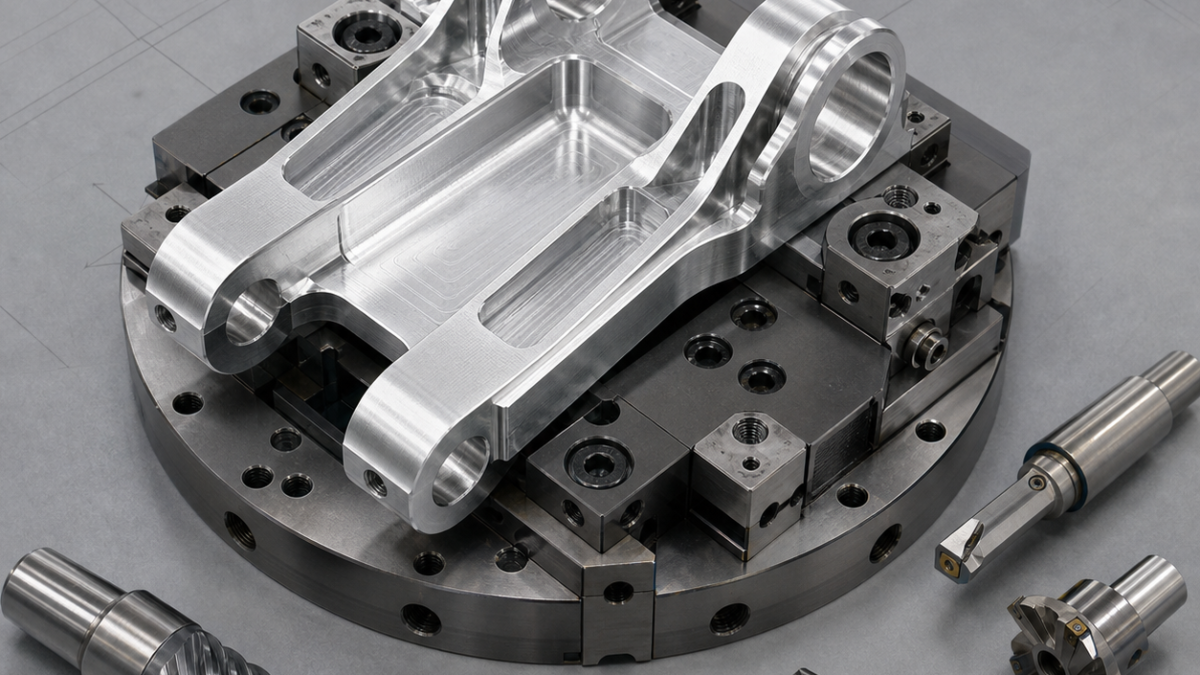
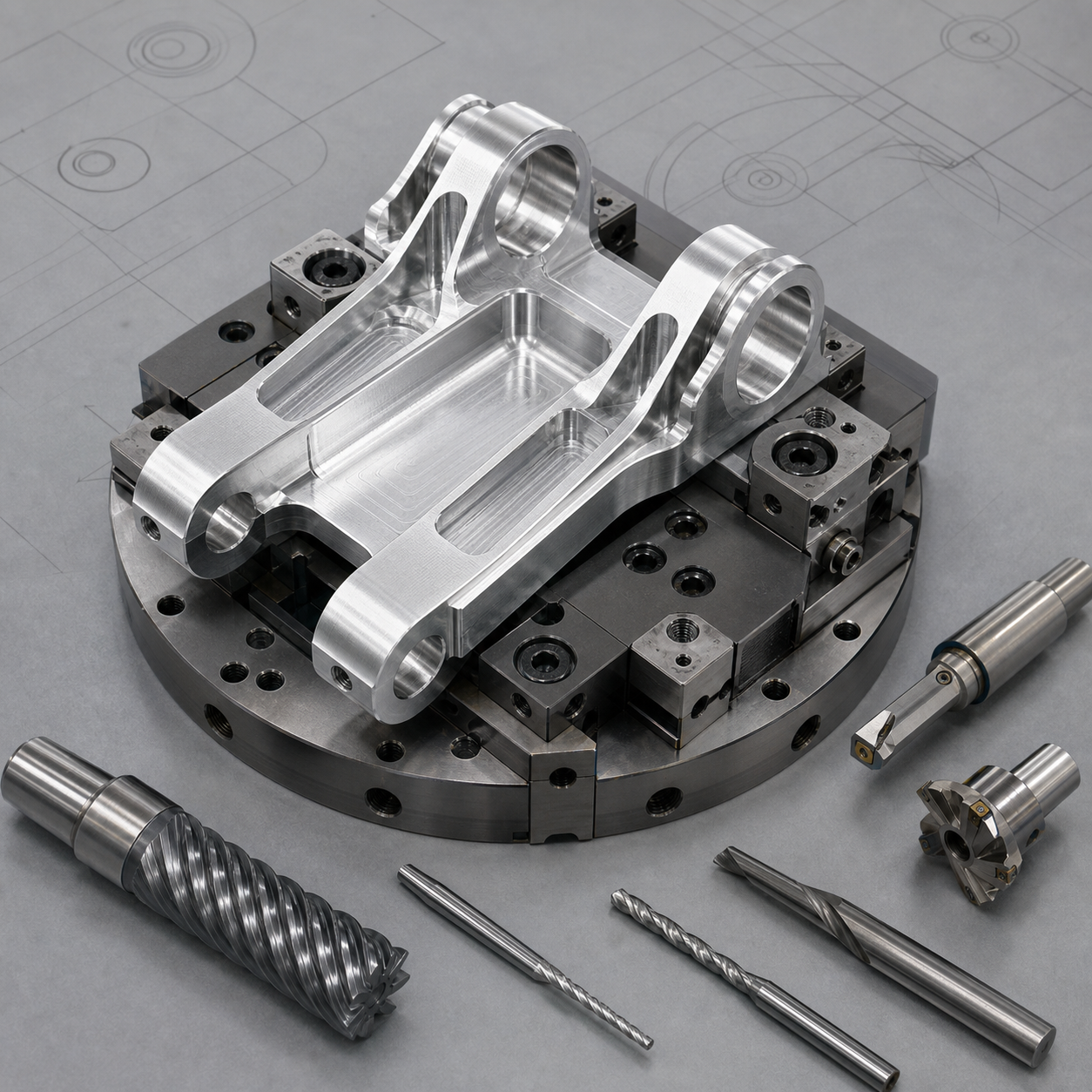
This hypothetical case starts with a 7050-T7451 billet and a drawing that prioritizes the common axis of two lug bores, fork spacing, pocket floor thickness and profile datums. The tooling plan must protect those relationships after heavy stock removal.
Translate features into controls
Treat the primary mounting face and two locating holes as datum A-B-C. Mark the lug bores as one functional feature rather than two independent holes. Deep fork pockets create unequal wall stiffness, so leave balanced stock and delay final bore sizing until the main pockets are stable.
Carbide tool set
Use a short variable-helix rougher for open-pocket adaptive milling, then a reduced-neck long-reach end mill for fork walls. Pre-drill the lugs, interpolate close to size, and finish both bores in one setup with a precision boring tool or line-boring arrangement. A small chamfer mill breaks edges without pushing the slender arms.
Process and fixture sequence
Face and establish datums first; rough both sides symmetrically with temporary ribs or sacrificial tabs. Stress-relieve through a controlled rest period if required by the process specification, reclamp on hardened datum pads, finish pockets, then bore the lugs. Probe the datum plane after every turnover and use a 5-axis trunnion only when it preserves tool rigidity.
Tolerance, finish and tool-life risks
The main risks are fork-arm movement, chatter from excessive stickout and built-up edge on aluminum. Use polished flutes, high chip evacuation and conservative radial engagement. Inspect coaxiality with a common mandrel or CMM routine, and check fork spacing only after unclamping because fixture force can hide movement.
FAQ
Why not finish the lug bores before the pockets?
Pocketing releases more stress and changes arm position, so early-finished bores may lose coaxiality.
Is a reamer enough for both bores?
Only when alignment and allowance are already controlled. For separated lugs, a common-axis boring method is usually safer.