English: Drawing Review and Tooling Plan
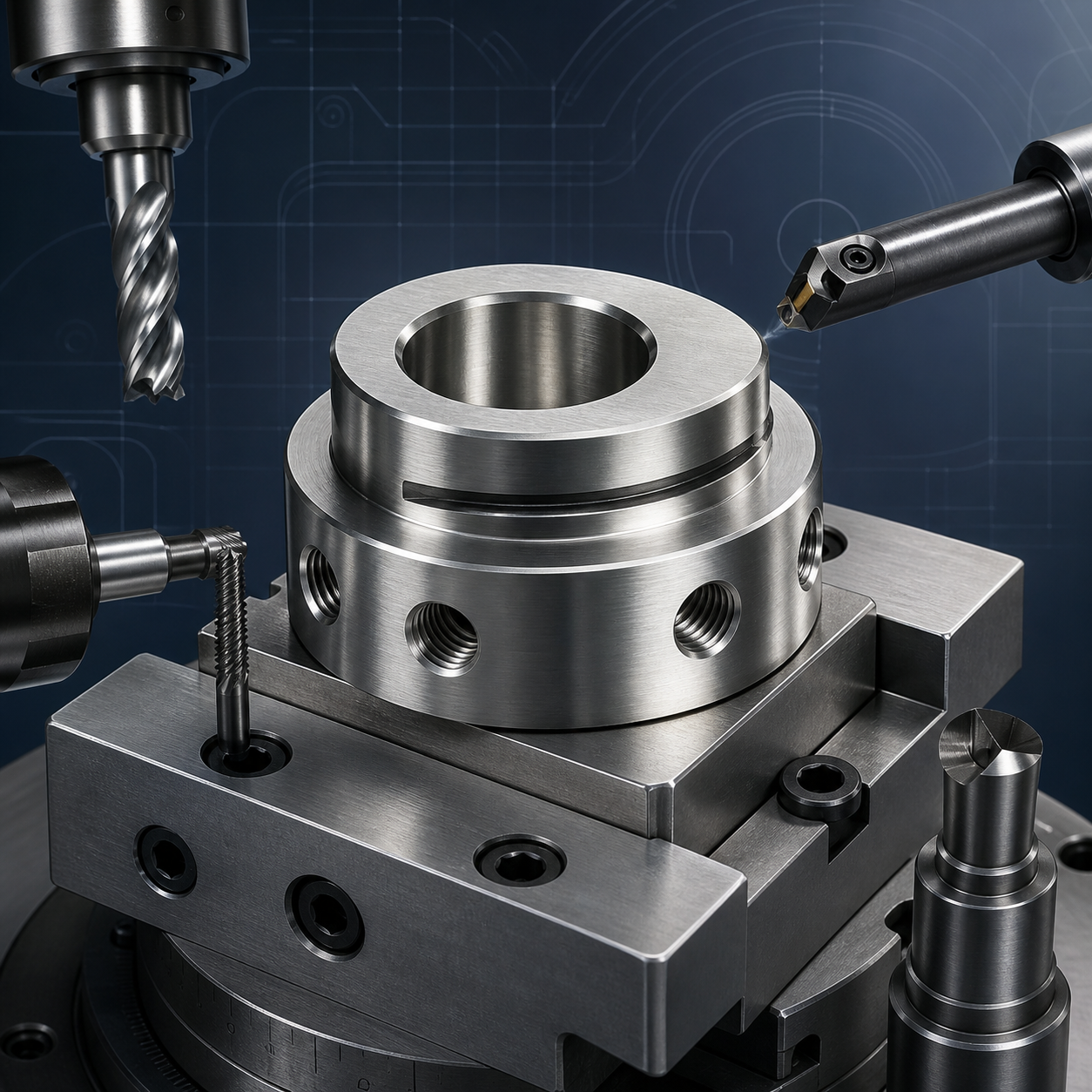
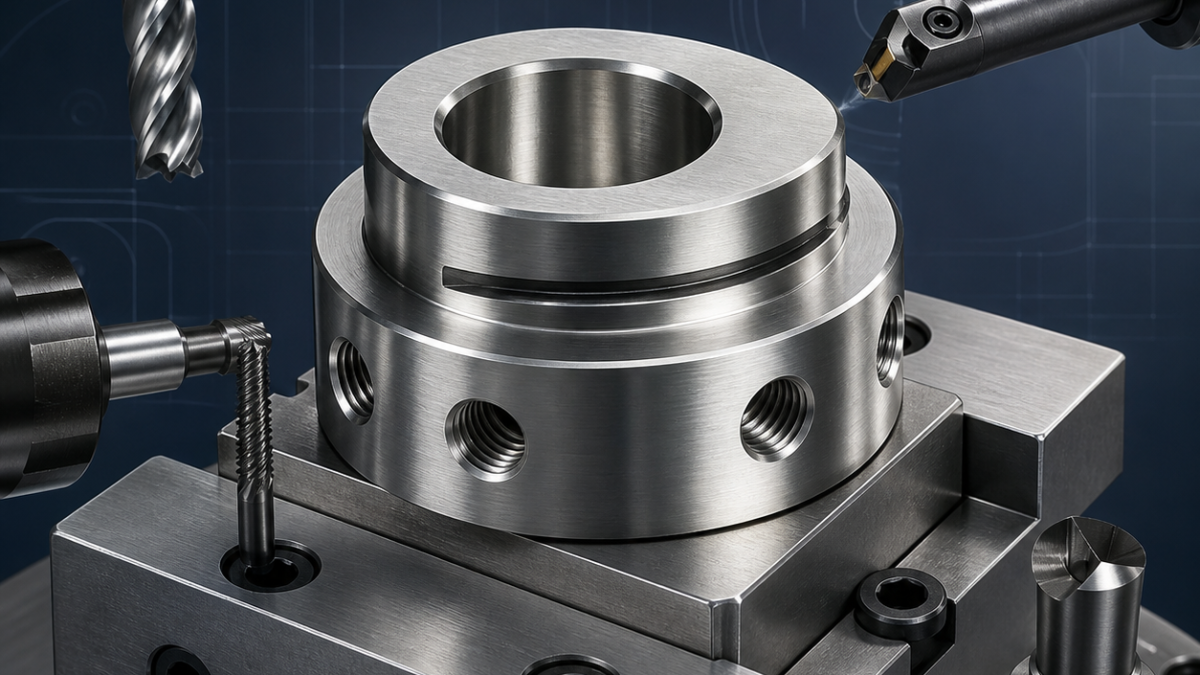
This practical planning article focuses on 304 stainless eccentric clamp hub CNC offset bore radial thread groove tooling. The part drawing combines two controlled faces, an eccentric precision bore, a retaining groove, radial threaded holes, outside profile and break-edge chamfers. The process goal is to convert drawing requirements into a stable fixture, a short tool list, controlled cutting conditions and measurable inspection gates.
Drawing and datum review
The first step is to identify the true functional datums. For this part, the process should treat the primary face datum, bored nest and keyed angular stop as the main reference. Nonfunctional stock should stay in place until the critical geometry is stable. This reduces the risk of chasing dimensions that move after unclamping.
Fixture and tool selection
The fixture plan is to finish the primary faces first, locate on a bored nest and use a keyed angular stop for repeatable radial-hole orientation. The recommended tooling is a variable-helix carbide end mill, short boring tool, necked groove mill, carbide thread mill and small chamfer mill. Keep tool reach short, verify holder runout and separate roughing tools from finishing tools. That separation protects the final surface from roughing wear and heat.
Starting parameters and sequence
Initial parameters should be conservative and based on the tool supplier’s grade data. Start with light radial engagement, steady chip evacuation and a documented tool-life limit. A reliable sequence is datum preparation, supported roughing, semi-finishing, critical holes or grooves, final surface finishing, deburring and inspection.
Inspection plan
Inspection should confirm bore size, eccentricity, groove width and position, radial thread orientation, face runout and burr condition. The useful SEO terms belong naturally here: 304 stainless eccentric clamp hub CNC offset bore radial thread groove tooling, fixture method, tool selection, burr control, dimensional inspection and process stability.