English: Drawing Review and Process Target
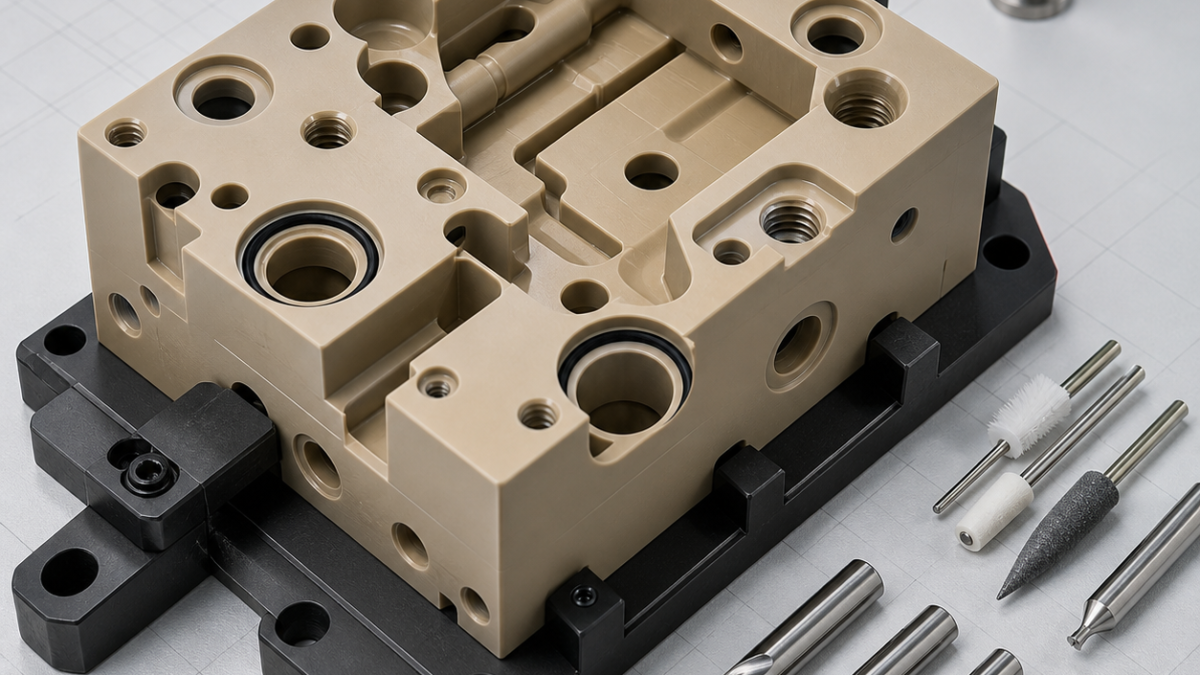
This CNC case study focuses on a PEEK fluid manifold with deep intersecting ports, O-ring grooves, threaded inserts and a flat sealing face. The example drawing calls for burr-free internal intersections, 0.05 mm groove width control, smooth sealing surfaces and thread quality suitable for repeated assembly. PEEK is much softer than metal, but it is easy to damage with heat, clamping pressure and dull tools.
The manufacturing objective is to keep the material cutting cleanly while avoiding melting, fuzzing and hidden burrs inside cross ports. A good process balances sharp tooling, low clamping stress, chip evacuation and inspection methods that can see into the internal flow path.
Fixture and Datum Strategy
Use broad, clean support under the sealing face and avoid point loading near thin walls. Vacuum support can work for broad plates, but a manifold with open ports often needs a soft-jaw nest or a machined pocket fixture. The fixture should locate from stable outside datums and leave the sealing face accessible for a light final pass.
Because PEEK can creep under pressure, clamp force should be documented and repeatable. Let the part return to room temperature before final inspection if machining heat is measurable. A short stabilization step often explains why a part changes size after leaving the machine.
Tooling Plan
| Feature | Suggested tool | Reason |
|---|---|---|
| Sealing face | Sharp polished face mill or single-flute fly cutter | Creates a clean surface with low heat |
| Deep ports | Polished carbide drill with coolant or air evacuation | Prevents chip packing and heat buildup |
| Intersecting holes | Small ball end mill or deburring tool on a programmed path | Removes internal burrs consistently |
| O-ring grooves | Sharp grooving tool with radius control | Maintains groove width and bottom finish |
| Threads | Thread mill or sharp form tap when suitable | Controls burrs and reduces scrap risk |
Starting Cutting Parameters
For a 6 mm polished carbide end mill in PEEK, trial speeds around 250-500 m/min and 0.04-0.10 mm per tooth are reasonable when chip evacuation is strong. Drilling should prioritize sharp edges and chip removal over aggressive feed. If the chip becomes stringy or smeared, reduce heat generation, improve evacuation and confirm that the tool is cutting rather than rubbing.
Operation Sequence and Inspection
- Confirm material grade, annealing condition and moisture handling requirements.
- Machine broad datums with light, sharp cuts.
- Drill deep ports with chip evacuation checks before full-depth production.
- Machine cross ports and remove internal burrs using a controlled toolpath.
- Finish O-ring grooves after the main porting operation.
- Finish the sealing face with minimum heat input.
- Inspect groove width, port intersections, thread quality, flatness and surface finish.
The SEO focus is PEEK fluid manifold CNC machining, deep ports, O-ring grooves and burr-free threads. The terms are included where they help buyers and engineers understand the process capability.