English: Part Requirements and Material Behavior
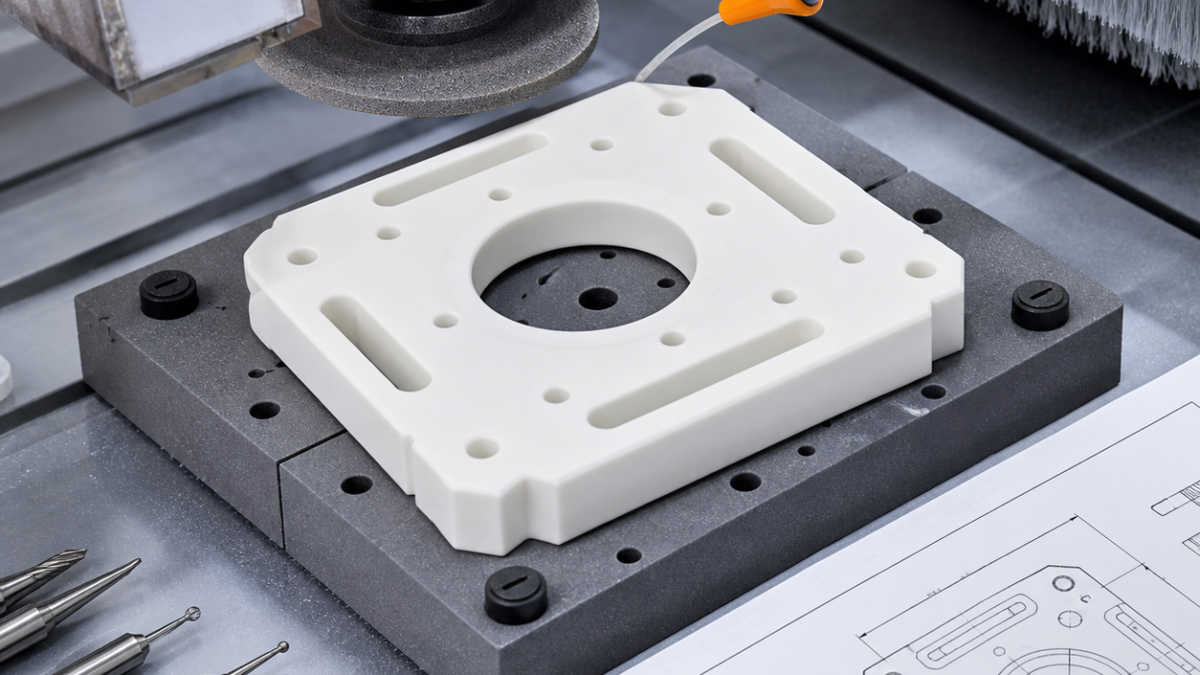
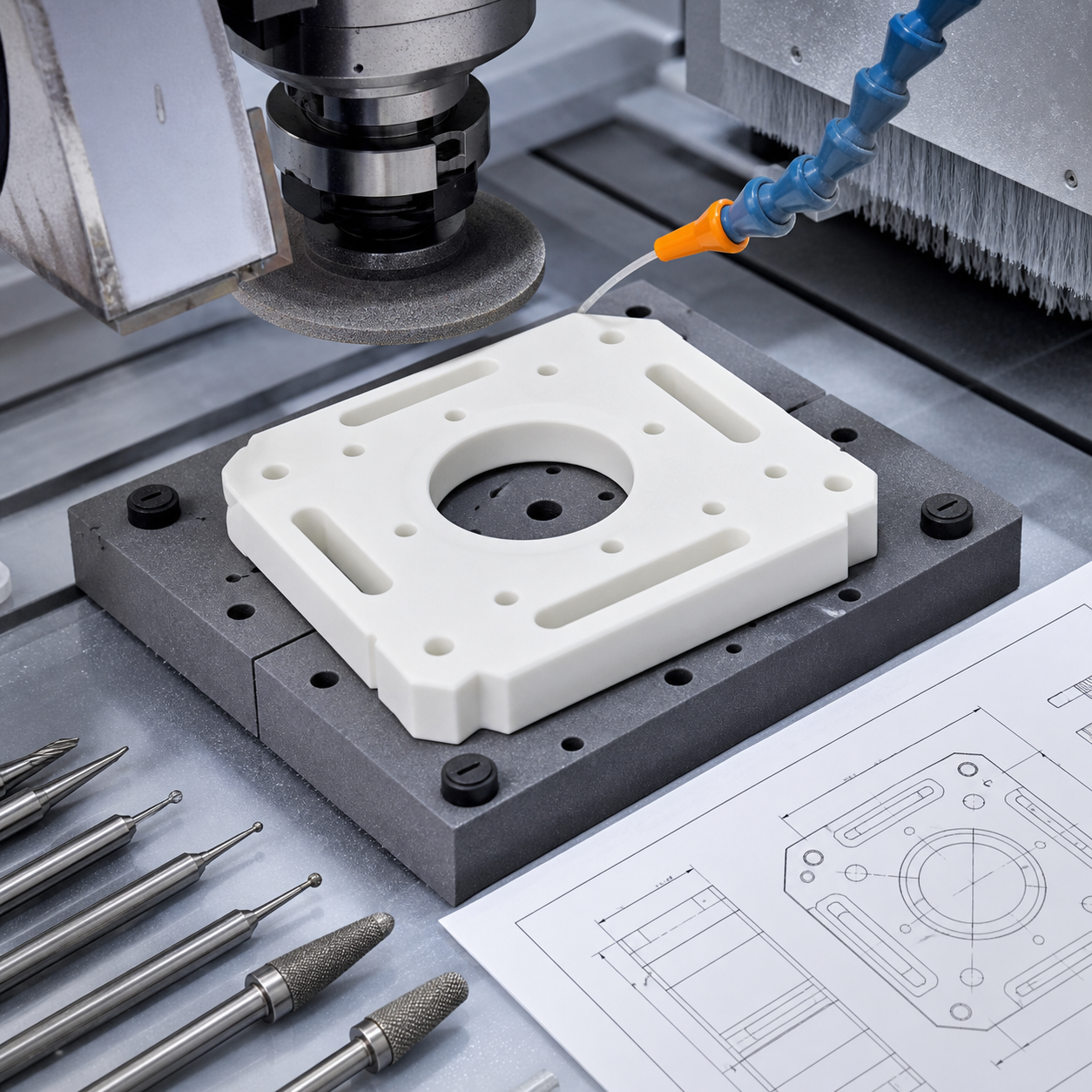
This case study covers a zirconia ceramic insulating base with a central clearance bore, four long slots, small mounting holes and chamfered edges. The example drawing calls for 0.02 mm flatness on the mounting face, controlled slot width, clean hole exits and no visible edge chipping on functional surfaces. Zirconia is hard and wear-resistant, but it does not behave like metal under a cutting edge.
The main process risk is brittle fracture. Excess force, poor support, tool runout or aggressive exit conditions can create microcracks that are not obvious during machining. For this reason, the plan emphasizes diamond tooling, gentle engagement, constant support and inspection that looks beyond simple dimensions.
Holding and Support
A flat vacuum fixture with a soft sacrificial interface is suitable when the underside is already ground. The fixture should support the part close to slots and holes, not only around the perimeter. If vacuum is not reliable because of through features, use a mechanical frame clamp with compliant pads and a controlled torque procedure.
Never clamp directly on a sharp ceramic corner. Local stress concentration can start cracks before the spindle turns. Keep the part clean, remove abrasive slurry frequently and verify that no hard chips are trapped between the ceramic and the support face.
Diamond Tooling Plan
| Operation | Suggested tool | Process reason |
|---|---|---|
| Face finishing | Fine diamond grinding wheel or cup wheel | Controls flatness with low thermal load |
| Slot roughing | Diamond electroplated or resin-bonded grinding pin | Avoids metal-style chip formation and reduces cracking |
| Small holes | Diamond core drill or ultrasonic-assisted diamond drill where available | Improves exit quality and reduces thrust |
| Edge chamfer | Small diamond chamfer wheel or diamond burr | Removes fragile sharp edges consistently |
| Final touch | Fine-grit diamond lap or polishing tool | Improves sealing or insulation contact surfaces |
Starting Parameters and Coolant
Parameter selection should begin with the diamond tool supplier’s data, because bond type and grit size change the process strongly. As a commissioning reference, use shallow infeed, high spindle speed, low axial force and steady coolant flow. For small diamond tools, reduce depth before reducing feed so the tool continues to cut or grind cleanly instead of rubbing and heating the ceramic.
Coolant must remove heat and abrasive debris. A clogged contact zone raises temperature, loads the diamond tool and increases edge chipping. Filter the coolant and clean the fixture between parts so abrasive particles do not damage reference surfaces.
Operation Sequence and Inspection
- Inspect incoming ceramic blanks for chips, warpage and surface defects.
- Grind or verify the primary mounting face before precision features.
- Support the part on a soft vacuum or compliant mechanical fixture.
- Machine holes with exit support or a sacrificial backing plate.
- Grind slots using multiple shallow passes and controlled entry/exit paths.
- Add chamfers before final cleaning to remove fragile edges.
- Clean ultrasonically or with an approved process to remove abrasive residue.
- Inspect flatness, slot width, hole diameter, edge condition and visible cracks under magnification.
The SEO focus is zirconia ceramic CNC grinding with diamond tooling, edge chipping control and inspection. These phrases belong naturally in the technical explanation because they describe the real manufacturing problem.
中文:氧化锆陶瓷绝缘座加工方案
本案例针对氧化锆陶瓷绝缘座,特征包括中心孔、长槽、小安装孔和倒角边。陶瓷材料硬而脆,不能按普通金属铣削思路处理。加工重点是金刚石刀具、低切削力、充分支撑、冷却排屑和崩边控制。
夹具可采用软接触真空支撑,或使用带柔性垫的机械压框。孔加工建议使用金刚石套料钻或具备条件时采用超声辅助钻削;槽加工使用金刚石磨头多次浅切。检测不仅看尺寸,还要用放大检查确认孔口、槽口和倒角处没有明显崩边或裂纹。
Francais : Base isolante en zircone
Ce cas concerne une base isolante en zircone avec alesage central, rainures longues, petits trous et chanfreins. Le risque principal est l ecaillage, car la ceramique ne se deforme pas comme un metal. Le montage doit soutenir la piece pres des zones usinees.
La gamme utilise des outils diamant, de faibles efforts, des passes peu profondes et un arrosage propre pour evacuer les particules abrasives. Le controle final comprend planeite, largeur des rainures, diametre des trous, etat des arêtes et recherche de fissures visibles sous grossissement.
Русский: изолятор из диоксида циркония
В этом примере рассматривается обработка керамического изолятора из диоксида циркония с центральным отверстием, длинными пазами, малыми отверстиями и фасками. Главный риск – сколы и микротрещины, поэтому нужна равномерная опора и алмазный инструмент.
Для отверстий применяют алмазные сверла или корончатый инструмент, для пазов – алмазные шлифовальные штифты с малыми проходами. Охлаждение должно удалять тепло и абразивную пыль. Контроль включает плоскостность, ширину пазов, диаметр отверстий, состояние кромок и визуальную проверку трещин.
FAQ
Can zirconia ceramic be machined like aluminum or steel?
No. Zirconia normally requires grinding or diamond abrasive tools because brittle fracture and abrasive wear dominate the process.
Why is exit support important for ceramic holes?
The final breakthrough can chip the hole edge. Sacrificial backing or controlled drilling reduces exit damage.
Related reading: Graphite Electrode CNC Milling and Micro End Mills in CNC Machining.