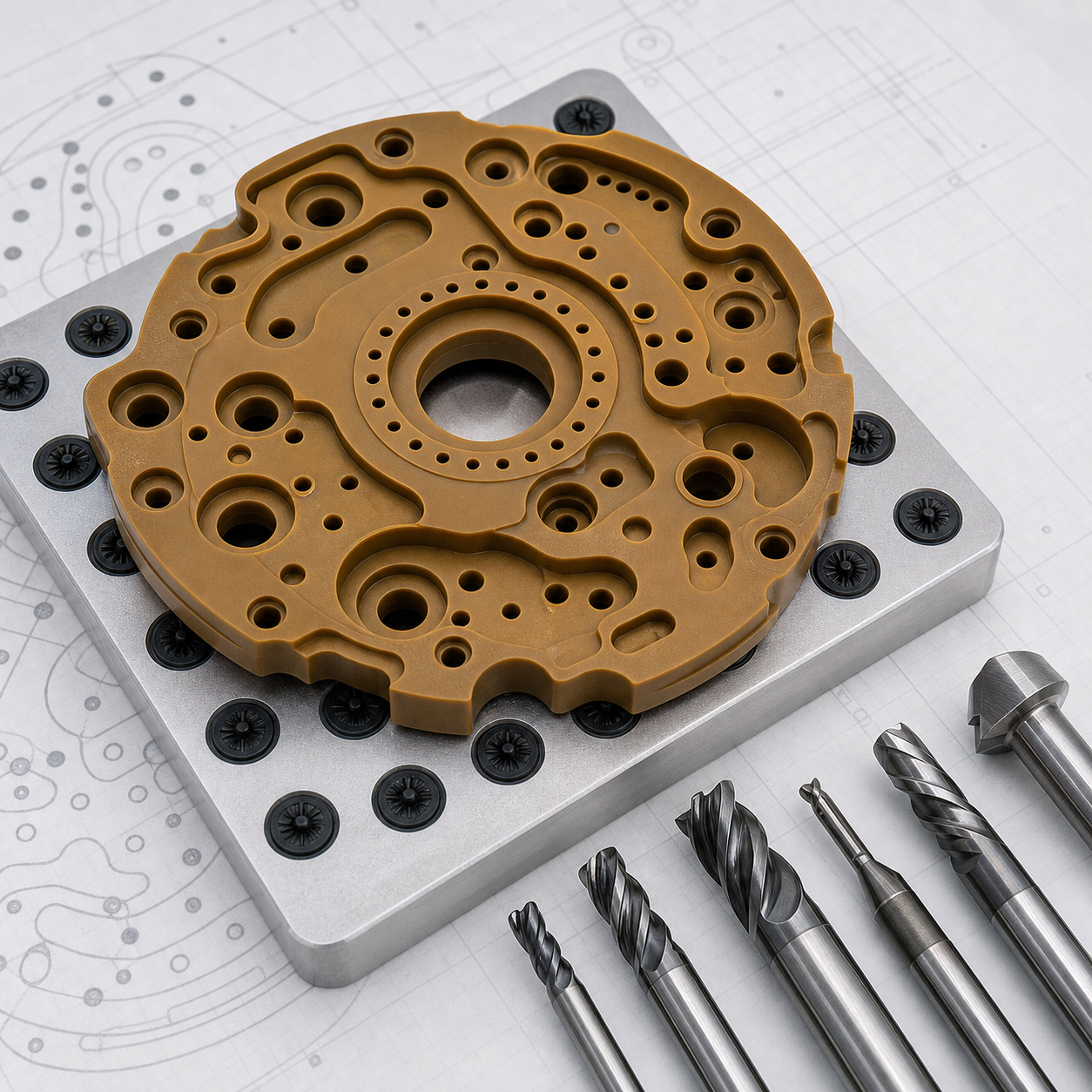
English: interpreting the Torlon valve-plate drawing
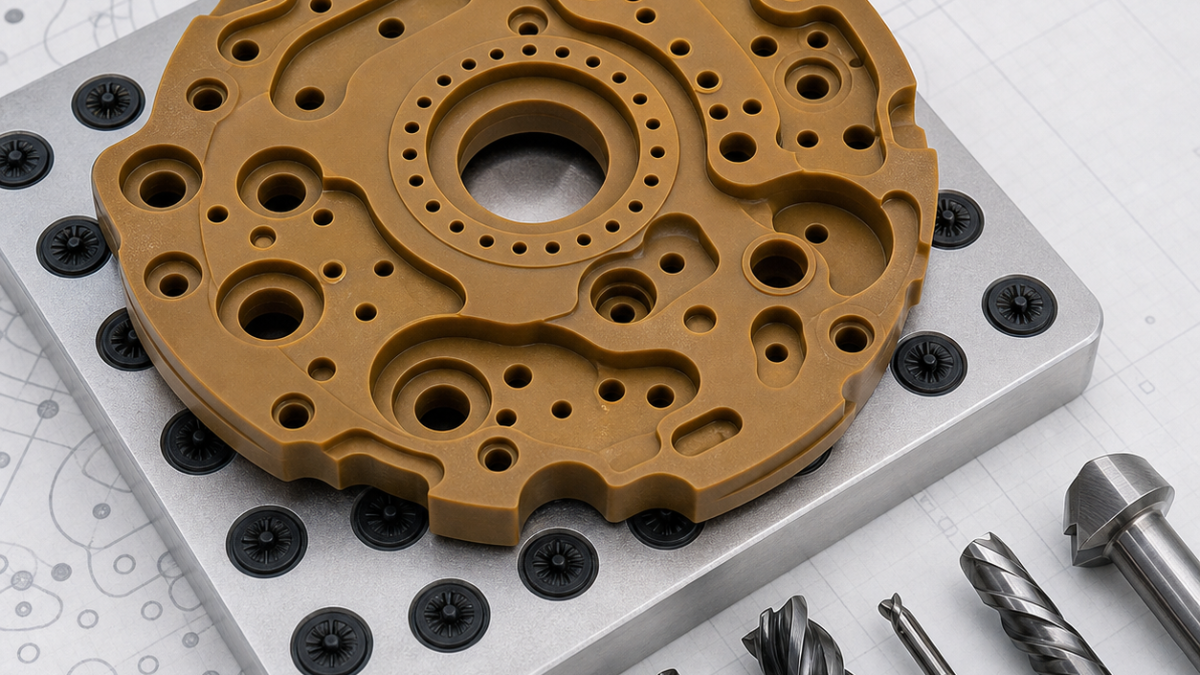
This hypothetical Torlon PAI compressor valve plate has two flat functional faces, shallow flow pockets, narrow sealing lands, many small holes and selected counterbores. The challenge is to preserve flatness and crisp land edges while preventing local heat from changing dimensions. Polymer stock condition, moisture history and inspection temperature should be controlled before machining begins.
Support and datum strategy
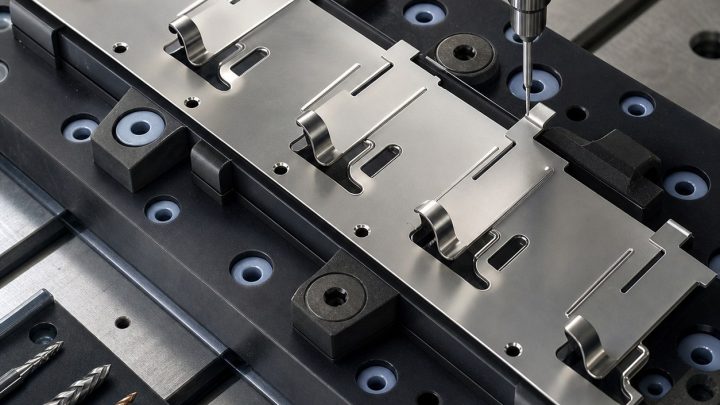
Skim the first face on a broad sacrificial plate, then establish that face as datum A. For the pocket side, use a vacuum fixture with distributed support under the sealing lands and mechanical edge stops for shear load. Keep vacuum channels away from small through-holes. If vacuum area is insufficient, add light peripheral clamps over supported zones rather than bending the plate.
Tools matched to delicate features
- A polished single- or two-flute carbide end mill roughs pockets with ample chip space.
- A fresh small-diameter finisher traces sealing-land walls with low radial engagement.
- Stub carbide drills make small holes in size groups, with frequent chip evacuation.
- A sharp reamer is reserved for holes whose fit cannot be achieved reliably by drilling.
- A controlled chamfer tool removes only the specified edge break without widening the sealing land.
Thermal and dimensional control
Use sharp tools, moderate spindle speed, air or clean compatible coolant, and toolpaths that distribute heat around the plate. Rough symmetric pocket groups, allow the plate to return to a stable temperature, then finish both faces with minimal stock removal. Do not measure immediately after a warm cut. Inspect overall thickness, flatness on a defined support, sealing-land width, small-hole true position, counterbore depth and edge condition under magnification.
Related reading: PEEK machining heat and burr control and vacuum fixturing for thin parts.