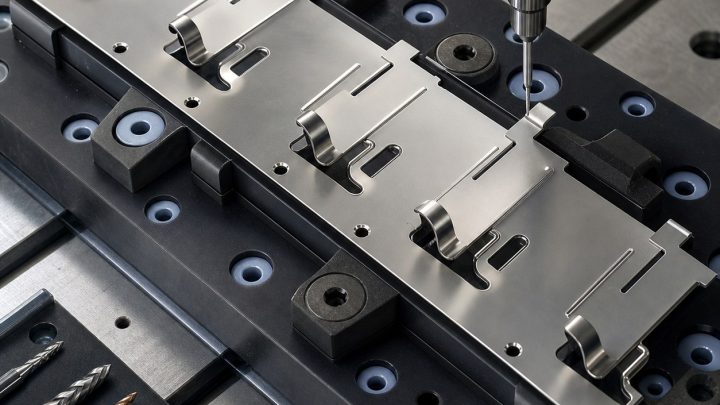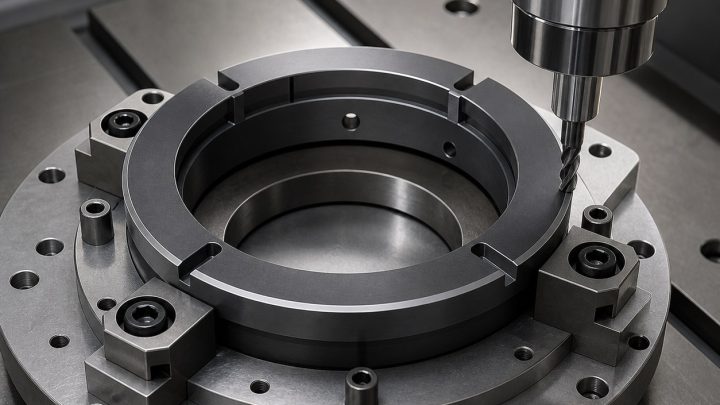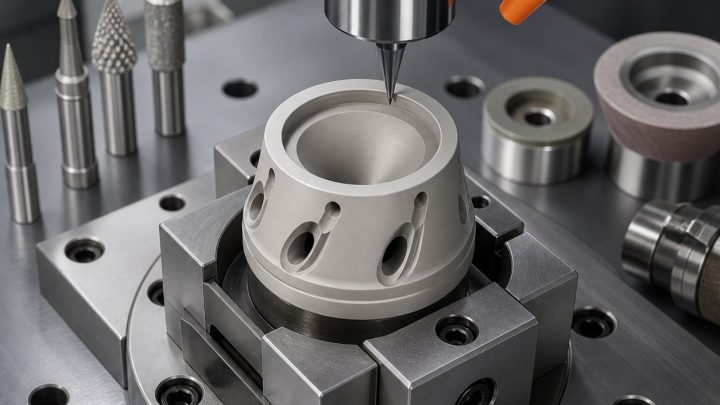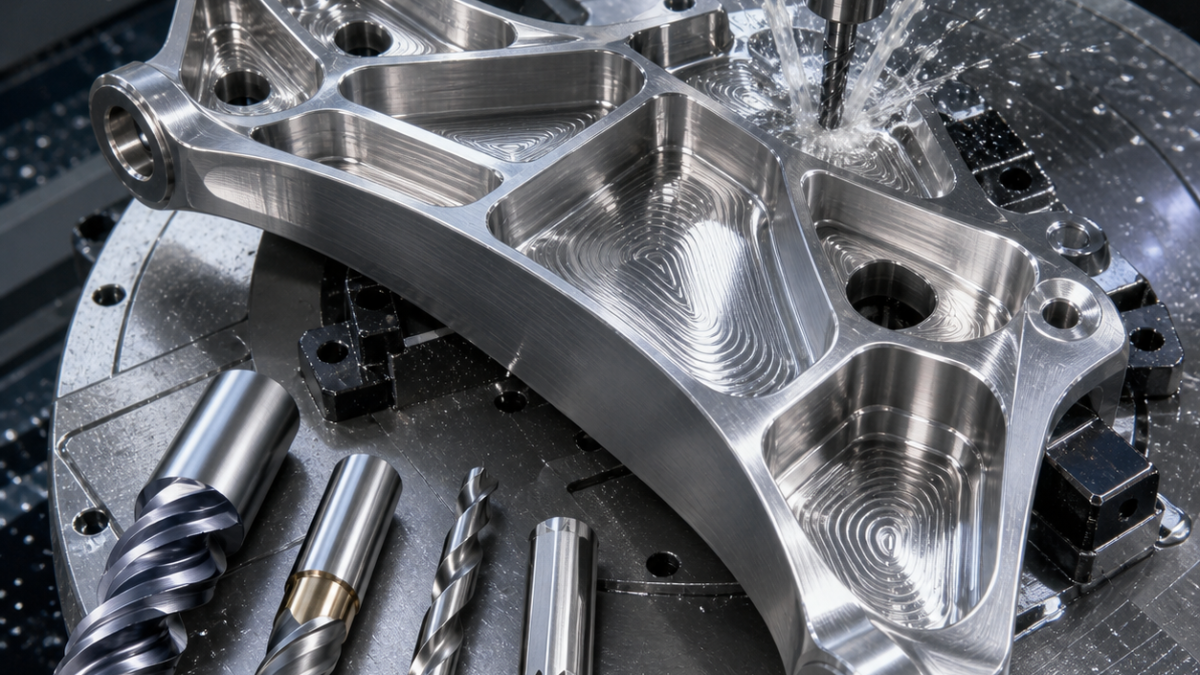
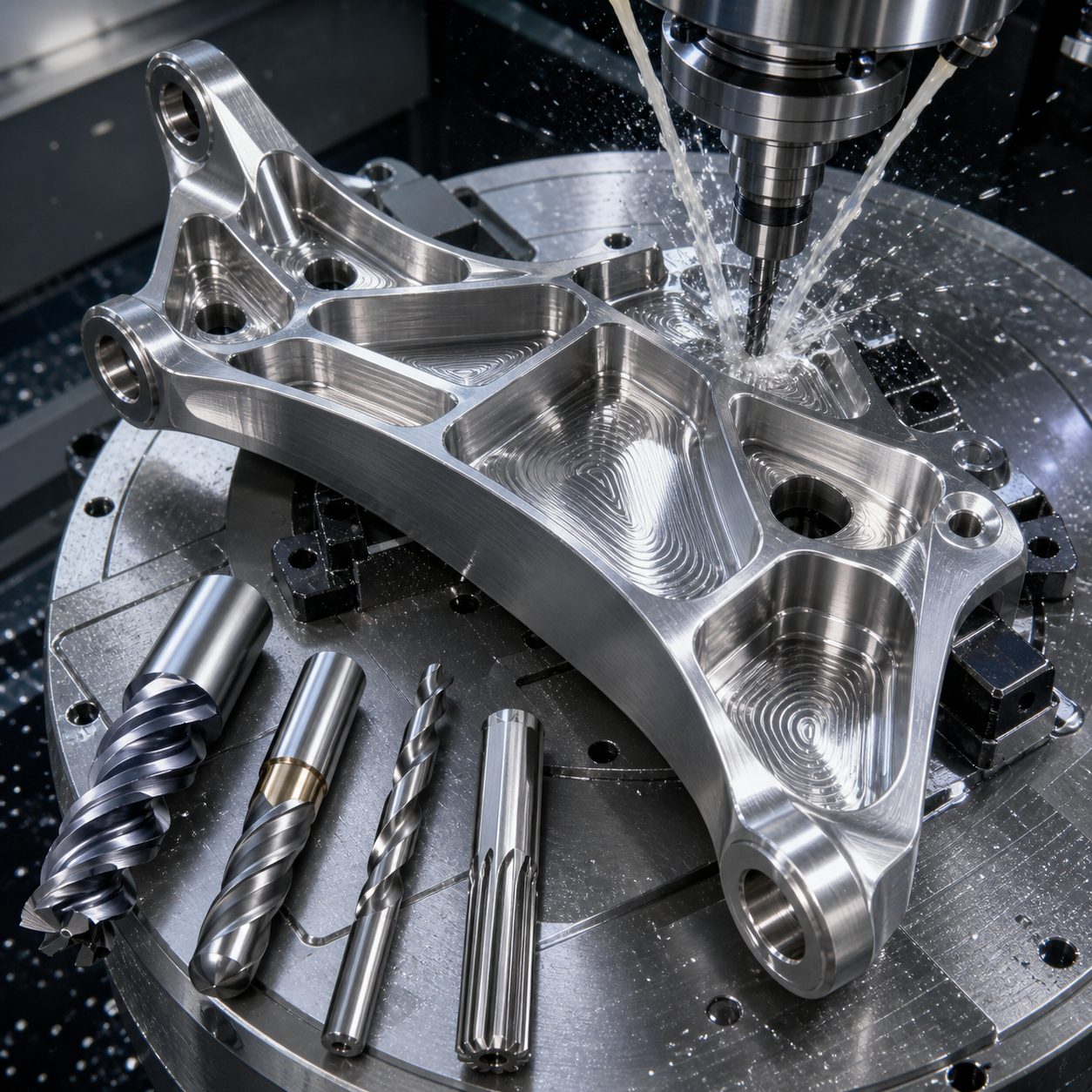
A titanium aerospace bracket CNC machining plan must balance material removal, heat control and thin-feature stability. This Ti-6Al-4V drawing includes deep pockets, thin ribs, filleted corners and precision holes. The process uses rigid fixturing, constant-engagement roughing and staged finishing so that heat and residual stress do not distort the final geometry.
Drawing Review and Risk Features
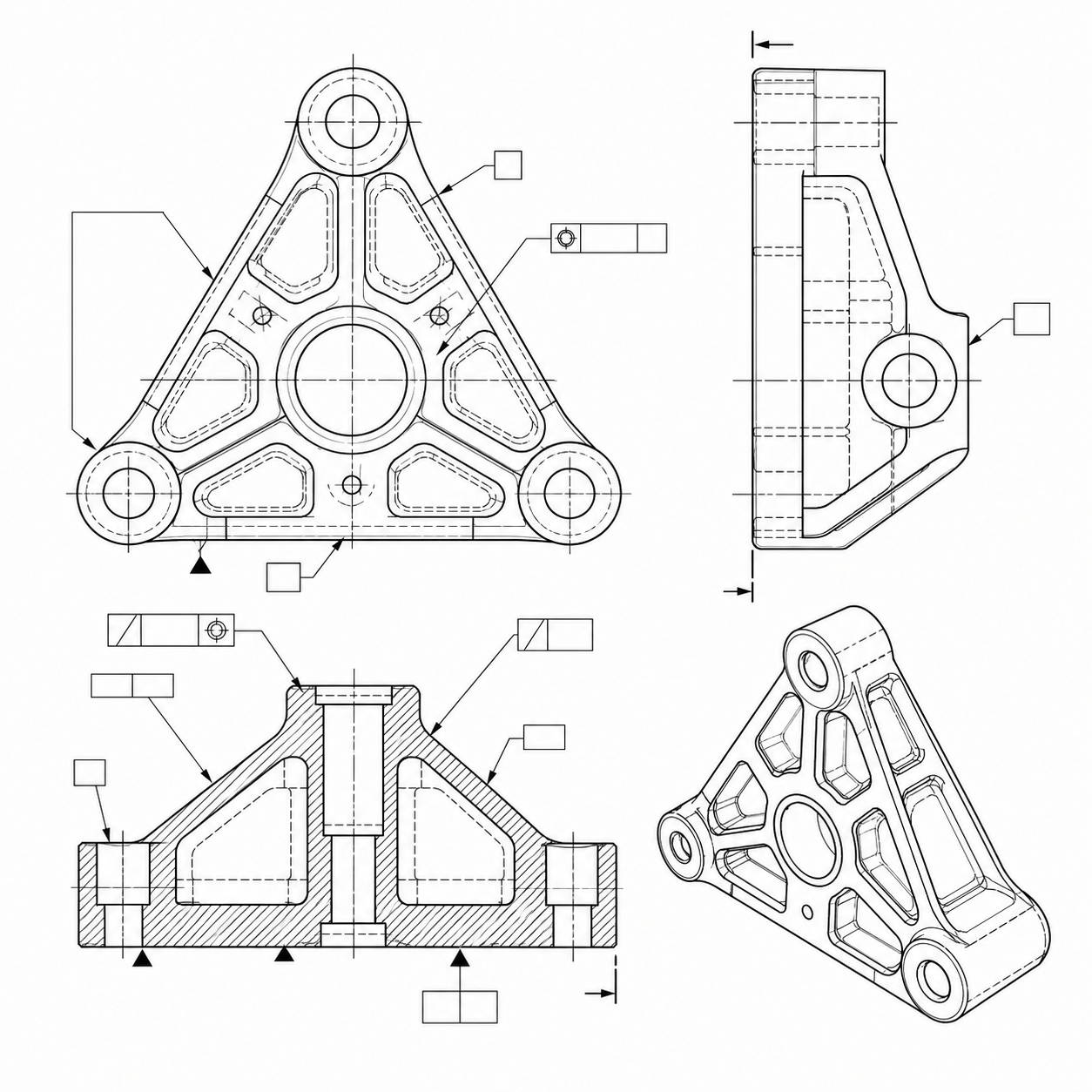
Start by identifying load-path surfaces, datum holes, minimum rib thickness, corner radii and inaccessible undercuts. Keep the part supported by a stable outer frame during early operations. Do not finish the thinnest ribs while large amounts of stock remain elsewhere. Critical holes should be machined after the surrounding pockets have reached a stable semi-finished state.
Carbide Tooling and Heat-Control Plan
- Roughing: a variable-helix, unequal-pitch carbide end mill with a titanium-appropriate coating. Use adaptive or trochoidal paths with controlled radial engagement.
- Semi-finishing: a rigid corner-radius end mill leaves a uniform finishing allowance and strengthens the cutting edge.
- 3D fillets: a ball nose end mill with a short overhang; select step-over from the required scallop height.
- Precision holes: carbide drilling with through-tool high-pressure coolant, followed by reaming or finish boring according to diameter and positional tolerance.
- Edges: a sharp chamfer tool and controlled deburring prevent local bending of thin ribs.
Recommended Operation Sequence
- Face the stock and establish datums with a rigid fixture.
- Open pockets using constant-engagement roughing and high-pressure coolant.
- Alternate opposing pockets to balance heat and stress.
- Semi-finish ribs and walls while retaining support tabs or a stable frame.
- Machine critical holes from the inspection datum system.
- Finish 3D fillets, ribs and datum faces with minimal tool overhang.
- Deburr, clean, allow temperature normalization and perform CMM inspection.
Cutting data must come from the actual tool manufacturer and machine condition. In titanium, rubbing is costly: keep chip load stable, avoid dwell, evacuate chips and replace a degrading tool before notch wear damages the surface. Record tool life by actual cutting time and inspect the edge at planned intervals.
中文方案
Ti-6Al-4V 航空支架的配刀重点是控热、保持切削负载稳定以及防止薄肋变形。粗加工采用适合钛合金的变螺旋硬质合金立铣刀,配合自适应或摆线刀路,控制径向吃刀量并使用高压内冷。相对区域交替去除材料,有助于平衡热量和残余应力。
薄肋不要过早精加工,应保留外框或工艺连接位支撑。半精加工用圆角立铣刀留下均匀余量,三维圆角用短悬伸球头刀完成。关键孔在周围型腔稳定后加工,并从检验基准建立坐标。最终需在温度稳定后进行三坐标检测。
Résumé français
Pour un support aéronautique en Ti-6Al-4V, l’ébauche utilise une fraise carbure à hélice variable et une trajectoire adaptative avec faible engagement radial. L’arrosage haute pression évacue les copeaux et limite la concentration thermique.
Les nervures minces restent soutenues pendant l’ébauche et ne sont finies qu’après stabilisation des poches. Une fraise torique prépare une surépaisseur uniforme; une fraise boule courte termine les congés 3D. Les alésages critiques sont usinés depuis les références de contrôle, puis la pièce est vérifiée sur MMT.
Русское резюме
Для кронштейна из Ti-6Al-4V черновую обработку выполняют твердосплавной фрезой с переменной спиралью по адаптивной траектории при малом радиальном контакте. Подача СОЖ под высоким давлением удаляет стружку и ограничивает нагрев.
Тонкие ребра сохраняют опору до завершения основной выборки материала. Равномерный припуск создают радиусной фрезой, а трехмерные сопряжения чистят короткой шаровой фрезой. Критические отверстия обрабатывают от контрольных баз и проверяют на КИМ после стабилизации температуры.
FAQ
Why is constant engagement important in titanium milling?
It limits sudden chip-thickness and heat spikes, helping stabilize tool load and reduce edge chipping in corners.
When should thin ribs be finished?
After major stock removal and semi-finishing have stabilized the part. Keeping temporary support longer reduces vibration and distortion.
Related CNC Tooling Cases
Compare this process with the drawing-based aluminum bracket plan, the titanium milling heat-control guide and the 5-axis tool-orientation article.