Case basis: This is a realistic hypothetical CNC tooling case for process-planning education, not a verified medical-device manufacturing instruction.
English: Ti-6Al-4V Bone Plate CNC Case: Slotting, Ball-Nose Finishing and Heat Control
Titanium plate drawings require heat-aware tool selection
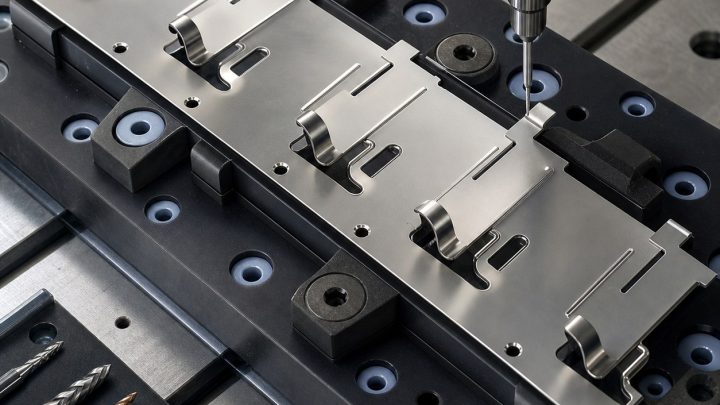
A contoured Ti-6Al-4V plate combines thin edges, multiple slots and a curved top surface. The drawing may emphasize profile accuracy and smooth transitions, but the process planner must also control heat. Titanium does not forgive rubbing, dull edges or excessive tool engagement.
Drawing features that drive tool choice
- Long narrow slots with limited chip evacuation.
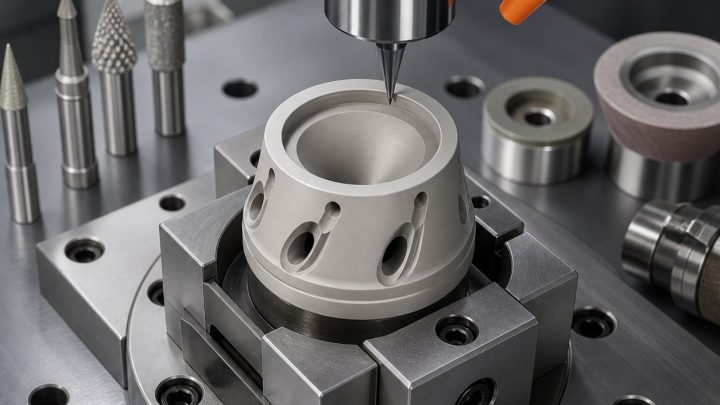
- Curved surface blending that benefits from ball-nose finishing.
- Thin perimeter regions that can spring after roughing.
- Small holes near edges where burrs and exit breakout must be controlled.
Tooling and process plan
- Use sharp variable-helix carbide end mills with conservative radial engagement for roughing.
- Open slots with peck-style or trochoidal motion rather than one heavy full-width pass.
- Finish the curved top with a coated carbide ball-nose end mill and consistent step-over.
- Use coolant delivery and programmed dwell avoidance to prevent rubbing heat.
Risk controls before production
- Monitor tool wear before the cutting edge turns polished.
- Avoid leaving unsupported thin islands until the final operations.
- Confirm deburring access before choosing slot sequence.
- Validate fixture contact without clamping distortion.
FAQ
- Why not use aggressive feed to reduce heat? Feed helps only if the edge remains engaged correctly; overload can chip the tool.
- Is coating necessary? A suitable titanium coating can help, but geometry and coolant matter more than coating alone.
- Can ball-nose finishing remove all roughing marks? It can, if step-over and remaining stock are controlled.
中文: Ti-6Al-4V 骨板 CNC 案例:开槽、球头刀精加工与热量控制
钛合金弧形板件的热控制刀具方案
Ti-6Al-4V 钛合金板件常见窄槽、薄边、曲面过渡和边缘孔。图纸看的是轮廓和表面,工艺要额外关注热量。钛合金一旦刀口发钝或局部摩擦,尺寸和表面都会迅速恶化。
图纸特征如何影响刀具选择
- 长窄槽排屑空间有限,满刀切削风险高。
- 曲面过渡适合球刀稳定小步距精加工。
- 薄边粗加工后可能释放变形。
- 靠边小孔容易产生出口毛刺和崩边。
刀具与工艺方案
- 粗加工选锋利变螺旋硬质合金立铣刀,控制径向吃刀。
- 窄槽采用摆线或分段开槽,避免一次重切满槽。
- 曲面使用涂层硬质合金球刀,小步距均匀精加工。
- 冷却和路径衔接要避免停顿摩擦生热。
量产前的风险控制
- 刀口变亮发钝前就要监控寿命。
- 薄弱区域不要过早加工成孤岛。
- 排好去毛刺路径,避免槽底不可处理。
- 夹紧要稳定,但不能压弯薄板。
常见问题
- 钛合金是不是越快越不热?不是,进给要和刀具负载匹配,过载会崩刃。
- 涂层是不是关键?涂层有帮助,但几何角度、冷却和路径更重要。
- 球刀能不能消掉粗加工刀纹?可以,但前提是余量和步距受控。
Français: Cas CNC d’une plaque osseuse en Ti-6Al-4V : rainurage, finition à la fraise boule et maîtrise thermique
Stratégie CNC pour une plaque en Ti-6Al-4V
Une plaque profilée en Ti-6Al-4V impose une stratégie sensible à la chaleur. Les rainures, bords minces et surfaces courbes exigent des outils carbure très affûtés et une trajectoire sans frottement inutile.
Éléments du plan qui guident le choix des outils
- Rainures longues avec évacuation copeaux limitée.
- Surface courbe à finir avec fraise boule.
- Bords minces pouvant se détendre après ébauche.
- Petits trous proches du bord avec risque de bavure.
Plan d’outillage et d’usinage
- Fraises carbure à hélice variable pour l’ébauche.
- Ouverture des rainures par trajectoire trochoïdale.
- Finition avec fraise boule carbure revêtue.
- Arrosage et suppression des arrêts en contact.
Points de maîtrise avant série
- Suivre l’usure avant l’arrondi de l’arête.
- Ne pas isoler les zones minces trop tôt.
- Prévoir l’accès d’ébavurage.
- Brider sans déformer la plaque.
FAQ
- Un fort avance réduit-il la chaleur ? Seulement si la charge reste correcte.
- Le revêtement suffit-il ? Non, géométrie et arrosage restent essentiels.
- La fraise boule efface-t-elle les marques ? Oui avec un pas adapté.
Русский: Пластина Ti-6Al-4V: пазы, сферическая фреза и контроль нагрева
Обработка пластины Ti-6Al-4V с контролем тепла
Контурная пластина из Ti-6Al-4V требует выбора инструмента с учетом тепла. Узкие пазы, тонкие кромки и криволинейная поверхность не допускают трения тупой режущей кромкой.
Какие элементы чертежа определяют выбор инструмента
- Длинные узкие пазы со сложной эвакуацией стружки.
- Криволинейная поверхность для сферической фрезы.
- Тонкие края с риском пружинения.
- Отверстия у края с риском заусенцев.
План инструмента и обработки
- Острые твердосплавные фрезы с переменной спиралью.
- Трохоидальное открытие пазов.
- Финиш сферической фрезой с малым шагом.
- Подача СОЖ и исключение остановок в резании.
Контроль рисков перед серией
- Следить за износом до появления полированной кромки.
- Не изолировать тонкие участки рано.
- Проверить доступ для снятия заусенцев.
- Закреплять без деформации.
FAQ
- Большая подача всегда лучше? Нет, перегрузка вызывает сколы.
- Достаточно ли покрытия? Нет, нужна правильная геометрия и охлаждение.
- Сферическая фреза уберет следы? Да, при правильном припуске и шаге.