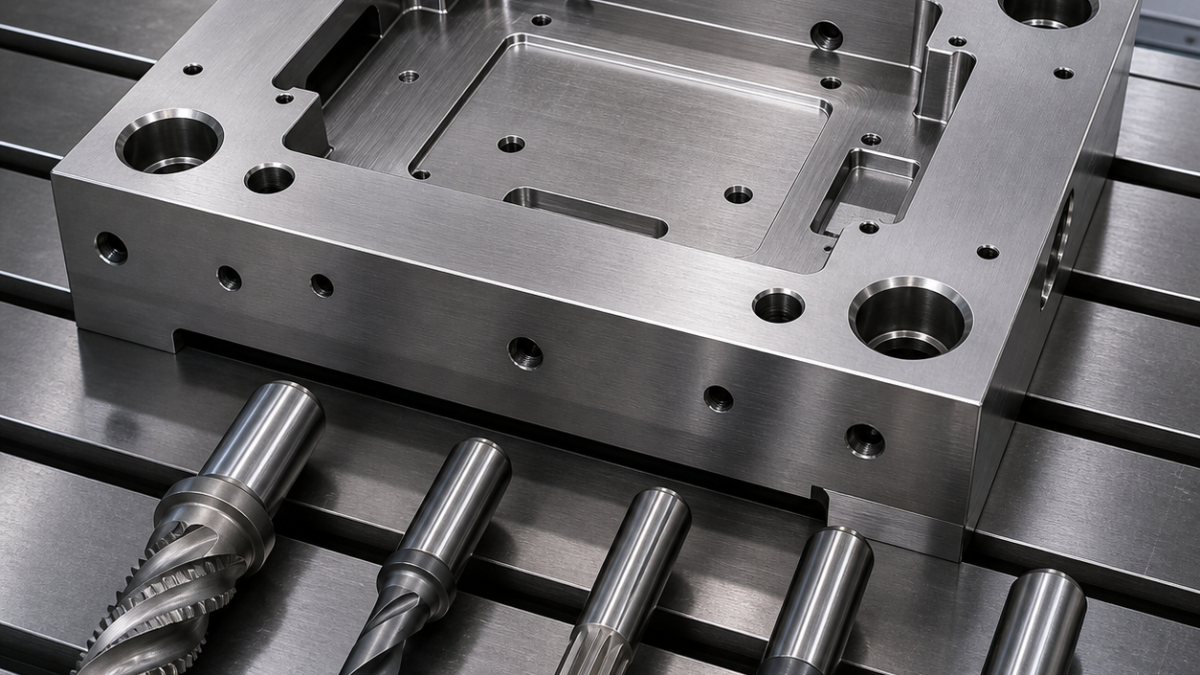
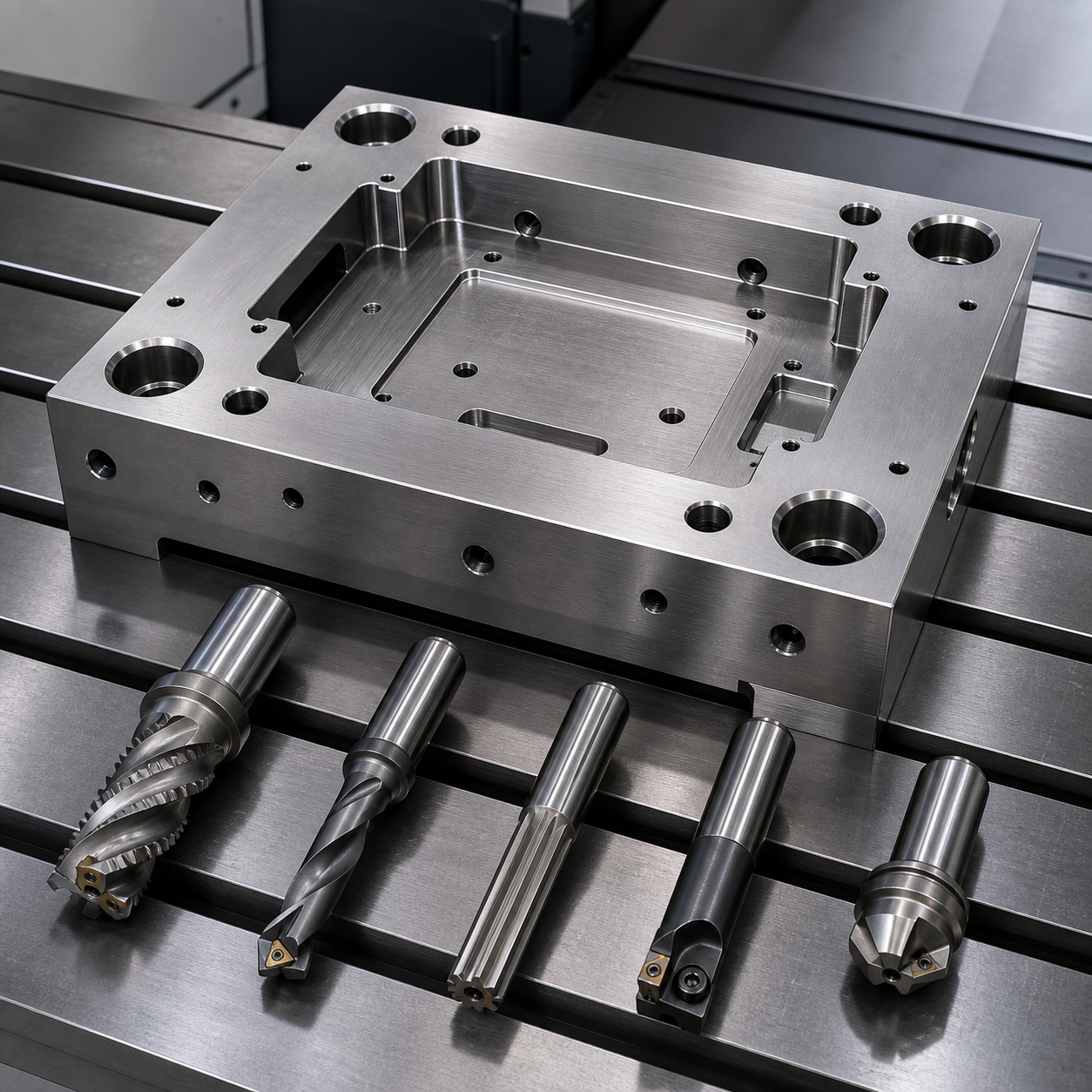
A plastic mold base plate CNC machining plan should begin with the drawing, not with a favorite cutter. In this case, the P20/1.2311 steel plate includes datum faces, a stepped central pocket, four guide-pin bores, counterbores, screw holes and edge chamfers. The process must protect squareness and bore position while keeping tool changes and air cutting under control.
Drawing Review and Machining Targets
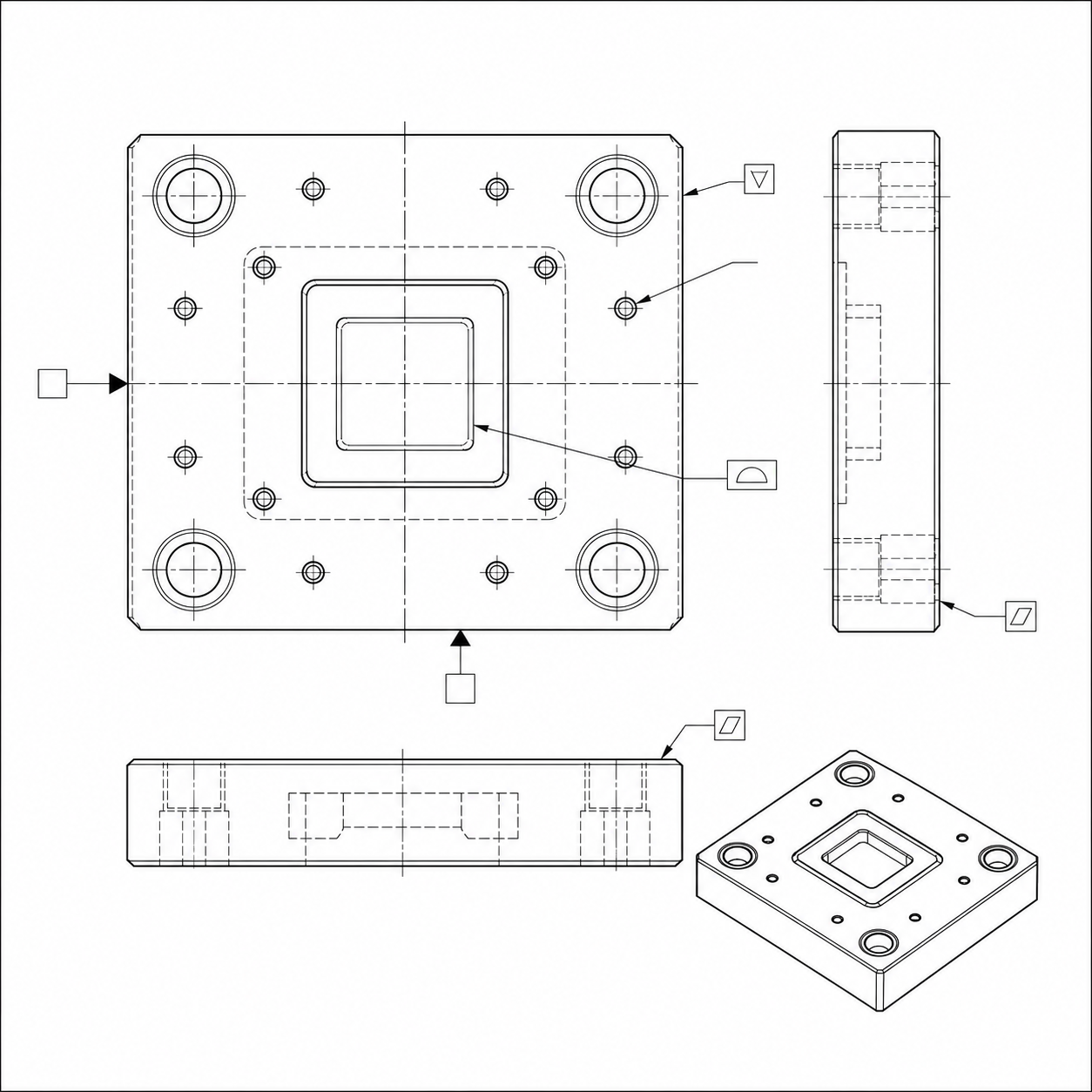
Establish the broad bottom face as datum A, then use two perpendicular edges as B and C. Rough and semi-finish the central pocket before finishing the guide bores, because heavy pocketing can release stress. Leave a controlled finishing allowance on walls and floor. Guide-pin bores should be located from the same datums used for inspection; their diameter, cylindricity and positional tolerance determine whether reaming or finish boring is the better final operation.
Tool Selection and Cutting Strategy
- Face milling: a 45-degree indexable face mill with a positive geometry insert reduces entry shock and produces a stable datum.
- Pocket roughing: a variable-helix carbide roughing end mill with adaptive or trochoidal paths maintains a consistent engagement angle.
- Corner finishing: use the largest practical carbide end mill for rigidity, then a smaller necked tool only where the drawing requires a tight radius.
- Guide bores: pilot drill, carbide drill, semi-finish boring and precision reaming or finish boring. Measure before the final correction.
- Threads and edges: use a thread mill where recovery and size adjustment matter; finish with a carbide chamfer mill.
Recommended Process Sequence
- Face datum A and machine reference edges B/C.
- Rough the pocket with constant-engagement toolpaths, leaving stock on walls and floor.
- Spot, drill and counterbore noncritical holes.
- Semi-finish the pocket and allow the plate to stabilize before critical finishing.
- Finish the guide bores from the established datum system.
- Finish pocket walls, floor and corner radii; then thread, chamfer and deburr.
- Inspect flatness, squareness, bore size and true position.
中文方案
这套模架板配刀方案以图纸基准和孔位精度为核心。先加工大平面建立 A 基准,再用两条互相垂直的侧边建立 B、C 基准。型腔先粗后精,粗加工采用变螺旋硬质合金立铣刀和恒定吃刀量刀路,减少转角负载突变。导柱孔应在大余量去除后完成,避免材料应力释放造成孔位漂移。
导柱孔可采用“定心—钻孔—半精镗—铰孔/精镗”的路线。批量稳定且孔径固定时优先铰刀;孔径补偿和位置修正要求高时优先精镗。所有精孔尽量在同一装夹和同一基准体系内完成,最后检查平面度、垂直度、孔径与位置度。
Résumé français
Pour cette plaque de moule en acier P20, la gamme commence par la création des références A, B et C. La poche est ébauchée avec une fraise carbure à hélice variable et une trajectoire à engagement constant. Une surépaisseur régulière est conservée pour la semi-finition et la finition.
Les alésages de guidage sont réalisés après les opérations lourdes: centrage, perçage, semi-alésage, puis alésage de finition ou alésoir selon la tolérance. Le contrôle final porte sur la planéité, l’équerrage, le diamètre et la position vraie des alésages.
Русское резюме
Для плиты пресс-формы из стали P20 сначала формируют базы A, B и C. Карман обрабатывают твердосплавной фрезой с переменной спиралью по траектории с постоянным углом контакта, оставляя равномерный припуск под чистовую обработку.
Направляющие отверстия завершают после снятия основного объема материала: центровка, сверление, получистовое растачивание и развертывание либо чистовое растачивание. Контролируют плоскостность, перпендикулярность, диаметр и позиционный допуск.
FAQ
Should guide-pin holes be reamed or finish bored?
Reaming is efficient for a stable repeated diameter. Finish boring provides better size compensation and correction when positional and cylindricity requirements are demanding.
Why finish the bores after pocket roughing?
Heavy stock removal can release residual stress. Delaying the critical bores reduces the risk of size and position changing after roughing.
Related CNC Tooling Cases
Compare this plan with the plate drawing with counterbores and threaded holes and the hardened mold insert finishing case.