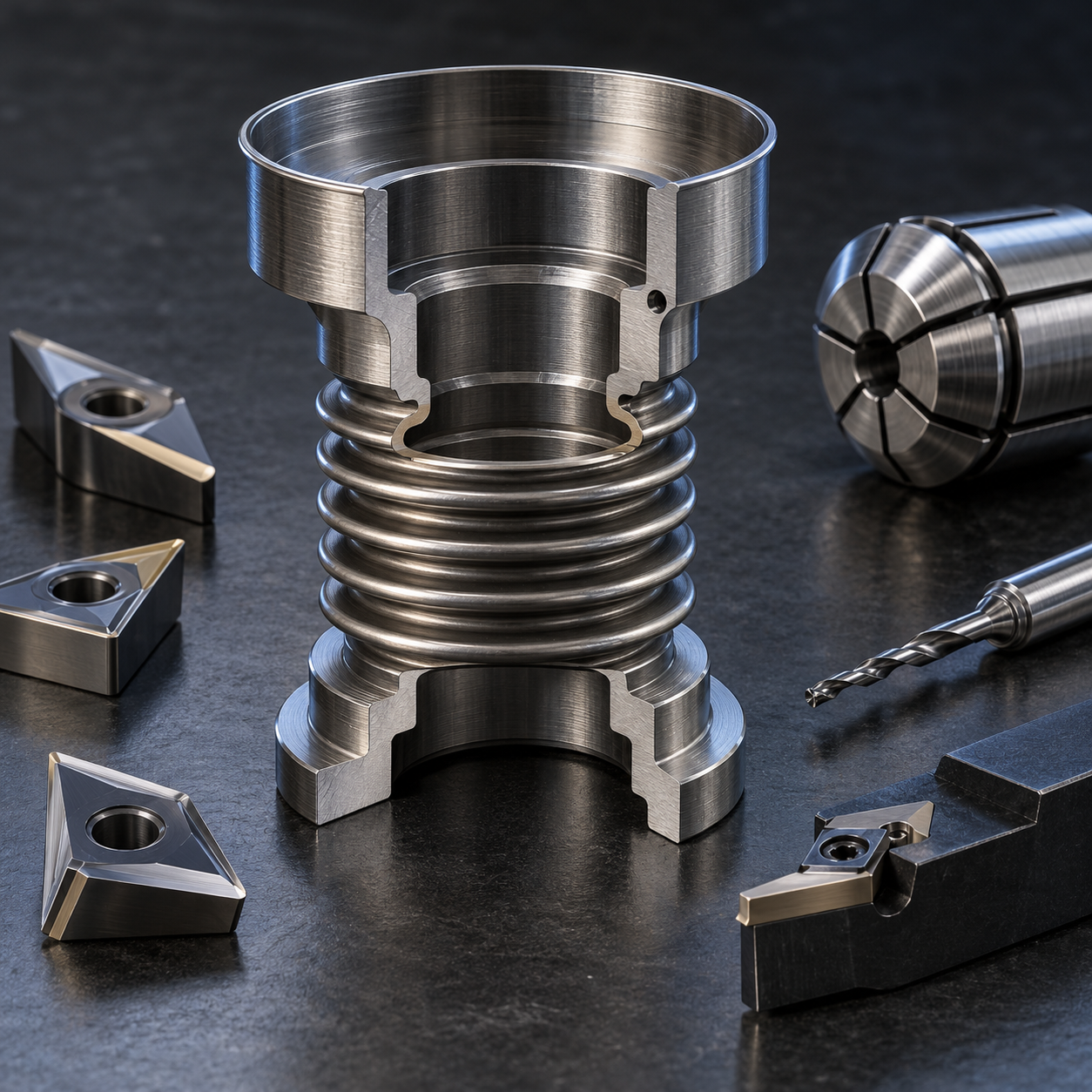
English: Kovar Bellows End-Fitting Tooling for a Thin Weld Rim and Capillary Vent
The search intent is how to machine a Kovar bellows end fitting without pulling the thin weld rim off-axis or leaving a burr in its capillary vent. The drawing links pilot runout, rim thickness, relief depth and seal-face flatness to the later weld setup.
Finish the weld rim from the bellows pilot, not the chuck
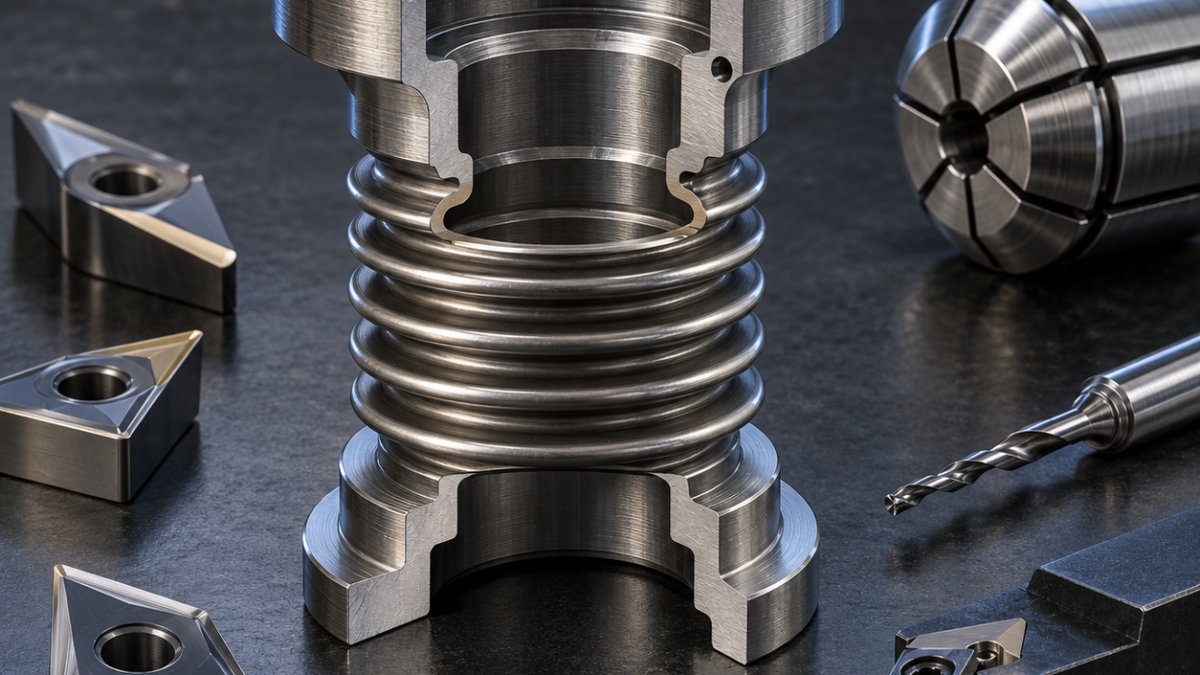
Hold annealed bar in a precision collet and turn the bellows pilot, seal face and rough rim with a sharp positive PVD carbide insert. Bore the internal relief with a 1.5 mm full-radius grooving tool in a damped holder, leaving a temporary support ring behind the weld rim. A broad wiper is rejected because its axial pressure can dish the seal face.
Feature-to-tool map for the Kovar fitting
| Drawing feature | Carbide tool and holder | Selection logic / rejected alternative |
|---|---|---|
| Pilot and seal face | Sharp positive PVD carbide insert, 0.2 mm radius, precision collet | One axis and low force; a wiper can dish the face. |
| Internal relief | 1.5 mm full-radius carbide groover, damped holder | Controls relief root while retaining support; a long boring bar chatters. |
| Capillary vent | 0.7 mm AlCrN micro-grain carbide drill, high-accuracy collet | Low runout and hot-hardness; a jobber drill walks on the radius. |
| Vent intersection | 0.5 mm reverse chamfer tool, minimum reach | Removes the hidden burr; hand wire can tear the rim. |
| Thin weld rim | Sharp finishing insert then narrow groover to release support | Low radial force preserves concentricity; a broad cut pulls the rim. |
Keep a support ring until the last turning pass
While the rim is supported, spot the radial vent with a 120-degree micro spotter and drill 0.7 mm using an AlCrN micro-grain carbide drill in a high-accuracy collet at minimum projection. Break the internal intersection using a 0.5 mm reverse chamfer tool. Finish the pilot and rim in one final light turning path, then remove the support ring with the narrow groover.
Drill the capillary vent before the rim becomes fragile
Kovar produces adhesive chips and can work-harden when a tool dwells, so use continuous feed, filtered oil and a strict no-pause rule at the vent. Measure pilot-to-rim runout on an air spindle, rim thickness optically at eight sectors, seal-face flatness interferometrically or on a calibrated flat, and confirm vent continuity by helium-compatible flow testing. A rising exit burr is a tool-change signal.
Related tooling comparisons: Kovar connector-shell tooling; niobium RF flange tooling.
Kovar bellows-fitting FAQ
Why drill before final rim thickness? The support ring absorbs radial drill load. Why not laser-drill? Recast and heat tint change weld preparation and need separate qualification. Can the weld rim be polished? Only a qualified non-rounding clean-up; freehand polishing changes thickness and edge location.
For the drill, holder, exit-support and burr-control decision behind this feature, use the Micro-hole decision hub.