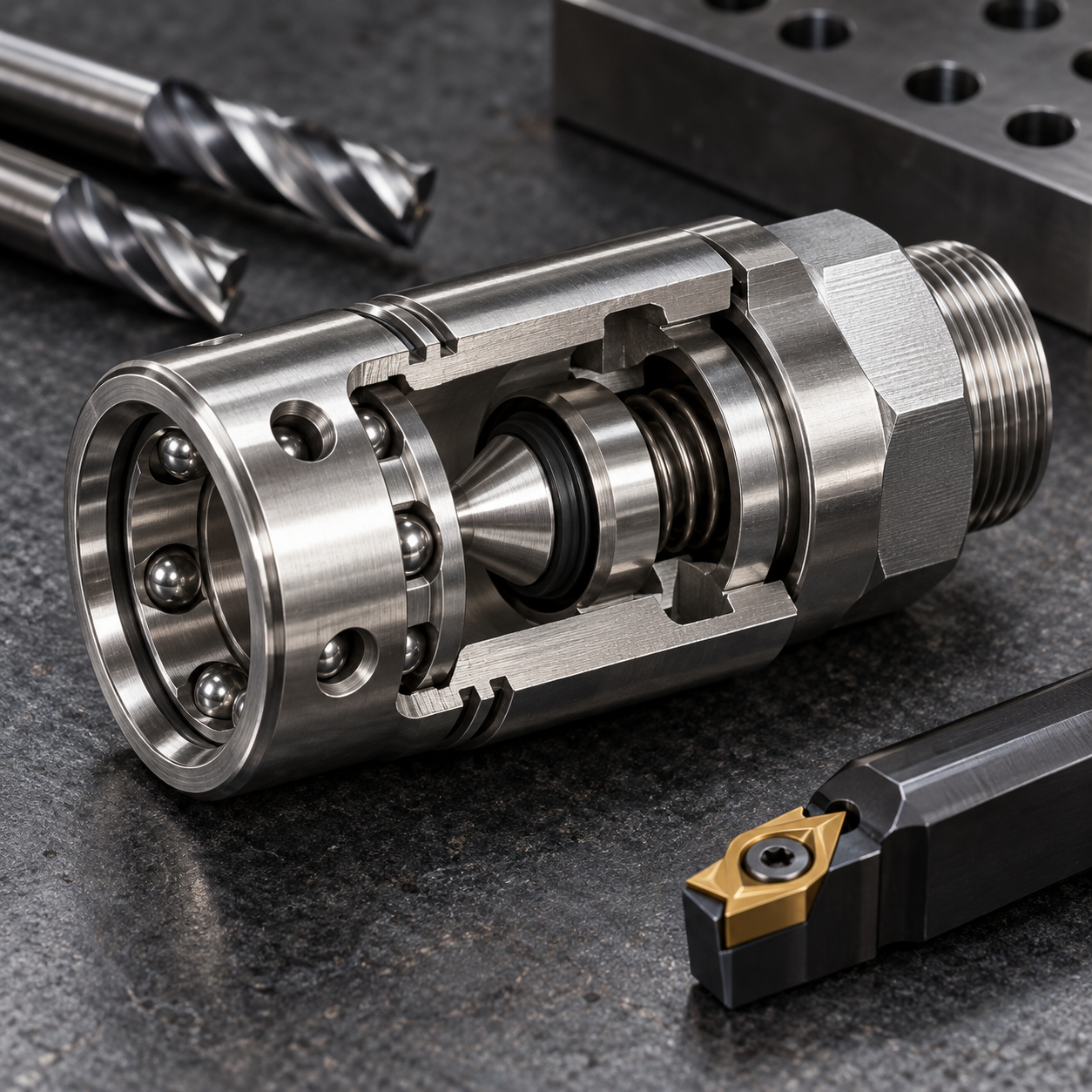
English: Custom 455 Quick-Connect Socket Tooling for Ball Holes, Poppet Seat and Snap Groove
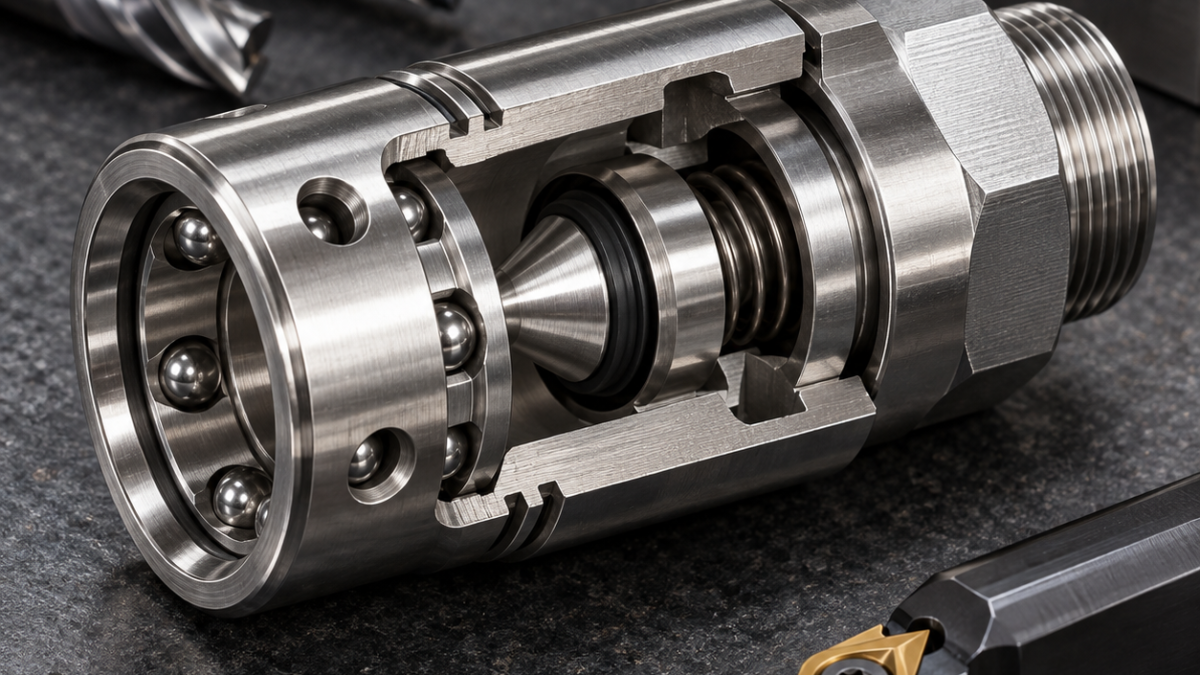
The drawing’s leak boundary belongs to the poppet cone and pilot bore, while coupling retention belongs to the equal-depth ball holes. Treating all holes as one radial pattern hides two different datum chains. The machining plan must preserve the seal axis through age hardening and keep every ball edge free of a raised burr.
Assign each tolerance to its functional datum
Rough-turn the body in solution-treated condition, leaving balanced stock on pilot, cone and thread shoulder. Finish the pilot and 30-degree poppet cone in one spindle orientation with a damped micro boring bar. A form reamer is rejected because it follows a drifting bore and cannot independently tune cone runout.
Tool map for the quick-connect socket
| Drawing feature | Carbide tool and holder | Selection logic / rejected alternative |
|---|---|---|
| Pilot bore and poppet cone | 6 mm damped carbide boring bar, PVD grade, sharp 0.2 mm radius | One axis controls sealing; a form reamer follows error. |
| Indexed locking-ball holes | 3 mm through-coolant AlTiN carbide drill, hydraulic micro chuck | Low runout and direct chip exit; HSS bends in hardened stock. |
| Hole edge break | 1.5 mm reverse-chamfer carbide tool | Measurable internal break; hand picking leaves raised lips. |
| Snap-ring groove | Rigid modular blade, fine-grain PVD insert, controlled hone | Holds width and corner; brazed form tools mask wear. |
| Port thread | Multi-tooth carbide thread mill, TiAlN, synchronized collet | Compensates pitch diameter; a tap creates high torque and trapped chips. |
Keep the seal cone on the bore axis
Clamp the finished pilot in a collet fixture and support the thin sleeve with a split backup ring. A 3 mm through-coolant AlTiN drill produces each ball hole; a small circular interpolation at entry controls diameter without pushing a full form cutter through the wall. Finish the snap groove with a rigid modular blade before the final thread pass.
Index ball holes without pushing the sleeve
After age hardening, skim the cone with a CBN-tipped boring bar only if runout exceeds the preplanned allowance. Air-gauge the pilot, blue-check the cone with a master poppet, probe hole depth around the circumference and inspect each intersection by borescope. Tool replacement follows cone waviness, drill thrust and groove corner wear, not appearance alone.
Related tooling comparisons: seal-cone and cross-hole tooling; deep thread and grease-hole control.
Quick-connect tooling FAQ
Why not drill ball holes before the pilot? Their breakthrough burr distorts later bore readings. Why separate groove and thread tools? Their edge loads and wear directions differ. How is sealing accepted? Geometry plus a controlled pressure-decay test on a clean hypothetical assembly.